
Industrial & Deep Tech
Techadyant Labs research on industrial & deep tech in India — the dependencies, constraints and opportunity surfaces that decide the real outcome. 3 published reports.
 ₹6,999
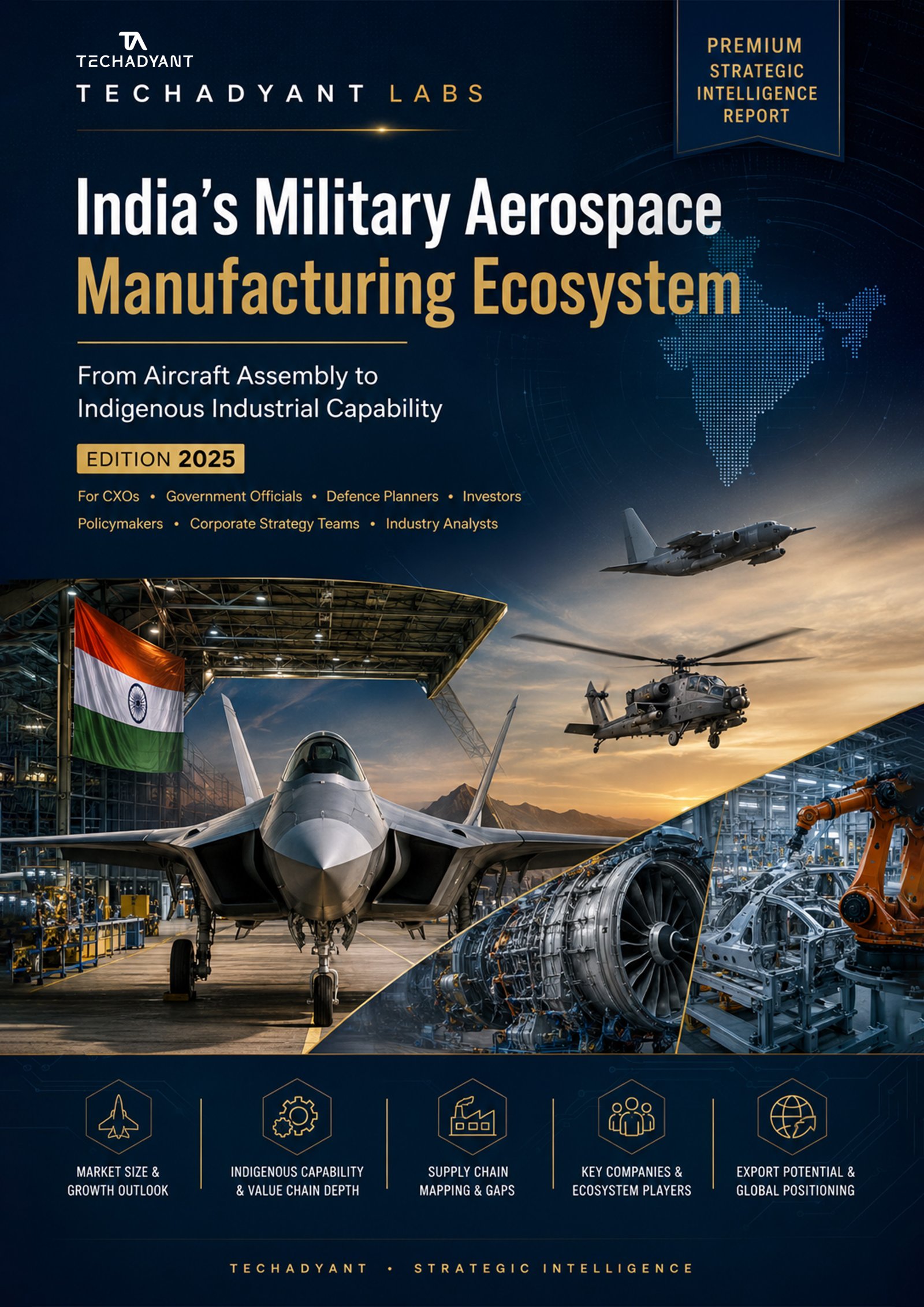
India’s Military Aerospace Manufacturing Ecosystem
From aircraft assembly to industrial sovereignty — propulsion, subsystems, IP and exports, and the choice that decides 2035India’s military aerospace industry has reached an inflection point: a 1,500+ aircraft-and-helicopter procurement pipeline worth roughly ₹2,50,000 crore over 2025–2035, a private-sector prime layer that can now build (TASL’s C-295, HAL’s Tejas and rotorcraft, Mahindra, L&T), and policy tailwinds from the 75% domestic capital earmark and five positive-indigenisation lists. Yet the sovereignty question is unresolved below the airframe: India imports 85–90% of aircraft-engine value and depends on foreign supply for single-crystal turbine blades, FADEC, aerospace-grade semiconductors, AESA T/R modules and superalloys. This report maps the full ecosystem — the 16-subsystem architecture, the prime and Tier-1/2/3 supplier network, eleven ₹1,000 crore-plus opportunity surfaces, the critical-dependency chain, and a three-scenario 2035 outlook (Assembly Nation, Deep Localisation, Indigenous Stack) separated by whether India invests in the layers it does not yet own. It prescribes the capital, the certification capacity and the engine programme required to move from assembly to genuine industrial sovereignty.
 ₹6,999
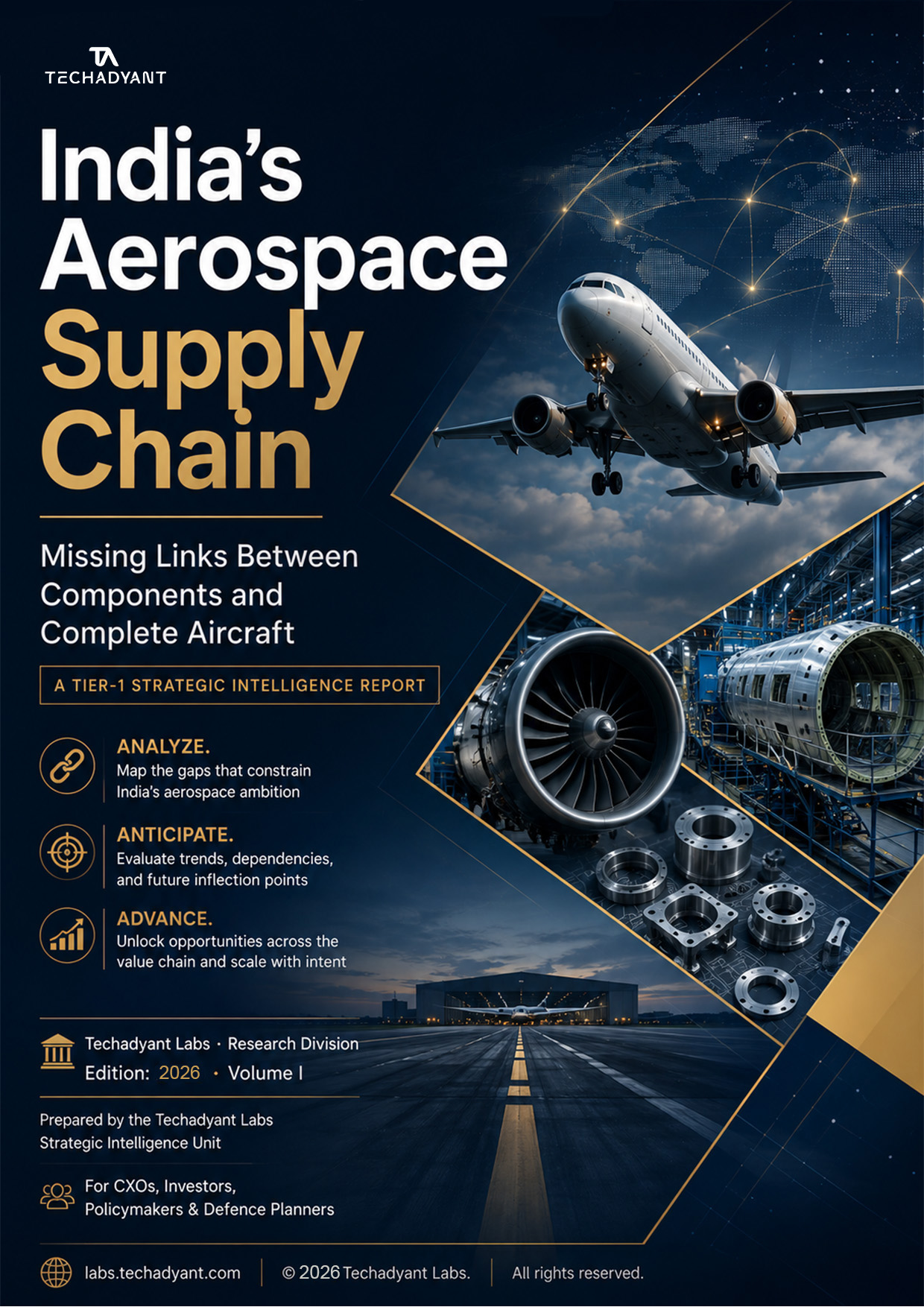
India’s Aerospace Supply Chain: Missing Links
Missing Links Between Components and Complete Aircraft — Why India Has the Parts but Not the Platforms, and the Industrial Architecture That Closes the GapIndia’s aerospace industry is structurally bifurcated: it has built a globally competitive Tier-2/3 component base, yet still lacks the Tier-1 sub-system integration, unified type certification and serial final-assembly capability required to produce complete aircraft. This strategic-intelligence report identifies three "missing links" — integration, certification and final assembly — and shows why component capability does not automatically aggregate into aircraft capability. Against a $42B total addressable market in 2025, India’s serviceable obtainable market spans a 5× spread by 2035: $21.0B (bull), $11.7B (base) or $4.2B (bear), decided almost entirely by domestic execution inside the 2025–2027 policy window rather than by exogenous demand. The report scores India’s capability across ten dimensions (civil propulsion 1.5/10 vs a 9.5 global frontier), maps an 85%-concentrated engine supply chain, quantifies a 4.2-year average policy-implementation latency, and prescribes eight priority interventions — a National Aerospace Certification Authority, a $1.5B Tier-2/3 Supplier Development Fund, propulsion JVs and five domestic Tier-1 integrators — requiring ~$16.7B of coordinated capital. It also reads India’s emerging space-sector R&D-to-industrialisation model as an institutional analogue, without extending the report’s scope into space.
 Free
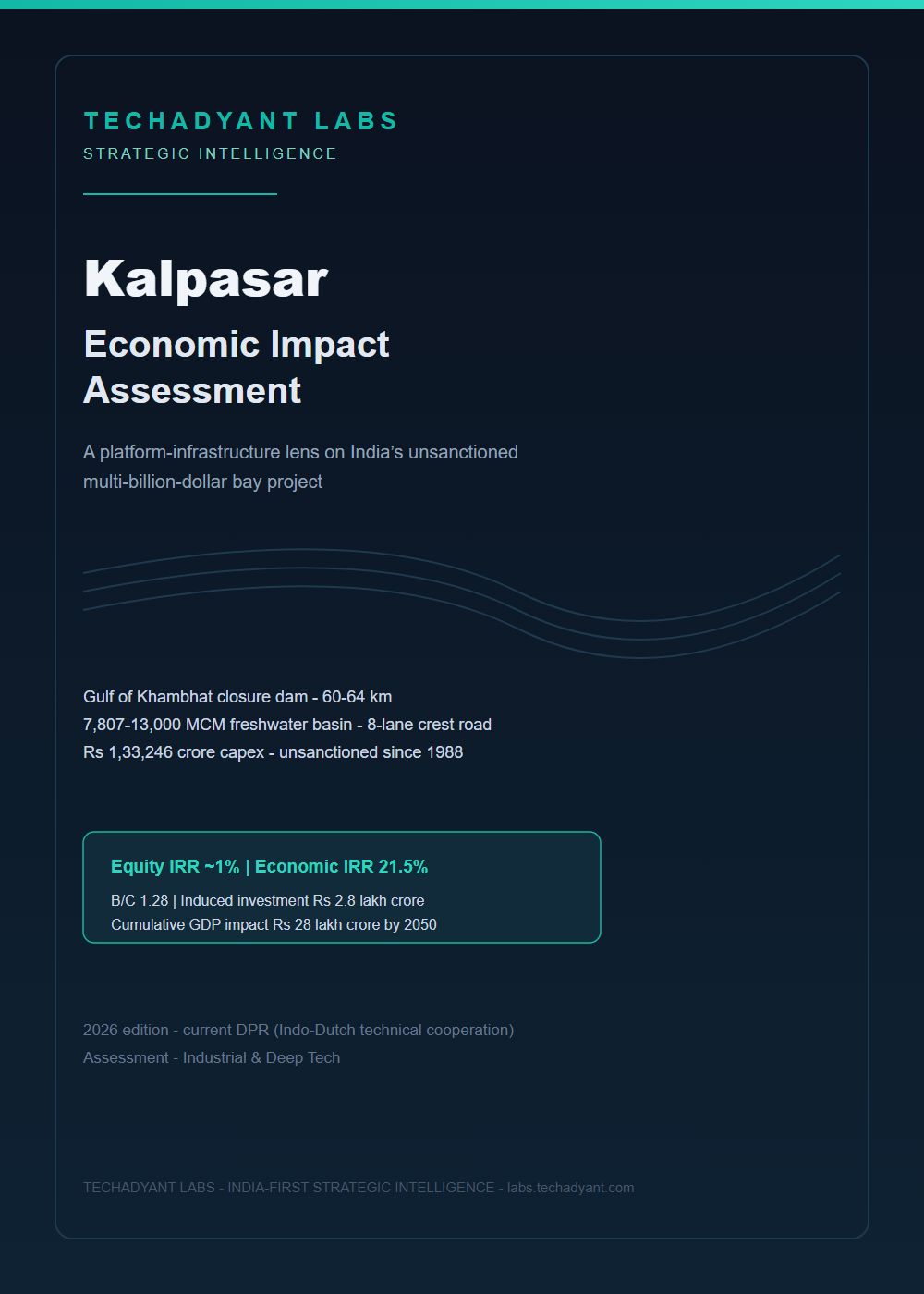
FreeKalpasar Economic Impact Assessment
A platform-infrastructure lens on India’s unsanctioned multi-billion-dollar bay projectThis strategic assessment examines the Kalpasar bay project through a platform-infrastructure lens, evaluating why a project conceived as a national game-changer has remained in discussion for decades without construction, financial close or binding environmental clearance. The report maps the engineering dependency surfaces — dam engineering, marine works, power evacuation, coastal-zone clearance and water-rights allocation — and explains why fragmented agency accountability has prevented a credible implementation sequence. It reviews the financing pathways that would be required for a project of this scale, from central budget and public-private partnership variants to blended multilateral and commercial debt structures, and explains why lenders require conditions that have not yet been met. The analysis also traces the milestone dependencies: detailed project report, independent peer review, inter-state agreement, land acquisition, long-lead marine procurement and financing close. Across six chapters the report provides a structured pre-project roadmap, dependency mapping, implementation risk analysis and a clear verdict: Kalpasar is defensible as a strategic idea, but it is not yet ready to build.
Map this ecosystem
See where India stands across the value chain — players, dependencies and scores — in the free Atlas.