
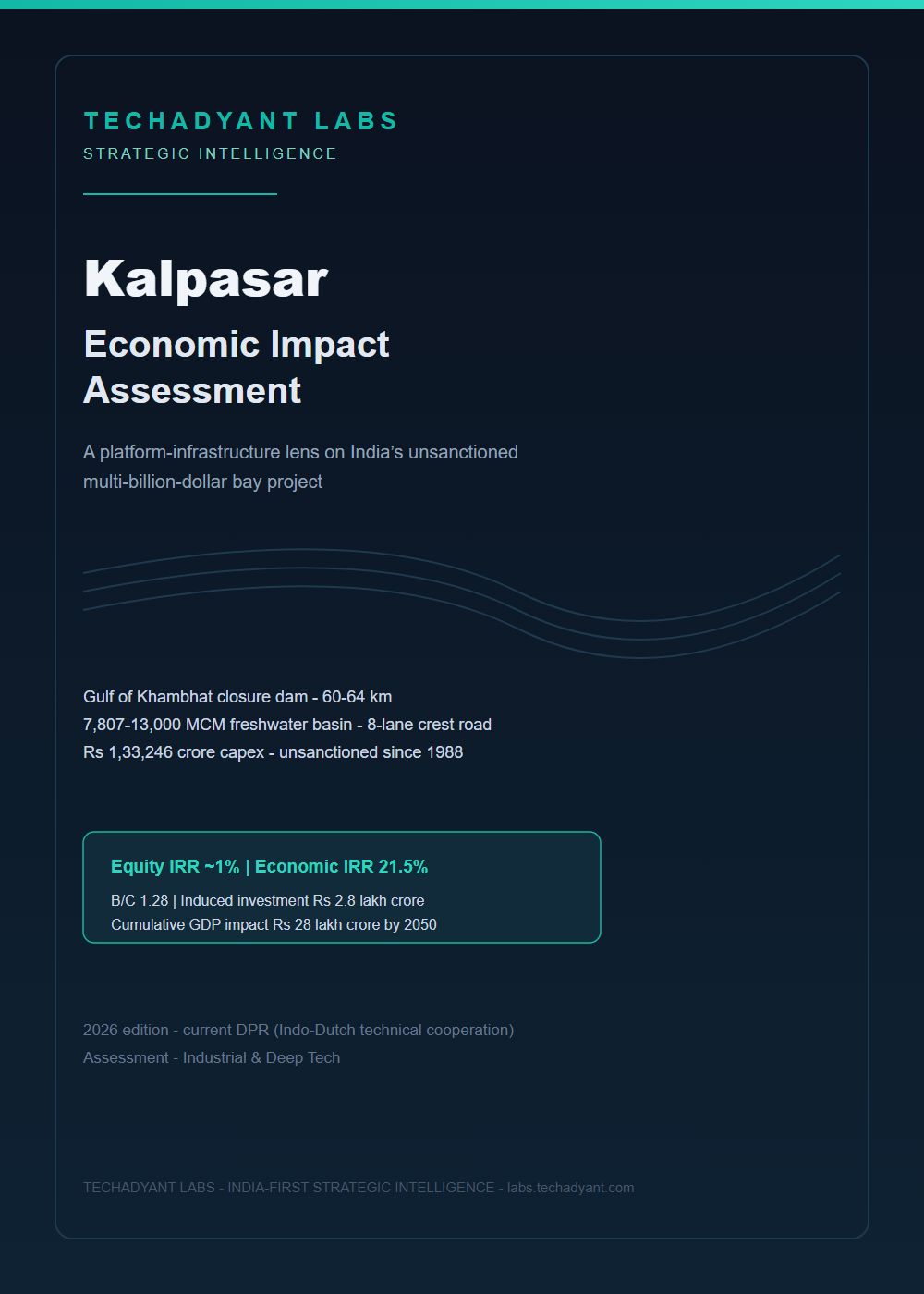
Kalpasar is not a single dam. It is a multi-billion-dollar platform proposal that would dam the Gulf of Khambhat, create a freshwater reservoir, generate captive solar and wind power, and shorten the road and rail distance between Saurashtra and mainland Gujarat across a roughly 60 km closure dam. The project has been discussed for decades without a binding financial close, environmental clearance or land-assembly order. This report assesses why.
Project overview
The proposed closure dam would stretch roughly 60 km across the Gulf of Khambhat, separating the Arabian Sea from a proposed 1,600 sq km reservoir. The current Detailed Project Report puts the capital cost at approximately ₹1,33,246 crore, with construction timelines of 10 to 15 years. The project remains unsanctioned, with feasibility, environmental impact and funding still unresolved.
The strategic interest lies in what Kalpasar would actually deliver: freshwater storage, captive solar and wind power, a road-rail link, and coastal land-reclamation. Each of these benefits depends on separate engineering, financing and governance systems that have not been integrated into a single accountable programme.
Assessment framework
This report applies a platform-infrastructure lens: large infrastructure projects succeed when dependency surfaces are mapped before capital is committed. A dependency surface includes engineering inputs, long-lead equipment, land and water rights, inter-state agreements, environmental clearances, and the financing instruments that convert political intent into contractor behaviour.
Kalpasar fails this test. It has repeated feasibility revisions, multiple cost estimates with no baseline audit, and no publicly available dependency map. The result is a project that is easy to announce and difficult to cancel, but not yet ready to build.
Dependency surfaces
The main technical dependencies are dam engineering, marine works, power evacuation, water-rights allocation, and coastal-zone clearance. Each dependency has multiple state and central agencies involved, with no single entity holding end-to-end accountability. The Gulf of Khambhat also has one of the highest tidal ranges in India, which affects both construction sequencing and long-term structural integrity.
Financing dependencies are equally unresolved. The project has moved from central budget to public-private partnership models, then back to central-state sharing, without a final financial structure. International lenders typically require environmental clearance, feasibility audit and partial risk guarantees before committing large-ticket infrastructure finance. None of those conditions are fully satisfied.
Financing pathways
If Kalpasar were to proceed, financing would likely require a blend of Centre funding, state equity, external multilateral support and long-tenor debt. The current fiscal and regulatory environment makes large greenfield infrastructure more viable when packaged as a revenue-generating asset rather than a public-works project. That means power tariffs, water pricing and toll revenue would all need political consensus before contractors would bid.
The report reviews three financing scenarios: base-case public funding, blended PPP with output-based grants, and a phased-build model that would allow partial commissioning while keeping later phases contingent on revenue performance.
Implementation milestones
A credible implementation roadmap for Kalpasar would require: a completed detailed project report with independent peer review; environmental and coastal-zone clearances; inter-state agreement on water allocation and cost sharing; land-acquisition and resettlement framework; procurement of long-lead marine equipment; and a financing close with committed multilateral or commercial lenders.
None of these milestones is scheduled. The report maps each milestone, its typical lead time, the agencies that must approve it, and the risks that would arise if sequencing is ignored.
Conclusion
Kalpasar remains a strategic idea in search of an implementation system. The underlying logic — coastal water security, captive renewable power, and a new national corridor — is defensible. But ideas without dependency discipline remain proposals, not projects.
The report’s recommendation is a structured pre-project phase: dependency mapping, independent DPR audit, environmental baseline, and a transparent financing framework. Until those conditions are met, the project is likely to remain in discussion rather than execution.
The companion data workbook ships the underlying data tables, source data and project-economics worksheets behind this assessment.
↓ Download the data workbook (Excel)