Home/Reports/Industrial & Deep Tech
Flagship Edition

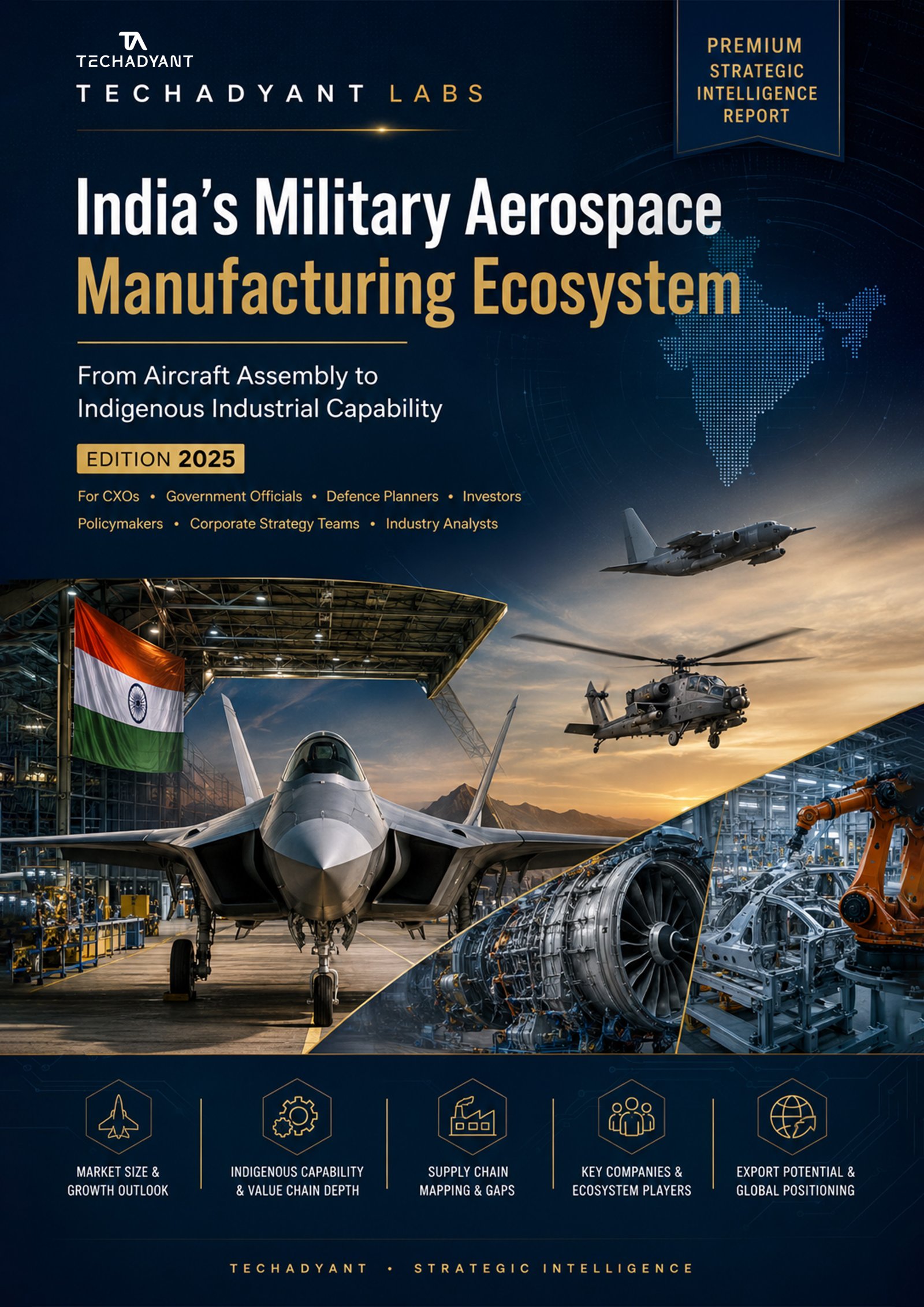
India’s Military Aerospace Manufacturing Ecosystem

From aircraft assembly to industrial sovereignty — propulsion, subsystems, IP and exports, and the choice that decides 2035

India’s Military Aerospace Manufacturing Ecosystem — cover
₹6,999Complete report

158-page PDF · ~ 55 min read · Figures & citations included

Checking your access…

Free condensed report · 15 pages

Free condensed edition — the thesis, the framework and the headline findings, with figures. No signup required.

Digital product — access is granted instantly and is non-refundable once downloaded. See our refund policy and terms.

What’s inside
  • Full 158-page report (PDF)
  • Proprietary analytical frameworks & scorecards
  • Primary-source citations with verification labels
  • Free condensed preview edition
  • Optional data pack — the full underlying dataset (Excel)

The Thesis

India's military aerospace opportunity is real, but manufacturing footprint does not equal technological sovereignty. The decisive question for 2025–2035 is whether India converts aircraft assembly and systems integration into control over propulsion, critical subsystems, intellectual property, design authority and export capability — or remains dependent on foreign industrial control points.

The report estimates approximately ₹2,50,000 crore of cumulative industrial value across the aerospace opportunity over the next decade. At the same time, aircraft engines, aerospace-grade semiconductors, single-crystal turbine blades, FADEC and other critical technologies remain concentrated dependency points. Airframe assembly and integration are largely solved; the layers below them are not.

Key Numbers

₹2,50,000 Cr
Estimated cumulative industrial opportunity over 2025–2035 [modelled]
Techadyant Estimate ◆ ES-01
1,500+
Aircraft and helicopters in the projected demand pipeline
Techadyant Analysis ◆ ES-02
85–90%
Estimated aircraft engine dependency by value
Techadyant Analysis ◆ DEP-01
₹50,000–75,000 Cr
Focused industrial investment identified over 10 years [modelled]
Techadyant Model ◆ INV-01
45%
Likelihood assigned to the Deep Localisation scenario [modelled]
Techadyant Scenario Model ◆ SCN-B
$8–12 Bn
Annual export outcome under Scenario B [modelled]
Techadyant Scenario Model ◆ SCN-B

Key Findings

01 · The demand engine exists. India's procurement pipeline creates industrial opportunity across airframes, propulsion, avionics, electronics, UAVs and lifecycle services.
₹2,50,000 crore over 2025–2035
Source: Techadyant programme analysis
02 · Assembly is not sovereignty. The report separates manufacturing capability from control over systems integration, technology ownership, design and export capability.
5 layers of aerospace sovereignty
Source: Techadyant Indigenous Stack framework
03 · Propulsion is the hardest gap. Aircraft engine dependency remains concentrated in foreign platforms and technology, making propulsion the largest strategic industrial bottleneck.
85–90% dependency by value
Source: Techadyant dependency analysis
04 · India lacks a sufficient Tier-2 middle. Large primes and hundreds of smaller suppliers exist, but the specialist layer required for globally competitive subsystems remains thin.
~110 Tier-2 specialists estimated
Source: Techadyant supplier analysis
05 · Strategic control points are concentrated. Aerospace-grade semiconductors, single-crystal blades, FADEC and AESA radar T/R modules represent concentrated technology dependencies.
4 strategic control points
Source: Techadyant dependency framework
06 · Private primes are altering the structure. Private-sector companies are moving from component participation toward prime contracting and industrial integration.
40–50% projected private prime share by 2035
Source: Techadyant industry outlook
07 · Localisation must be measured differently. Part-count localisation can obscure value concentration and strategic dependency in engines and other high-value subsystems.
3 metrics: value, criticality and IP ownership
Source: Techadyant localisation framework
08 · The next five years decide the trajectory. Programme choices, engine development, certification capacity and supplier capital will determine which industrial scenario India reaches.
3 scenarios to 2035
Source: Techadyant scenario analysis

The Framework

Techadyant's Indigenous Aerospace Stack separates industrial sovereignty into five layers: Manufacturing, Systems Integration, Technology Ownership, Design and Global Export Capability. The framework is intended to prevent localisation claims from being read as equivalent to full technological control.

The report also uses a three-scenario framework for 2030–2035. Scenario A represents assembly-led growth; Scenario B represents deep localisation; Scenario C represents a substantially indigenous aerospace stack. The analytical distinction is not simply the percentage manufactured in India, but the degree of control over high-value and strategically critical technologies.

What It Means

For policymakers

The central policy challenge is to move from platform procurement to industrial-stack development. The report identifies supplier capital, certification capacity, propulsion, critical materials and aerospace-grade electronics as bottlenecks requiring deliberate intervention.

For industry

Prime contractors and suppliers face a shift from manufacturing participation toward systems capability, subsystem ownership, certification and export readiness. The strongest industrial positions are likely to emerge where companies control specialised technology rather than only production volume.

For investors

The report identifies approximately ₹25,000–30,000 crore of potential private capital deployment over 2025–2035, with opportunities concentrated in specialist Tier-2 capabilities, UAV and autonomous systems, and MRO and lifecycle services.

Analytical Figures

The report's central analytical distinction is between manufacturing presence and strategic industrial control. India can progress in manufacturing and systems integration while remaining dependent at the technology-ownership, design and export layers.

Five layers of the Indigenous Aerospace Stack 5. Global Export Capability 4. Design Authority 3. Technology Ownership / IP 2. Systems Integration 1. Manufacturing
Figure 1 · The Indigenous Aerospace Stack — manufacturing is necessary but does not by itself establish technological sovereignty. Source: Techadyant Labs.

The report evaluates three scenarios rather than a single deterministic forecast. Deep Localisation is assigned the highest probability, while a full indigenous stack requires several additional technical and industrial breakthroughs.

India aerospace scenarios to 2035 PROBABILITY INDIGENOUS CONTENT EXPORTS Scenario A — Assembly-led 35% 40–50% $2–3 Bn Scenario B — Deep Localisation 45% 60–75% $8–12 Bn Scenario C — Indigenous Stack 20% 80–90% $25–35 Bn
Figure 2 · Techadyant scenario model for India's aerospace industrial trajectory [modelled]. Source: Techadyant Labs.

Several dependencies are more consequential than their numerical part count would suggest. High-value, high-criticality subsystems can dominate strategic exposure even when most physical components are produced domestically.

Strategic dependency heatmap STRATEGIC CRITICALITY → Aircraft engines 85–90% dependency by value Single-crystal blades ~100% import dependency Aerospace semiconductors 90–95% dependency Carbon-fibre pre-preg ~90% dependency HIGH DEPENDENCY / HIGH STRATEGIC CRITICALITY
Figure 3 · Strategic dependency concentration across selected aerospace control points. Source: Techadyant Labs dependency framework.

The analytical conclusion is that localisation priorities should focus on strategic control points rather than the total number of imported parts. A single imported engine or semiconductor technology can carry more strategic significance than a large number of lower-value mechanical components.

Strategic recommendations roadmap 0–2 YEARS Tier-2 supplier fund Certification capacity 2–5 YEARS Strategic engine JV Single-crystal capability 5–10 YEARS 110 kN engine programme Aerospace semiconductor capability 10+ YEARS Global Tier-2 supplier hub $25 Bn export ambition
Figure 4 · Strategic recommendation horizons from the report's industrial build-out roadmap. Source: Techadyant Labs.

The next 24 months receive particular emphasis, because supplier financing, certification bandwidth and strategic technology partnerships determine whether later localisation targets can be converted into actual industrial capability.

The Numbers, Tabulated

Scenario comparison (2030–2035)

ScenarioProbabilityIndigenous contentEngine dependencyAnnual exports
Assembly-led growth35%40–50%90%$2–3 billion
Deep Localisation45%60–75%50–60%$8–12 billion
Indigenous Aerospace Stack20%80–90%20–30%$25–35 billion

Selected dependency indicators

Technology / inputDependency statedStrategic implication
Aircraft engines85–90%Core propulsion dependency
Aerospace-grade semiconductors90–95%Electronic systems dependency
Single-crystal turbine blades~100%High-temperature propulsion technology gap
Carbon-fibre pre-preg~90%Advanced materials dependency

Capital and capability priorities

PriorityValue / requirement
Aerospace Tier-2 Supplier Fund₹5,000–10,000 crore
Focused industrial investment over 10 years₹50,000–75,000 crore
Private capital deployment opportunity₹25,000–30,000 crore
Indigenous 110 kN engine programme₹30,000 crore

What to Watch

  • 2026C-295 final-assembly localisation begins its next phase, an early test of whether programme localisation translates into a broader supplier ecosystem.
  • 2027Aerospace-grade semiconductor partnership capability is identified as a strategic milestone required for the deeper industrial scenario.
  • 2028Single-crystal turbine-blade capability is identified as a required breakthrough for reducing the propulsion technology gap.
  • 2030The indigenous 110 kN engine trajectory and AMCA design milestones become decisive indicators of whether India can move beyond assembly-led aerospace industrialisation.

Frequently Asked Questions

How large is India's military aerospace manufacturing opportunity?
The report estimates approximately ₹2,50,000 crore of cumulative industrial value across the 2025–2035 aerospace opportunity. The demand pipeline includes 1,500+ aircraft and helicopters.
How dependent is India on foreign aircraft engines?
The report estimates aircraft engine dependency at approximately 85–90% by value across major programmes. Under the Assembly-led scenario, engine dependency remains at 90%.
What is the most likely aerospace scenario for India by 2035?
The report assigns a 45% likelihood to Scenario B, Deep Localisation. It projects 60–75% indigenous content, 50–60% engine dependency and $8–12 billion in annual exports.
How much investment does India's aerospace industry need?
The report identifies ₹50,000–75,000 crore of focused industrial investment over 10 years. It also identifies ₹25,000–30,000 crore of potential private capital deployment over 2025–2035.
What is the proposed investment for India's indigenous 110 kN engine?
The report identifies a ₹30,000 crore indigenous 110 kN engine programme on a roughly 15-year horizon, positioned as part of the longer-term transition toward a deeper indigenous aerospace stack.

Sources & Methodology

This reading edition is derived from the full strategic-intelligence report, which is based on triangulation of publicly available sources and explicitly labelled Techadyant estimates. The source base includes:

  1. Ministry of Defence publications, DAC clearances and procurement disclosures.
  2. Comptroller and Auditor General performance audits.
  3. DRDO disclosures and programme updates.
  4. Company annual reports, filings and public disclosures (HAL, BEL and others).
  5. Industry-association data, DPIIT FDI statistics and trade databases.
  6. Public news intelligence and academic research.

Evidence labels — [V] verified · [V1] single-source · [modelled] analytical projection. Estimates are labelled as Techadyant estimates; forward-looking scenarios represent analytical judgement based on public information and observed industrial trajectories. See the full edition for source lines and assumptions.

Continue reading

Unlock the complete report

You’re reading the free preview. The full analysis continues with six more sections and the downloadable PDF edition.

  • 🔒04 · Water, power & land
  • 🔒05 · The packaging layer
  • 🔒06 · Who captures the value
  • 🔒07 · The talent constraint
  • 🔒08 · Second-order effects
  • 🔒09 · What to watch · references

You’ll be asked to sign in, then complete a one-time secure purchase.

Did this research answer your question?

Want us to go deeper on this — or research something adjacent? Shape what we research next →

Primary sources

Frequently asked questions

How large is India’s military aerospace opportunity?
The report estimates approximately ₹2,50,000 crore of cumulative industrial value over 2025-2035 across major aerospace programmes.
How dependent is India on foreign aircraft engines?
The report estimates aircraft engine dependency at approximately 85-90% by value across major programmes.
What indigenous content scenario is considered most likely?
Scenario B, Deep Localisation, has a 45% likelihood and projects 60-75% indigenous content and $8-12 billion annual exports by 2035.
How much private capital could Indian aerospace require?
The report estimates ₹25,000-30,000 crore of private capital deployment over 2025-2035.
What investment is proposed for India’s indigenous aerospace stack?
The report identifies ₹50,000-75,000 crore of focused industrial investment over 10 years and a ₹30,000 crore indigenous 110 kN engine programme as strategic capability requirements.
Evidence labels[V] verified · [V1] single-source · [U] unverified · [modelled] analytical projection
Share this
Keep reading

Related research

Read the next edition first

New reports, signals and briefings on India’s industrial systems — infrequent and independent.

Subscribe