
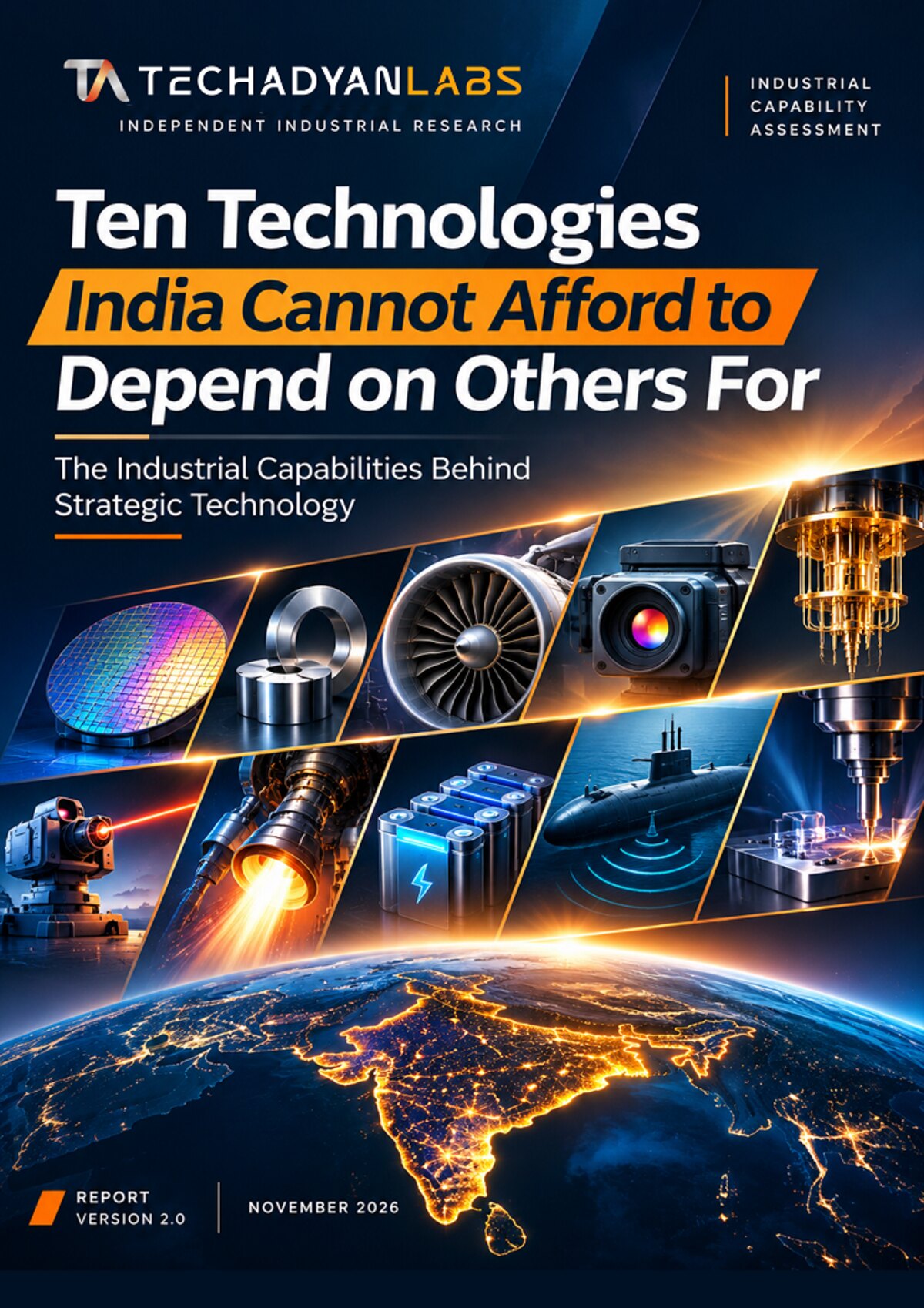
The Thesis
India's strategic technology challenge is not a list of imported products; it is the depth of the industrial stack beneath them. While policy targets and announced investments are strong signals, they are not outcomes. True resilience requires moving from pilot demonstrations to repeatable, customer-qualified industrial production. The most consequential gaps sit below the finished product—in process tools, materials, high-performance components, sensors, controls, software, and metrology.
Key Numbers
Key Findings
Semiconductor Equipment
Funded demand exists, but the domestic supply base for process tools, subsystems, and materials remains thin and unproven in commercial qualification.
Source: S1, S2, S31Rare-Earth Magnets
Upstream concentrate processing is real, but midstream sintering and coating are pilot-scale. 81.3% of metallic magnet imports come from China.
Source: S4, S35, S64Advanced Aero Engines
HAL delivers and overhauls engines at scale, but indigenous design authority over the critical hot section remains incomplete and unqualified.
Source: S67, S69, S74Infrared Detectors
System-level integration is established across Indian industry, but the industrial middle (readout, hybridisation, packaging) is not established from public evidence.
Source: S10, S25, S45Quantum Technologies
The National Quantum Mission is funded with 4 thematic hubs, but capability remains at the research and laboratory demonstration stage across all branches.
Source: S9, S23Advanced Propulsion
ISRO demonstrated a 35-second power-head test at 200-tonne thrust, but thrust-chamber integration and stage qualification are pending.
Source: S8, S28Machine Tools & Metrology
A broad domestic industry exists, yet high-end segments (five-axis machining, CNC controls, precision spindles) show probable import dependence.
Source: S12, S17, S41The Framework
The Five Rungs of Capability
A country can occupy different rungs simultaneously within a single technology. Operating an imported system (Rung 1) and licensed manufacture (Rung 2) do not equate to component indigenisation (Rung 3), indigenous design authority (Rung 4), or owning the next generation (Rung 5). This report strictly separates target, award, commissioning, output, and qualification, refusing to let one stand in for another.
What It Means
For Policymakers
Shift focus from headline outlays to qualification dashboards. Fund shared industrial foundations—such as metrology, test facilities, and advanced materials—rather than running ten isolated self-reliance programmes. A rupee spent on a shared foundation pays dividends across multiple domains.
For Industry
The highest-return investments are in the unglamorous middle: advanced materials, precision machining, and process know-how. Secure anchor customers with multi-year commitments to survive order lumpiness and fund the qualification gap.
For Investors
Look beyond prototype announcements and ribbon-cuttings. Durable value is created in companies that bridge the "qualification gap" and achieve repeatable, customer-accepted commercial production with verified yield and uptime.
Analytical Figures
Public discourse often conflates policy announcements with operational reality. The scale of declared intent across four flagship programmes is substantial, totalling ₹1,58,884 crore. However, these outlays differ vastly in scope, duration, and disbursement status. They represent approved amounts and demand-side signals, not money spent or capacity operating. Understanding this disparity is critical to evaluating whether industrial capability is actually being built or merely promised.
The most acute measured concentration in this report lies in rare-earth permanent magnets. These small components carry outsized industrial consequences for electric vehicles, wind turbines, and defence equipment. While India possesses mineral resources and upstream separation capacity, the midstream capability to produce high-performance, reliable magnets at industrial scale is overwhelmingly imported. The data shows a clear and worsening concentration of supply from a single geography, turning a commercial relationship into a strategic point of leverage.
Similarly, the machine-tool industry presents a deceptive aggregate picture. While domestic production is substantial and growing, the high-end frontier remains imported. A machine tool is effectively a computer with a spindle; when a domestic builder imports its CNC controls, drives, and precision encoders, it imports a substantial share of the machine's value and differentiation. The aggregate import share of 59.4% masks an even deeper dependence in the highest-performance segments required for aerospace and semiconductor manufacturing.
The Numbers, Tabulated
Programme Pipeline: Target vs. Reality
| Programme | Target | Allocated / Awarded | Commissioned | Actual Output |
|---|---|---|---|---|
| Semicon 1.0 | 12 approved | — | 5 in commercial production (Oct 2026) | Not established |
| REPM Magnets | 6,000 MTPA | 20 bids (Aug 2026); awards pending | None verified | Pilot scale only |
| ACC Batteries | 50 GWh | 40 GWh allocated | 1.4 GWh (30 Jun 2026) | Not established |
| Quantum Mission | ₹6,003.65 crore | 4 thematic hubs established | — | Research stage |
The Ten Domains at a Glance
| Domain | Where the Exposure Sits | India's Position Today |
|---|---|---|
| Semiconductor equipment | Process tools, subsystems, materials, metrology | Funded demand; thin supply base; qualification unproven |
| Rare-earth magnets | Metal, alloy, sintering, coating, customer qualification | Upstream real; midstream pilot-scale; 81.3% import share |
| Advanced aero engines | Hot section, materials, controls, test and certification | Large licensed base; indigenous design incomplete |
| Infrared detectors | Array fabrication, readout, hybridisation, cryocoolers | Integration established; industrial middle unverified |
| Machine tools & metrology | Controls, spindles, encoders, five-axis precision | Broad industry; 59.4% import share of consumption |
What to Watch
- 2027 Final beneficiary selection, plant locations, and first integrated line commissioning for the ₹7,280 crore REPM magnet scheme.
- 2028-29 HAL-Safran Shakti/Ardiden 1H second production line target (up to 100 engines/yr), testing the limits of co-development design authority.
- 2030 Target horizon for qualified domestic semiconductor tools/subsystems installed in Indian fabs, and operating integrated magnet lines producing customer-qualified grades.
- Ongoing Publication of actual cell output, chemistry, and customer qualification for ACC batteries, moving beyond the 1.4 GWh commissioned snapshot.
Frequently Asked Questions
What is India's import dependence on rare-earth permanent magnets?
How much ACC battery capacity is actually commissioned in India?
What is the total outlay for India's semiconductor and quantum missions?
Does India have indigenous design authority for fighter aero engines?
What percentage of machine tools does India import?
Sources & Methodology
This report uses four evidence classes: Established, Demonstrated, Under development, and Not established from public evidence. Primary sources cited in this summary include:
- S1, S2, S31: PIB, Semicon 2.0 portal and project composition (Jul–Nov 2026).
- S4, S15, S35: PIB/MHI, REPM scheme assessment, 2030 demand table, and DGCIS import annexure (FY22-25).
- S8, S28: ISRO, Semi-cryogenic engine power-head test technical notes (5 Sep 2026).
- S9, S23: DST/PIB, National Quantum Mission achievements and thematic hubs (Feb 2026).
- S11, S30: MHI/Parliament, ACC battery PLI beneficiary-wise capacity and commissioned status (Jun 2026).
- S12, S17, S41: IMTMA Annual Report 2025-26 and TradeStat-derived machine-tool supplier split.
- S67, S74: PIB/MoD, HAL Koraput 2,000th engine milestone and AL-31FP contract status (Oct 2026).
Full source register, claim audit, and unresolved items are available in the companion Data Workbook (Appendix B, D, E).