
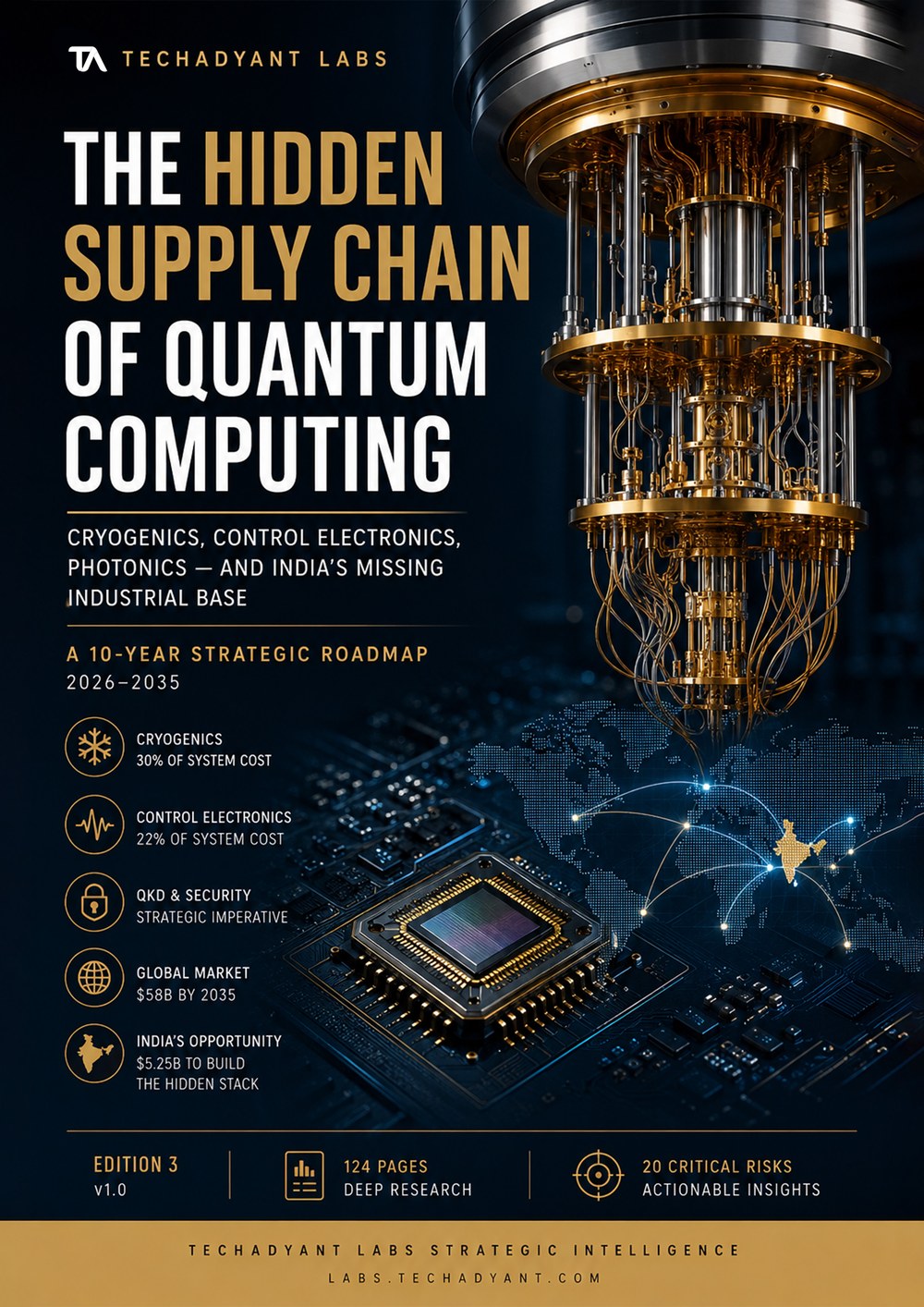
The industry watches the qubit. It is the wrong thing to watch. On a 100-qubit superconducting machine costing about $5.15 million, the qubit chip is roughly 17% of cost — and the qubit “layer” that attracts most of the attention is under 8%. The other ~63% is the hidden stack: cryogenics, control electronics, photonics, packaging and high-purity materials. That is where the money, the margin and the dependency actually live — and it is what this report maps.
The qubit is the wrong thing to watch
Quantum computing is told as a qubit story — counts, coherence, error rates. The supply chain tells a different one. Value in every quantum system concentrates below the qubit, in the enabling hardware that keeps it cold, controls it, connects it and packages it. A country can host quantum research and still own none of the industrial base that makes a machine work. That is India’s position, and it is the gap this report scores.
Where a quantum computer’s cost sits
The cost waterfall settles the argument. Cryogenic infrastructure — the dilution refrigerator plus cryostat — is the single largest line at ~$1.5M, and it comes from a near-monopoly supplier base with lead times that have tripled. Control electronics add ~$1.1M. Together with packaging and materials, the hidden stack is ~$3.25M of a $5.15M machine. The visible qubit chip is ~$0.9M.
India’s capability, layer by layer
The report scores India across the stack — cryogenics, control electronics, photonics, packaging, materials and foundry — and the capability matrix is, in the report’s own words, a sea of red. India lags the global frontier by 2–4 TRL levels across the stack, has world-class research concentrated in four or five institutions, and almost no commercial translation. On the dilution refrigerator — the highest-cost, highest- concentration component — India has about 4% of the US installed base.
Single-source dependency
Every quantum-critical component category exceeds a Herfindahl–Hirschman Index of 2,500 — the threshold for single-source concentration. India’s import dependency on critical components is effectively total, and Wassenaar export controls bite hardest exactly where India is weakest: materials and qubit chips. This is not a diversification problem; it is a build-from-near-zero problem, and the report is candid about the 18–30 month lead times that gate any response.
Where the value goes
The strategic implication is that India should not chase the qubit. Software and QKD hold ~70% of the margin pool, and value migrates toward control and integration — the layers where India’s software strength is real. The report maps the margin pool and the strategic control points so capital can target where value actually accrues, not where the headlines are.
A ten-year industrial roadmap
The report closes with a sequenced, ~$5.25 billion ten-year roadmap across three phases — a cryogenics mission, a dilution-refrigerator consortium, and a control-electronics and talent build-out to close a ~21,000-FTE gap by 2030. It weighs this against a funding reality: India’s ~$1.1B national programme is about 7% of China’s and 60% of the USA’s, and India is ~$205M short of even a 4% global funding share.
What the full report covers
The complete 150-plus-page edition carries 69 figures and 20 tables across 18 chapters: the full cost and cryogenics analysis, the India capability and TRL matrices, the control- electronics, photonics, packaging and foundry chapters, the patent, funding and talent landscapes, the defence QKD use-cases, the risk heat map and single-source chokepoint analysis, the margin-pool and value-migration models, three scenarios to 2035, and the ten-year roadmap — with five appendices (company, startup, policy and funding databases) and a 17-sheet data workbook behind every exhibit.
Unlock the complete report
You’re reading the free preview. The full analysis continues with six more sections and the downloadable PDF edition.
- 🔒04 · Water, power & land
- 🔒05 · The packaging layer
- 🔒06 · Who captures the value
- 🔒07 · The talent constraint
- 🔒08 · Second-order effects
- 🔒09 · What to watch · references
You’ll be asked to sign in, then complete a one-time secure purchase.