
Beyond the computer
India's quantum conversation is dominated by a single race: who builds the largest quantum computer, and when. That is the wrong frame for an industrial strategy. The more consequential story is the ecosystem forming around the machine — computing, communication and security, sensing, cryogenics, photonics, materials and post-quantum software — because that is where most of the capturable value sits, and where India's existing strengths in software, design and systems can actually compete. The question this report works is not “can India build a quantum computer” but “what industrial ecosystem does the quantum transition create, and where can India capture value rather than inherit a timeline?”
The National Quantum Mission
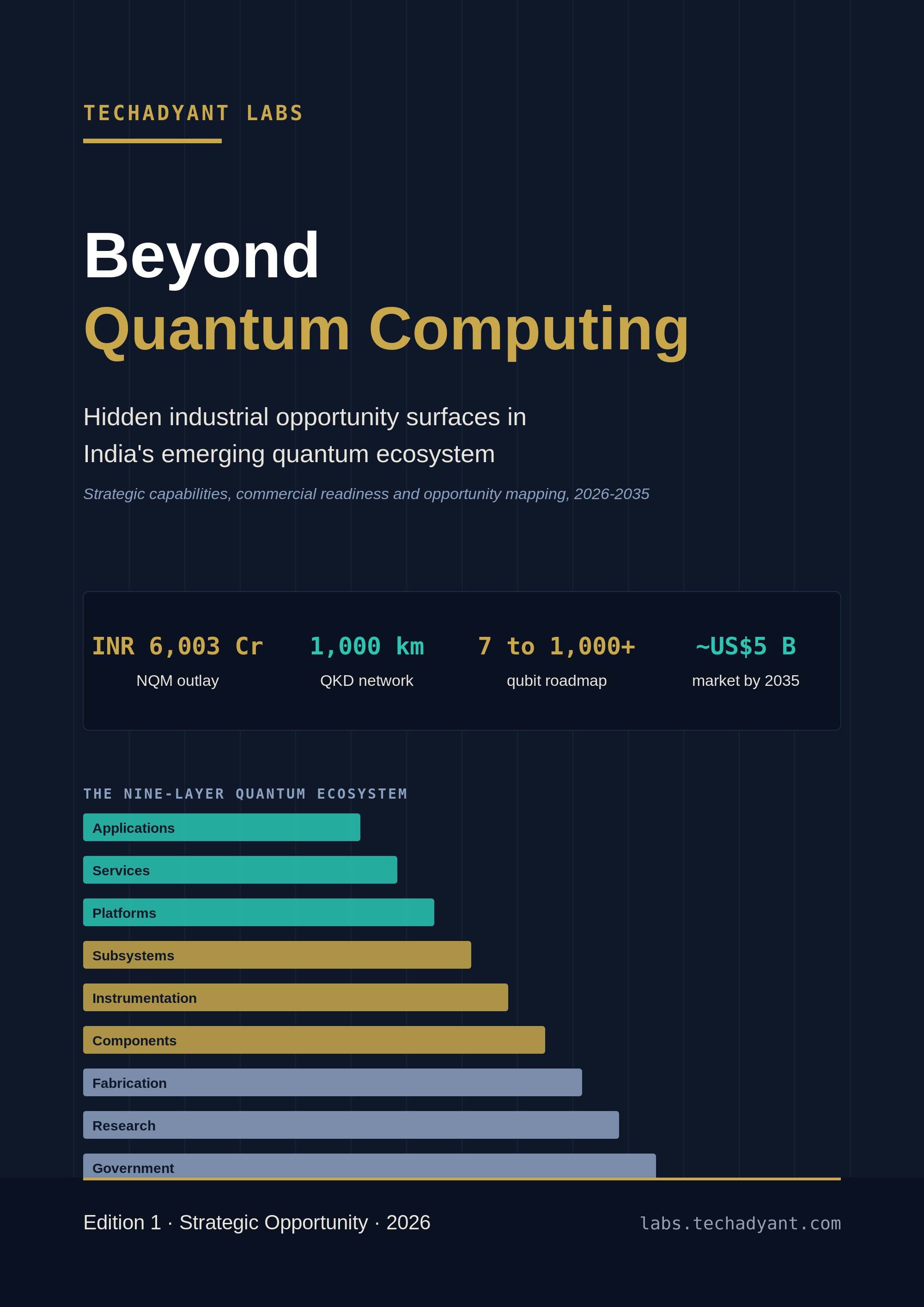
India is not starting cold. The National Quantum Mission, approved in April 2023 at a total outlay of ₹6,003.65 crore through 2030–31, organises the effort into four thematic hubs — computing (led by IISc Bengaluru), communication (IIT Madras with C-DOT), sensing & metrology, and materials & devices — with headline goals of 50–1,000-qubit machines and satellite-based quantum key distribution over ~2,000 km. The scaffolding is real. The constraint is execution: cumulative spend was reported at roughly ₹43 crore as of early 2025 against a FY25–26 allocation of ₹1,261 crore. The mission is stood up; the money is not yet flowing at the rate the timeline implies.
Where India imports
The dependence concentrates in the physical layer. Indian research labs import an estimated ~90% of the critical quantum-computing subsystems — dilution refrigerators, high-purity substrates, arbitrary waveform generators, specialised lasers, single-photon detectors and cryogenic components — sourced from a small set of global suppliers (Bluefors, Oxford Instruments and Leiden for cryogenics; Keysight and Zurich Instruments for control electronics; ID Quantique for detectors). This is the same shape as India's drone and semiconductor stories: the country competes at the top of the stack and imports the bottom. The exposure is sharpened by policy abroad — the United States is moving cryogenic systems toward export-controlled lists, directly over India's single biggest hardware gap.
Where India leads
The picture is not one of weakness everywhere. India is genuinely strong at two layers that matter most for trust and for near-term commercial value: quantum security and software. QNu Labs builds indigenous quantum random-number and key-distribution systems and has deployed a roughly 1,000 km QKD network — ahead of the mission's eight-year target — and is exporting. QpiAI has built full-stack systems, moving from a 25-qubit machine in early 2025 to a 64-qubit machine later that year. And early indigenisation is appearing at the hard layers: a domestic dilution refrigerator at roughly 70% Indian content, and India's first indigenous high-precision diode laser in late 2025. The sovereign opportunity is to widen these bridgeheads, not to attempt the entire stack at once.
The ecosystem, mapped
A credible ecosystem is already visible. In computing, QpiAI (backed by the mission and Avataar Ventures) anchors the full-stack effort. In security and communication, QNu Labs leads. In the enabling layers sit Dimira (cryogenic cables), PrenishQ (diode lasers), QuPrayog (optical atomic clocks), Quanastra (cryogenics and detectors), Pristine Diamonds (sensing materials) and Quan2D (single-photon detectors), with Sidwal Industries and QBit Force behind the indigenous dilution refrigerator. In sensing, the DRDO Quantum Technology Research Centre anchors defence applications — magnetometry for submarine and stealth detection, atomic clocks for GNSS-denied timing — while startups such as GDQ Labs pursue civil uses like cardiac magnetometry. The full report profiles each and maps how the layers connect.
The opportunity surfaces
Read as an opportunity map rather than a science project, the ecosystem sorts into what India can build now and what it should position for. The nearest-term, most commercial surfaces are the ones with dated demand or existing strength; the hardest hardware layers are deliberate, longer-horizon bets.
| Opportunity surface | Readiness | Why |
|---|---|---|
| Post-quantum cybersecurity | Build-now | Dated regulatory demand (SEBI, RBI CBOM); software + services |
| Quantum key distribution / QRNG | Build-now | Existing Indian strength (QNu Labs); defence + BFSI offtake |
| Quantum sensing | Position-early | Dual-use; defence-led (DRDO), medical proof points |
| Cryogenics & enabling components | Position-early | First indigenisation done (dilution refrigerator ~70% Indian) |
| Full-stack software & control | Build-now | Design-led, no fab required (QpiAI); talent-rich |
| Lasers / photonics / detectors | Watch | Deep import dependence; long-horizon localisation |
The post-quantum clock
Running alongside the opportunity is a risk that is already live. “Harvest-now, decrypt-later” means data exfiltrated today can be broken once a capable quantum computer exists, so any Indian data with a confidentiality life beyond ~2030 — government records, defence communications, financial and health data — is exposed now. India's response is arriving in layers: a national quantum-safe roadmap from the DST task force (February 2026, critical infrastructure by 2027, nationwide by 2033), SEBI's live cyber-resilience framework, and an RBI Q-SAFE committee with a mandatory Cryptography Bill of Materials from FY2027–28. The teeth are appearing sector by sector; what is still missing is a single funded, cross-government mandate of the kind the United States adopted in June 2026.
A path to 2033
The realistic doctrine is selective sovereignty. Build now where India is ready or where regulation creates demand — post-quantum cybersecurity, QKD/QRNG, full-stack software; position early in sensing and enabling components as the mission's funding flows; and secure trusted-supply arrangements for the deepest hardware layers (cryogenics, lasers, detectors, materials) that cannot be localised by the end of the decade. The measure of success is not one giant quantum computer but a widening share of the ecosystem's value captured at home.
What the full report adds
This online edition gives you the thesis, the mission baseline, the dependency picture, the player map and the opportunity surfaces. The complete edition adds the full nine-layer ecosystem framework and its scoring, the component-by-component import breakdown, the player and investor directories, the quantum-sensing deep dive, the post-quantum migration playbook by sector, market-sizing across the segments, five-nation benchmarking, and the strategic roadmap to 2033 in full.
Unlock the complete report
You’re reading the free preview. The full analysis continues with six more sections and the downloadable PDF edition.
- 🔒04 · Water, power & land
- 🔒05 · The packaging layer
- 🔒06 · Who captures the value
- 🔒07 · The talent constraint
- 🔒08 · Second-order effects
- 🔒09 · What to watch · references
You’ll be asked to sign in, then complete a one-time secure purchase.