
Critical Manufacturing Dependencies
Techadyant Labs research on critical manufacturing dependencies in India — the dependencies, constraints and opportunity surfaces that decide the real outcome. 1 published reports.
CGWB classifies Bengaluru and Hyderabad as over-exploited, Chennai as critical. The DC pipeline is densest where the water position is most stressed. This signal names the corridor-level audits that are not yet being published.
Dholera's industrial ambition rests on a single water artery. The fab can be financed and built on schedule; the water to run it at full utilisation has to arrive every day through the Narmada canal — and that concentration, not land or capital, is the binding constraint.
Across sectors the same pattern repeats: India assembles the finished good but imports the layers beneath it. The dependency lens resolves this by decomposing every product into localisable units — and the vulnerability almost always sits in the component, material and equipment tiers, not the assembly.
Techadyant's new Critical Manufacturing Dependency Index (CMDI) scores India's strategic imports on a common ruler — import value, supply risk, strategic importance, industrial multiplier and substitutability — turning a scattered import problem into a rankable, trackable dependency map.
The products that score highest on dependency — EUV photoresists (CMDI 95), sub-7nm logic ICs (94) and combat aero-engine turbofans (92) — are precisely the ones India can least localise in the near term (localisation scores of 5-28), a mismatch that defines the sovereignty problem.
Not every deep dependency is a hard problem. Silicon-carbide power semiconductors (dependency 82, localisation 62, investment attractiveness 80) and display-driver ICs (dependency 80, localisation 62, attractiveness 78) combine high exposure with genuine feasibility — the surfaces where capital should move first.
Mobile-manufacturing PLI has drawn 312% of its targeted investment, but Electronic Components sits at 68% and Bulk Drugs at 48% — evidence that incentivising finished products localises assembly while the dependency migrates one layer down, into the components.
On a composite Manufacturing Capability Index, Maharashtra (82), Gujarat (81), Tamil Nadu (79) and Karnataka (77) lead — but the forward-looking sub-scores tell the sharper story: Gujarat tops the pipeline and future-readiness axes on the back of its semiconductor and chemicals bets.
Below the product-level dependencies sit eight economy-wide gaps — manufacturing R&D at 0.3% of GDP versus Germany's 2.8%, a 500,000-worker skills shortfall, thin test-and-certification capacity, costlier project finance and absence from RCEP and CPTPP — that constrain every localisation attempt, with a ₹1.14 lakh crore fix identified.
Rather than spreading effort across hundreds of imports, the dependency framework narrows the field to twelve opportunity zones and a top-ten of opportunity surfaces — the intersection of deep-enough dependency, real localisation potential and workable economics — where concentrated capital and policy would move the dependency index most.
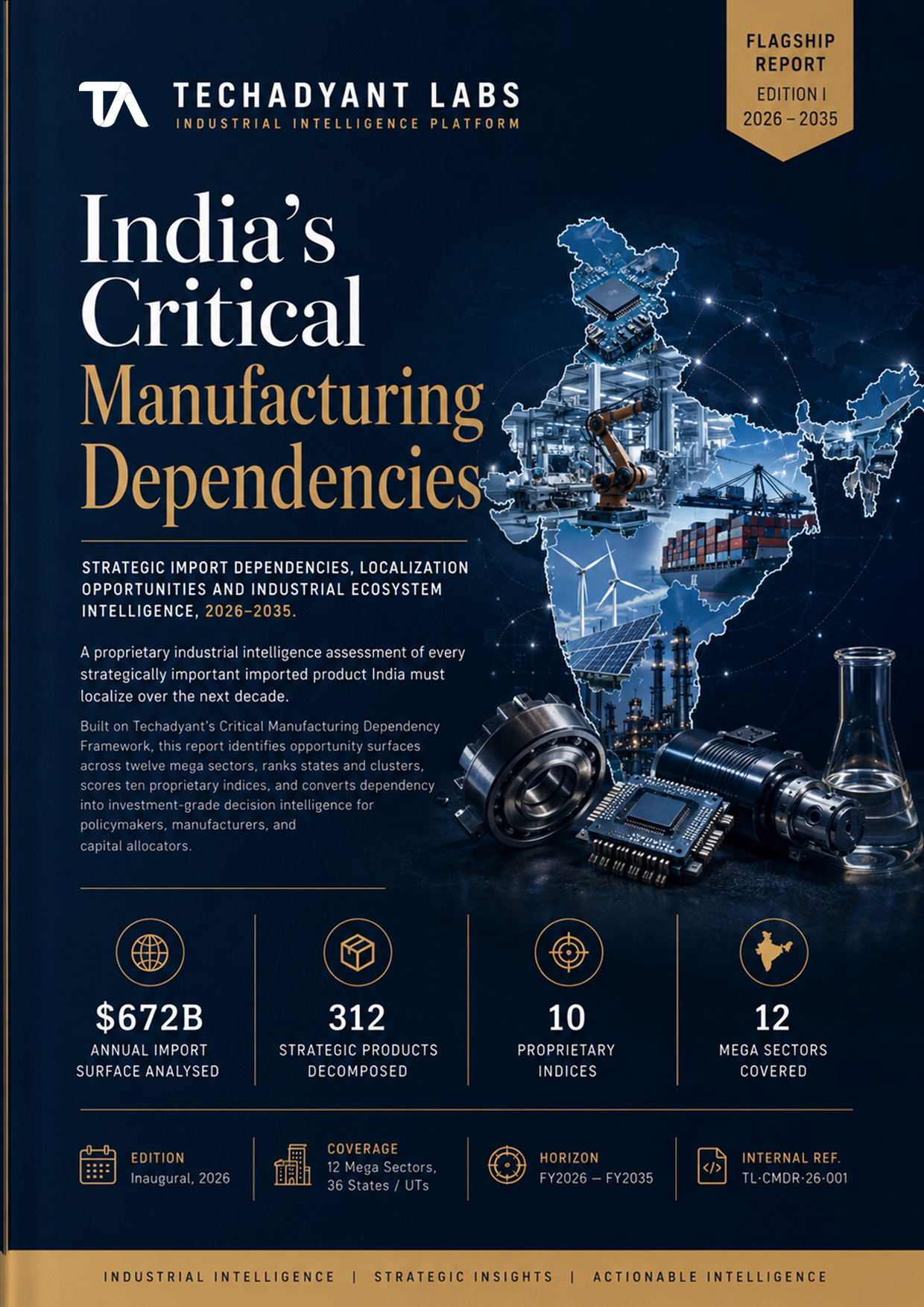
Techadyant Labs has released Edition I of India's Critical Manufacturing Dependencies — a framework-led report scoring the top strategic imports on ten proprietary indices, mapping opportunity surfaces, PLI performance, state capability and the policy gaps, and seeding a recurring national dependency monitor.
The Department of Telecommunications held its third Investors' Roundtable in Bengaluru on 22 September 2026 for the Gwalior Telecom Manufacturing Zone - India's first integrated TMZ - with 24 companies now proposing Rs 5,500 crore and a further Rs 700-800 crore of interest recorded. The zone spans design, components, semiconductors, optical fibre and equipment; the structural test is whether it draws component and process plants, not only final-assembly lines.
Indian drone avionics are increasingly designed in India, but the silicon inside them arrives through distributors' drone portfolios of foreign-brand processors, sensors, GNSS modules, MOSFETs and BMS chips. Board-level design and chip-level import dependence are both true at once.
Drone Expo 2026 showed Indian drone battery-pack and BMS integration, including semi-solid-state packs - but no verified Indian source of drone-grade cells. Pack localisation is being mistaken for battery localisation.
Map this ecosystem
See where India stands across the value chain — players, dependencies and scores — in the free Atlas.