
IAF Autonomous Air Power, 2026–2035
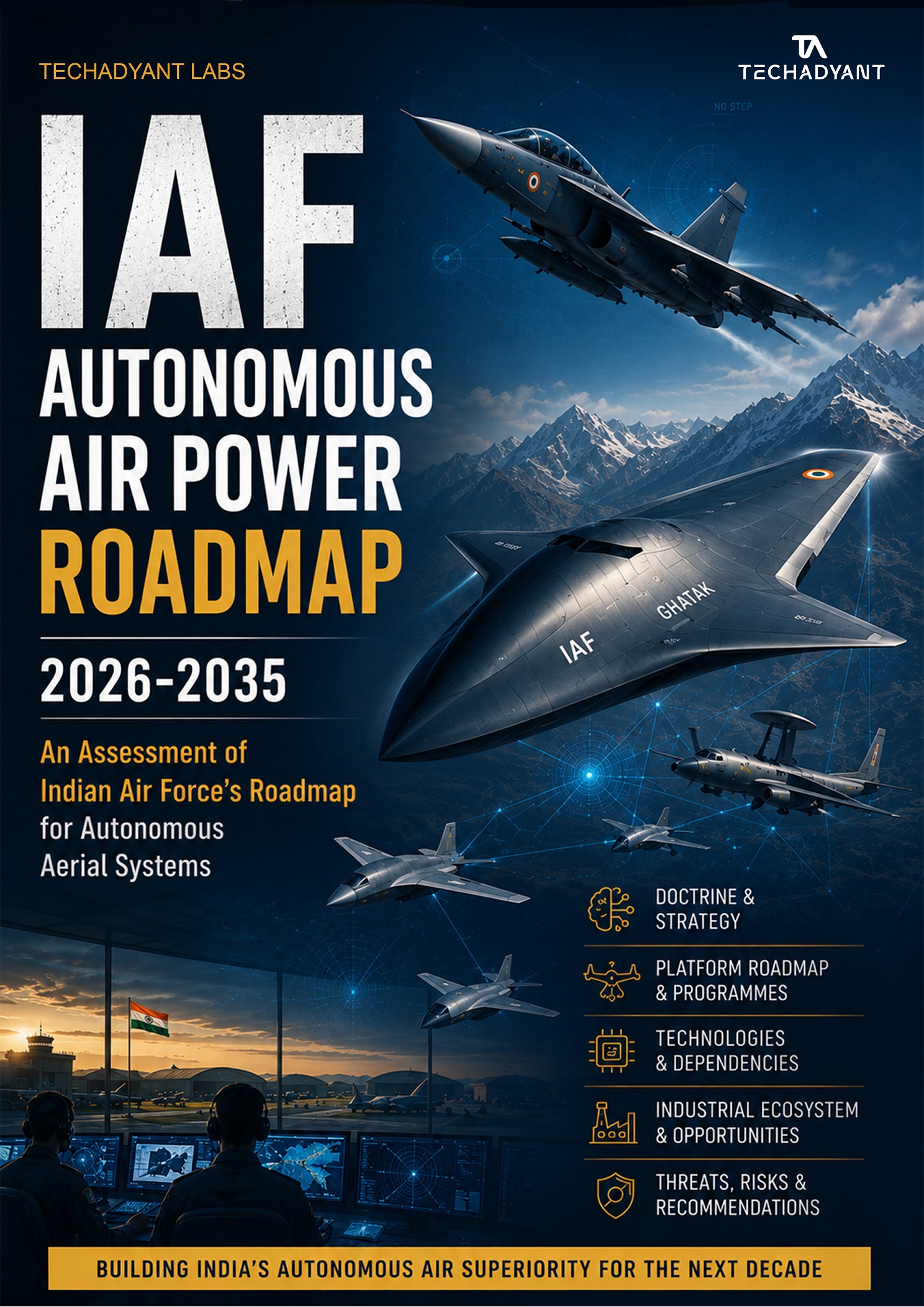
India’s Air Autonomy Readiness Index is 34/100 — less than half the USAF’s 88 — and the deficit is software, not aircraft. The industrial substrate and roadmap to close it by 2035.
The Thesis
India enters 2026–2035 roughly a decade behind leading autonomous-air powers, and the deficit is concentrated in the AI software stack, not aircraft. The IAF’s 31-squadron force faces a maturing PLAAF autonomous-air threat, a cost-exchange ratio that has flipped three orders of magnitude against exquisite air defence, and four critical dependencies — semiconductors, AI compute, jet engines, carbon fibre — that cannot close before 2030. The decade’s defining task is the industrial substrate beneath autonomous air power: hold the intervention path and the report models AARI 58–62 by 2035.
Key Numbers
Key Findings
A decade behind - in software
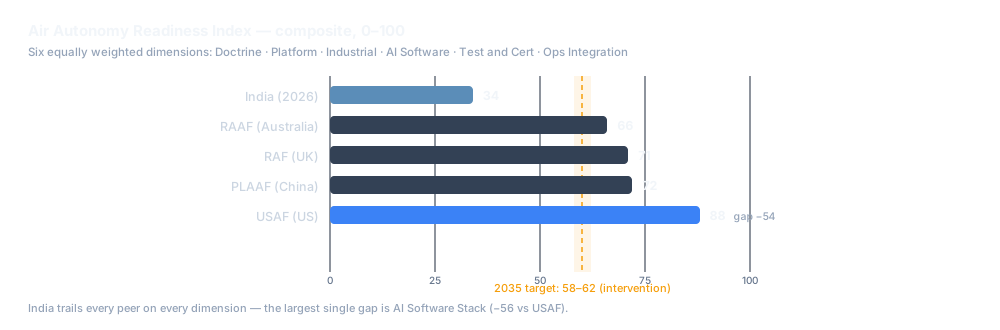
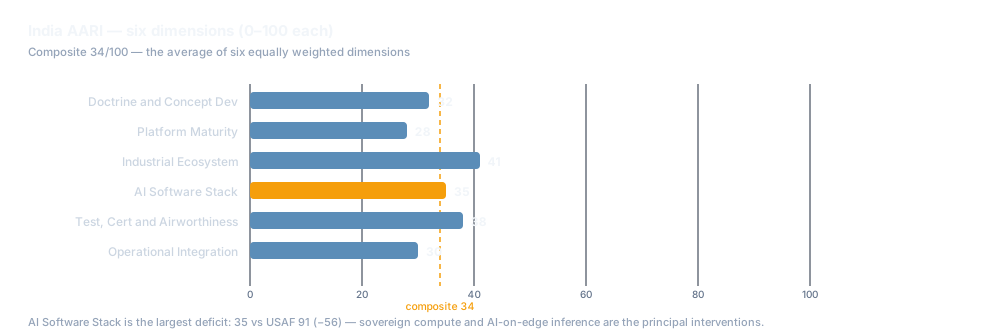
India scores 34/100 on the Air Autonomy Readiness Index - less than half the USAF’s 88. The deficit is concentrated in the AI software stack (35 vs USAF 91, a -56 gap), not in aircraft. India is roughly a decade behind leading autonomous-air powers.
[AARI Model - Verified]The cost-exchange flip
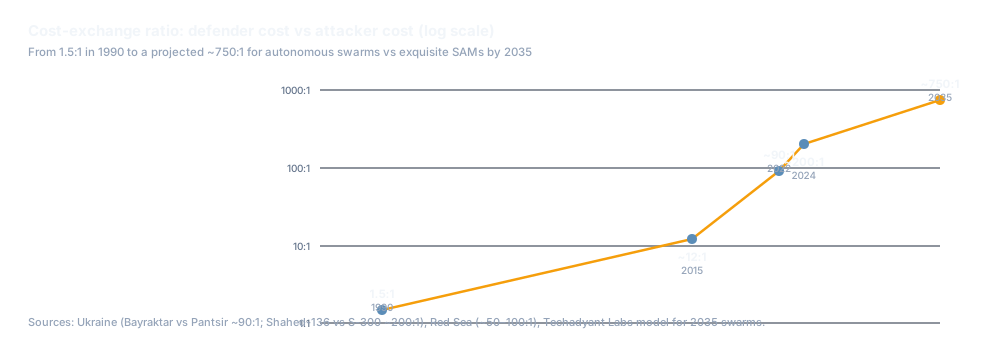
The defender-to-attacker cost ratio has moved from 1.5:1 (1990) to ~90:1 (Bayraktar vs Pantsir) and a projected ~750:1 by 2035 - nearly three orders of magnitude. An exquisite-heavy air-defence architecture (S-400, MR-SAM, Akash) is structurally unaffordable against sustained autonomous mass.
[Model - Ch 2 / Engagement data]2030 is the date that decides the decade
The report assesses CATS Warrior IOC 2030 as the single most consequential programme date: a slip to 2032 cascades the force-structure crossover past 2035. Three subsystems decide it - a Kaveri-class small turbofan, the Ghatak’s internal EW suite, and a reliable tactical data link.
[Projection - Ch 1]Four dependencies that cannot close before 2030
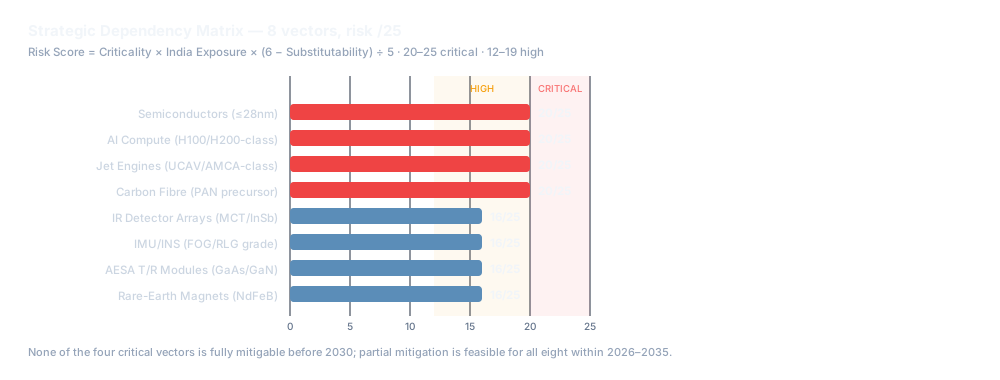
Semiconductors (≤28nm), AI compute (H100/H200-class), jet engines (UCAV/AMCA-class) and carbon fibre (PAN precursor) each score 20/25 on the Strategic Dependency Matrix. None is fully mitigable before 2030; partial mitigation is the realistic horizon for all eight vectors.
[SDM - Ch 10]No roadmap, measurable cost
The IAF has no published autonomous-air doctrine - the Army published its Land Warfare Doctrine in 2021. Of 33 programmes tracked, 9 are at IOC risk, and the typical DRDO aerospace programme slips 18-24 months. Vendors, startups and academia cannot align investment to a stated requirement.
[Programme Tracker - App P]Capital mismatch
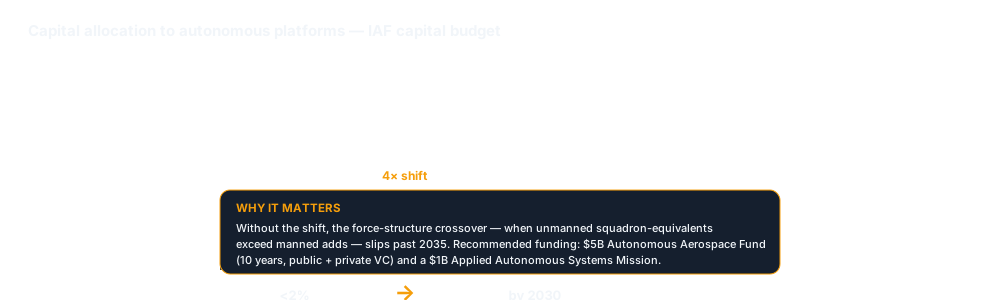
Autonomous platforms receive <2% of the IAF capital budget (FY2024-25); the report recommends 8% by 2030. Without the shift, the crossover - when unmanned squadron-equivalents exceed manned adds - slips past 2035.
[Projection - Ch 3 / Ch 12]The Framework
Six proprietary frameworks structure the assessment. The Autonomous Air Power Stack (7 layers, Mission to Outlook) is the analytical spine; the Air Autonomy Readiness Index (0–100, six equally weighted dimensions) scores countries; the Combat Autonomy Maturity Model places programmes on a 7-level scale (L0 Manual to L6 Cognitive) — India today sits at CAMM 2.1, with a 2030 target of 3.5–4.0 and 2035 of 4.0–4.5. The Strategic Dependency Matrix scores eight vectors on a 0–25 risk scale; the Industrial Opportunity Surface Matrix ranks 75 opportunities across eight clusters. Every quantitative claim carries an evidence tag: Public, Estimate, Model, Scenario or Projection.
What It Means
For policymakers: the 15-AARI-point gap between intervention and no-intervention scenarios quantifies the strategic-autonomy value at stake in 2026-27 choices. Publish the doctrine (R1), add an Autonomous Systems fast-track to DAP 2020 (R3), and stand up a Joint Aerospace Command by 2029 (R4).
For industry: the IOSM ranks 75 opportunity surfaces; the top quartile is concentrated in AI Software (10 of 25), Avionics (5) and Sensors/EW (4). Propulsion and materials score high on strategic importance but low on SME opportunity - capital intensity dictates prime-led execution.
For investors: the AARI scorecard is the year-over-year tracking metric for Indian autonomous-air readiness. The proposed $5B Autonomous Aerospace Fund co-invests public capital alongside private VC; startups that address IOSM top-25 surfaces find both capital and demand, with a $2B exports ambition by 2032.
The Numbers, Tabulated
| Country | AARI | Note |
|---|---|---|
| India | 34 | Gap concentrated in AI software (-56 vs USAF); 2035 target 58-62 |
| RAAF (Australia) | 66 | |
| RAF (UK) | 71 | |
| PLAAF (China) | 72 | AI-swarm 2027 target declared; WZ-7 deployed to Tibet |
| USAF (US) | 88 | Benchmark; CCA programmes in flight test |
| Dependency vector | Risk /25 | Band | Note |
|---|---|---|---|
| Semiconductors (≤28nm) | 20/25 | Critical | Advanced-node logic; no domestic foundry at scale |
| AI Compute (H100/H200-class) | 20/25 | Critical | Export-controlled GPUs; sovereign clusters early-stage |
| Jet Engines (UCAV/AMCA-class) | 20/25 | Critical | No indigenous small turbofan for CATS Warrior / Ghatak |
| Carbon Fibre (PAN precursor) | 20/25 | Critical | Precursor chemistry and high-tow fibre gaps |
| IR Detector Arrays (MCT/InSb) | 16/25 | High | Focal-plane arrays for ISR and seekers |
| IMU/INS (FOG/RLG grade) | 16/25 | High | GPS-denied navigation depends on indigenous inertial grade |
| AESA T/R Modules (GaAs/GaN) | 16/25 | High | Radar front-end; GaN wafer supply concentrated |
| Rare-Earth Magnets (NdFeB) | 16/25 | High | High-temperature magnets for actuation and motors |
Risk Score = Criticality × India Exposure × (6 − Substitutability) ÷ 5, on a 0-25 scale. None of the four critical vectors is fully mitigable before 2030.
What to Watch
- 2026-27The binding window - six Wave-1 critical-path recommendations determine whether the 2030 trajectory holds; delay past 2027 makes base-case slippage the most likely outcome.
- 2027PLAAF AI-swarm 2027 target declared; WZ-7 deployed to Tibet; Ghatak UCAV moves from wind-tunnel to flight-test milestones.
- 2030CATS Warrior IOC - the single most consequential programme date; a slip to 2032 pushes the force-structure crossover past 2035.
- 2032Projected force-structure crossover: unmanned squadron-equivalents exceed manned adds (under intervention).
- 2035AARI 58-62 under intervention vs 42-46 under none - the 15-point gap is the strategic value at stake in 2026-27 choices.
Frequently Asked Questions
How ready is India for autonomous air power?
India scores 34/100 on the Air Autonomy Readiness Index vs USAF 88, PLAAF 72, RAF 71 and RAAF 66. The largest absolute gaps are AI Software Stack (-56 vs USAF) and Platform Maturity (-54). The report models AARI 58-62 by 2035 under intervention scenarios and 42-46 under no intervention.
What are India's most critical strategic dependencies in autonomous air?
Four vectors score 20/25 (Critical) on the Strategic Dependency Matrix: semiconductors (advanced node up to 28nm), AI compute (H100/H200-class GPUs), jet engines (UCAV/AMCA-class) and carbon fibre (PAN precursor). A further four - IR detector arrays, IMU/INS, AESA T/R modules and rare-earth magnets - score 16/25 (High). None of the four critical vectors is fully mitigable before 2030.
What is the cost-exchange ratio and why does it matter?
The ratio of defender cost to attacker cost has moved from ~1.5:1 (1990) to ~12:1 for fifth-generation fighters, ~90:1 for cheap drones (Bayraktar vs Pantsir) and a projected ~750:1 for autonomous swarms vs exquisite SAMs by 2035 - nearly three orders of magnitude. It implies an exquisite-heavy air-defence architecture (S-400, Patriot, MR-SAM, Akash) faces acute affordability pressure against sustained autonomous mass.
Why is CATS Warrior IOC 2030 the pivotal programme date?
The report assesses the CATS Warrior IOC of 2030 as the single most consequential programme date in the IAF decade: a slip to 2032 cascades the force-structure crossover past 2035. Three subsystems determine whether 2030 holds: an indigenous small turbofan (Kaveri-class restart), the Ghatak internal electronic-warfare suite, and a reliable tactical data link for MUM-T.
How much capital is at stake?
Autonomous platforms receive under 2% of the IAF capital budget in FY2024-25; the report recommends 8% by 2030. Recommendation R2 proposes a $5B / 10-year Autonomous Aerospace Fund, with public capital co-invested alongside private VC, to fund the 75 IOSM-identified opportunities; priority P7 sets a $2B exports ambition by 2032.
What should happen in the next 12 months?
Six Wave-1 critical-path recommendations determine whether the 2030 trajectory holds: publish an unclassified Autonomous Air Power Doctrine (R1, within 12 months), add an Autonomous Systems fast-track to DAP 2020 cutting the procurement cycle from 36 to 18 months (R3), establish a Joint Aerospace Command by 2029 (R4), and mandate 50% indigenous content in UCAV procurements from 2030 (R5).
Sources & Methodology
Derived from IAF Autonomous Air Power Roadmap 2026–2035 Edition 1 (2026). Evidence tags: Public / Estimate / Model / Scenario / Projection. Primary sources:
- IISS Military Balance; Parliament Standing Committee on Defence, 47th Report (2023) [Verified]
- CSIS and RUSI analyses; US DoD China Military Power Report [Verified]
- USAF CCA programme documents; Boeing F-47 announcement (March 2025) [Verified]
- Ukraine, Red Sea and Israel-Lebanon engagement data (Techadyant Labs analysis) [Model]
- Techadyant Labs proprietary frameworks - AARI, CAMM, SDM, IOSM, AAPS, ADIE [Estimate]
Get the Full Report
142-page PDF · 12 chapters · 6 proprietary frameworks · programme tracker and full appendices (Report + Data pack).
Buy Report - ₹5,900Report + Data pack - ₹8,900Free Condensed Edition
29 pages - the thesis, the frameworks and the headline findings, with figures.
29-page condensed edition (PDF). Free to read here; subscribe with an email to download the PDF. We'll also tell you when this assessment changes.
Free · no spam · unsubscribe anytime · privacy policy