
Software is the strategic bottleneck
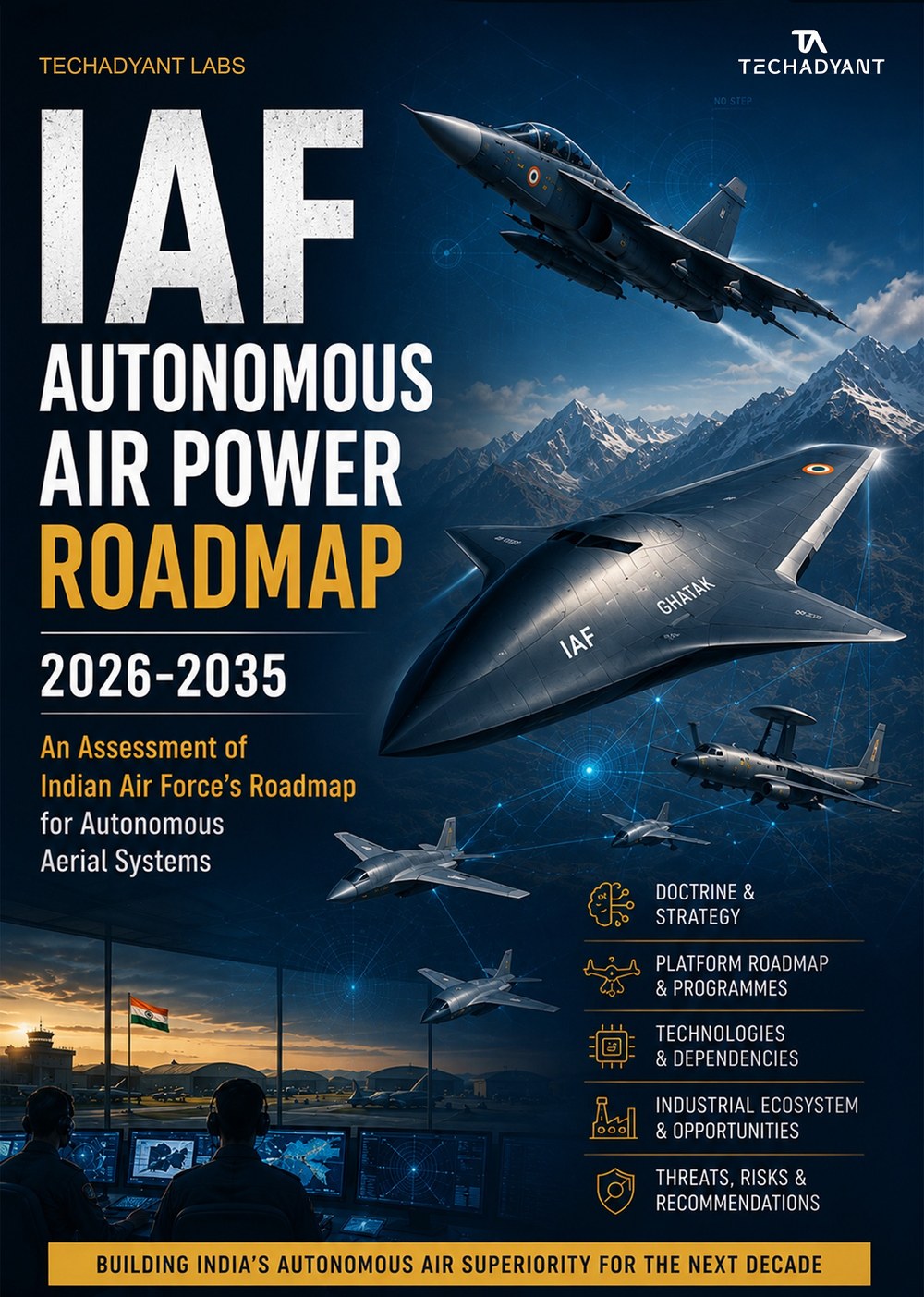
India enters the 2026-2035 decade with an assessed autonomous-air readiness score of 34/100 - less than half the USAF benchmark of 88 - and Techadyant Labs assesses that India is approximately a decade behind leading autonomous-air powers, with the deficit concentrated in software rather than aircraft. Three converging pressures define the decade: a 26% fighter-squadron shortfall (31 active vs 42 sanctioned), a maturing PLAAF autonomous-air threat (GJ-11 assessed operational, WZ-7 reported deployed to Tibet, a declared AI-swarm 2027 target), and a cost-exchange ratio that has flipped nearly three orders of magnitude against exquisite air-defence architectures. This report's central argument is that the strategic task of the decade is not the next platform decision but the industrial substrate beneath autonomous air power - AI software, semiconductors, jet engines and advanced materials - and that India's rate of building that substrate, not the pace of platform announcements, is what will determine its 2035 posture.
The readiness gap: AARI 34 vs 88
The Air Autonomy Readiness Index™ (AARI) is a composite 0-100 score across six equally weighted dimensions: Doctrine & Concept Development (India 32), Platform Maturity (28), Industrial Ecosystem Depth (41), AI/Autonomy Software Stack (35), Test, Certification & Airworthiness (38), and Operational Integration (30). India scores 34/100 against 88 for the USAF, 72 for the PLAAF, 71 for the RAF and 66 for the RAAF - trailing every peer on every dimension. The largest absolute gaps are AI Software Stack (-56 vs USAF) and Platform Maturity (-54). The report models the 2035 projection at 58-62 under intervention scenarios and42-46 under no intervention; the 15-AARI-point gap between those paths is the strategic value at stake in the 2026-2027 policy choices.
The cost-exchange revolution
The cost-exchange ratio - defender cost divided by attacker cost - has shifted from approximately 1.5:1 for a 1990 manned engagement to roughly 12:1 by 2020 for fifth-generation fighters, ~50:1 for cruise missiles, ~90:1 for cheap drones (Bayraktar TB2 vs Pantsir-S1, Syria 2020 and Ukraine 2022), and a projected~750:1 for autonomous swarms vs exquisite SAMs by 2035 - nearly a three-order-of-magnitude shift in three decades. Recent engagements (Ukraine ~1:90 and ~1:200; Red Sea ~1:50 to 1:100; Israel-Lebanon) show the defender spending one to three orders of magnitude more to defeat an autonomous attacker than the attacker spends to launch. The implication is that an air-defence architecture built primarily around exquisite interceptors (S-400, Patriot, MR-SAM, Akash) would face acute affordability pressure against sustained autonomous mass - and must be rebalanced toward attritable interceptors, directed energy and electronic warfare.
The two-front air challenge
India's air challenge is asymmetric. On the LAC, the PLAAF threat is severe and maturing: the GJ-11 Sharp Sword UCAV is assessed operational, the WZ-7 HALE ISR platform is reported deployed to Tibet, the WZ-8 supersonic rocket-boosted recon platform is reportedly in service, and a 2027 AI-swarm target is publicly declared. Tibetan-plateau geography favours HALE and high-altitude pseudo-satellite operations and constrains India's mountain-canyon air-defence coverage. On the LoC, the Pakistan threat is moderate but dense: loitering munitions, F-16/JF-17 Block IV fighters, HQ-9P long-range SAMs and developing loyal-wingman concepts. The report argues India's current answer - Su-30MKI + BrahMos + S-400 - is calibrated to a manned threat and is structurally unaffordable against autonomous mass.
CATS Warrior and the 2030 IOC
In this report's assessment, the CATS Warrior IOC of 2030 is the single most consequential programme date in the IAF's decade. Under the Combat Autonomy Maturity Model™ (CAMM), CATS Warrior is targeted at Level 3-4 at IOC; a slip to 2032 cascades into force-structure crossover past 2035. Three subsystems determine whether 2030 holds: the small turbofan engine, electronic warfare and the tactical data link - and no indigenous small turbofan exists today for CATS Warrior or Ghatak. Manned-unmanned teaming changes the unit of air combat from the platform to the package: a 31-squadron IAF operating in MUM-T configuration delivers the combat mass of a 60+ squadron legacy force. On cost, the AMCA Mk2 (2035, ~$150M/unit estimated) cannot be the instrument of mass air combat; it must command a swarm of attritable CATS Warriors (target ~$10-15M/unit).
Four critical dependencies
The Strategic Dependency Matrix™ (SDM) scores eight core dependency vectors - semiconductors (advanced node ≤28nm), AI compute (H100/H200-class GPUs), jet engines (UCAV/AMCA-class), AESA T/R modules (GaAs/GaN), IR detector arrays (MCT/InSb), IMU/INS (FOG/RLG grade), rare-earth magnets (NdFeB) and aerospace-grade titanium - plus four supporting dependencies (carbon fibre, MilSatCom, NavIC, cybersecurity). The composite Risk Score (0-25) combines criticality, India exposure and substitutability. Four vectors carry the top score of20/25 (Critical): semiconductors, AI compute, jet engines and carbon fibre - none fully mitigable before 2030. A further four sit at 16/25 (High): IR detector arrays, IMU/INS, AESA T/R modules and rare-earth magnets. Partial mitigation is the realistic horizon for the decade.
Where to build: 75 opportunity surfaces
The Industrial Opportunity Surface Matrix™ (IOSM) scores 75 industrial opportunities across eight clusters (A Propulsion & Power, B Avionics & Mission Systems, C Sensors & EW, D Materials & Structures, E AI Software & Edge Compute, F Communications & Networks, G Manufacturing & MRO, H Test / Certification / Training) on six dimensions - Strategic Importance (30%), Export Potential (20%), Localization Potential (20%), with Capital Intensity, Technology Complexity and SME Opportunity as modifiers. The Top-25 is concentrated in AI Software (10 of 25), Avionics (5) and Sensors/EW (4); hardware-heavy Propulsion and Materials clusters score high on strategic importance but low on SME opportunity due to capital intensity. Recommendation R2 proposes a $5B / 10-year Autonomous Aerospace Fund, with public capital co-invested alongside private VC, mirroring this cluster distribution. The Excel companion workbook carries the live formula-driven IOSM scoring.
The seven strategic priorities
Forty-eight recommendations consolidate into seven strategic priorities, each developed with five actions (35 total). The 2026-2027 window is the binding constraint: six Wave-1 critical-path recommendations determine whether the 2030 trajectory holds. The priorities include building the platforms (CATS Warrior, Ghatak, Kaveri restart), building the sovereign tech stack (AI compute, 28nm, jet engine, GPS-denied navigation), reforming test and certification, standing up a UCAV operator career stream, opening DRDO test ranges to startups, and anchoring the IOSM opportunity surfaces with the Autonomous Aerospace Fund.
What the full report adds
The full 142-page edition carries twelve chapters plus the methodology chapter and six appendices: the shift from manned air dominance to autonomous air power (NGAD/F-47, GCAP, FCAS); future air warfare and the cost-exchange revolution; the IAF's autonomous force structure and the two-front challenge; autonomous combat aviation (UCAV, loyal wingman, swarms); persistent intelligence (HALE/MALE/HAPS); the AI-enabled sensor-to-shooter cycle; the technology stack; the ADIE industrial ecosystem map; global benchmarking; the SDM dependencies; the 75 IOSM opportunity surfaces with full scoring; and per-stakeholder recommendations. Roughly 25 figures, six appendices (including strategic-priority deep dives and an implementation playbook), six proprietary frameworks and a companion data workbook.
Unlock the complete report
You’re reading the free preview. The full analysis continues with six more sections and the downloadable PDF edition.
- 🔒04 · Water, power & land
- 🔒05 · The packaging layer
- 🔒06 · Who captures the value
- 🔒07 · The talent constraint
- 🔒08 · Second-order effects
- 🔒09 · What to watch · references
You’ll be asked to sign in, then complete a one-time secure purchase.