
The First Line
September found the conversion gap. October asks where the first owned output actually runs. A test range opened to industry, a magnet line with an address in Kakinada, a fab with signed customers - none is yet a running line, but each can now be tracked to one. The Sanket Index moves to 36.
The issue at a glance
September’s Call: On Track — Partial
“Whether the equipment capital that arrived turns into a domestic line, whether the technology-transfer agenda publishes its own rate, and where the first owned subsystem actually ships.”
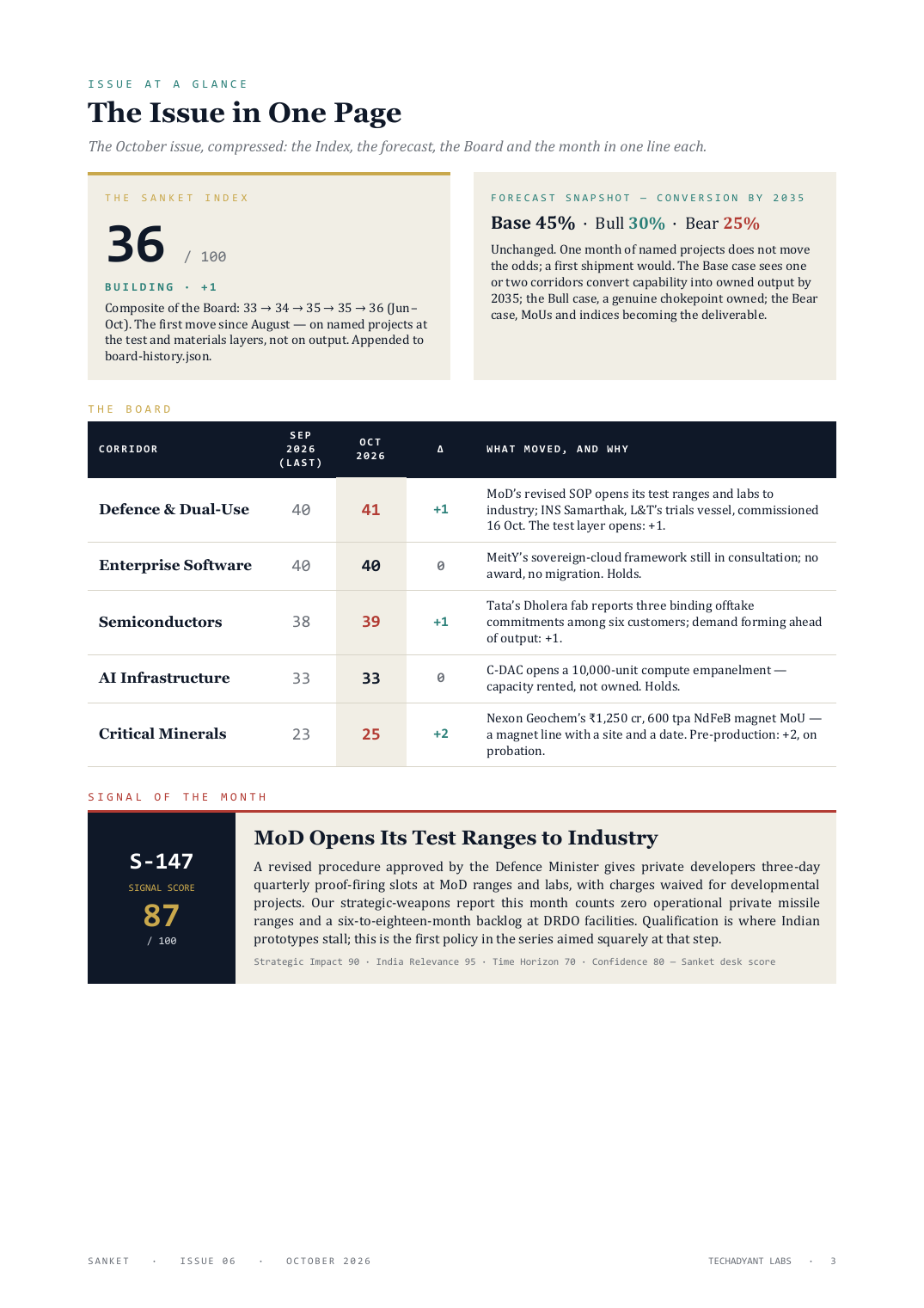
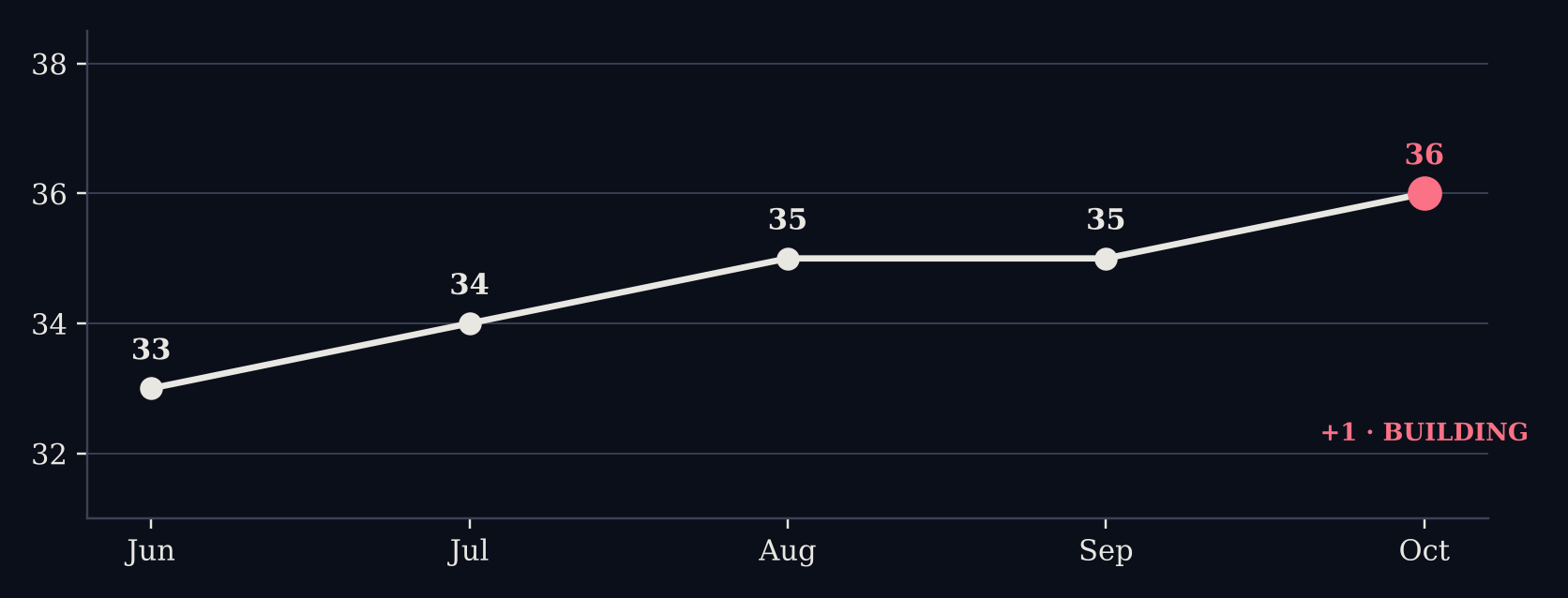
One of three tests moved. No domestic line came out of September’s equipment capital, and no public R&D system published its own conversion rate — though the Defence Secretary set November 2027 as the target for handing missile technology to industry. The third test moved furthest: HAL Koraput marked its 2,000th aero-engine and laid the foundation of a ₹218 crore second line for the licence-built Shakti, and MoD opened its test ranges to private developers. The Index moved one point (35 → 36), inside September’s single-digit base case. Track record: two forecasts graded; both On Track.
Five Corridors, Moving to 36
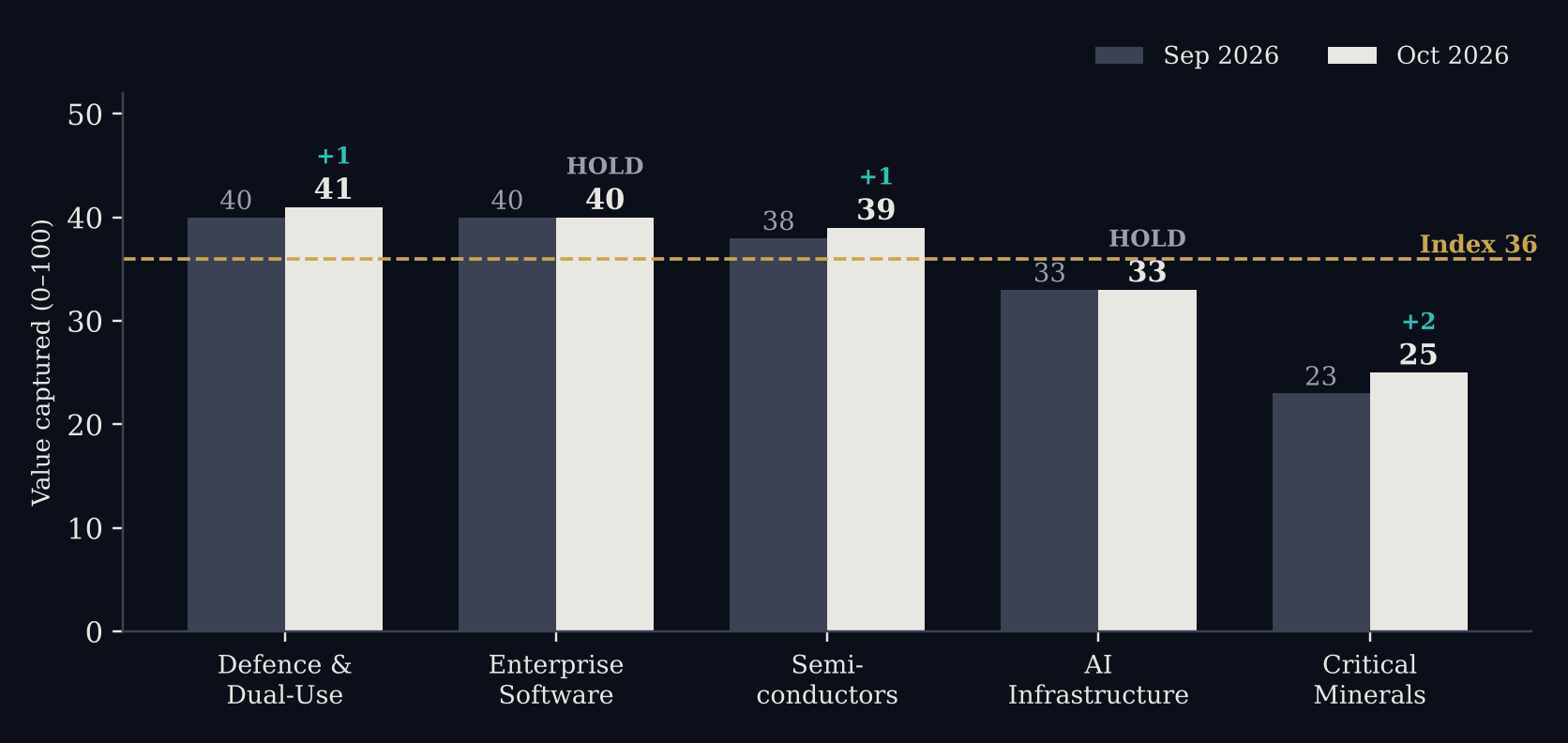
India’s industrial sovereignty, corridor by corridor, on the Dependency Capture Framework™ — how much of the value India captures, not how much it hosts. October’s gains are still pre-output, but they are the first moves at the test, materials and demand layers since the Index stalled.
MoD Opens Its Test Ranges to Industry
A revised procedure approved by the Defence Minister gives private developers three-day quarterly proof-firing slots at MoD ranges and labs, with charges waived for developmental projects. Our strategic-weapons report this month counts zero operational private missile ranges and a six-to-eighteen-month backlog at DRDO facilities. Qualification is where Indian prototypes stall; this is the first policy in the series aimed squarely at that step. See the signal feed.
- The month’s most important number is not a score. It is the appearance of named projects at the test, materials and demand layers that September said were missing.
- The test layer opened. MoD’s revised procedure lets industry use its ranges and labs, and INS Samarthak gives the Navy a floating trials platform built by a private yard.
- The materials layer has an address. Nexon Geochem’s ₹1,250 crore MoU puts a 600-tonne NdFeB line on 30 acres at Kakinada — still an MoU, first output due April 2029.
- The fab has an order book. Tata reports three binding offtake commitments for Dholera before its first wafer.
- The Board ticks up one point, to 36 — and one of those moves is on probation.
The First Line
September diagnosed the conversion problem with a number that is hard to forget: roughly 1.1% of India’s public R&D projects become products. The month’s capital arrived at the correct layer and still left the Board almost unchanged. Inputs are not output. October asks the next, sharper question: if conversion is the binding constraint, where does the first owned output actually run? Not the next MoU or scheme guideline — the first line that ships something India previously imported, under Indian process control, at a quality the customer will accept.
Three developments move that question from abstract to trackable. The test layer: our strategic-weapons report counts zero operational private missile-testing ranges; in the same month MoD opened its own ranges and labs to industry, and the Navy commissioned INS Samarthak, a trials and evaluation vessel built by L&T with around 75% indigenous equipment. The materials layer: Nexon Geochem signed a ₹1,250 crore MoU for a 600-tonne-a-year sintered NdFeB plant at Thondangi, Kakinada — and our electronic-grade chemicals report finds Tanfac’s solar-grade HF contracts (about 10,000 tonnes a year, ₹1,068 crore to FY2028-29) already exceed the modelled Indian solar HF pool 1.6 times. The demand layer: Tata reports three binding offtake commitments for Dholera. A fab with signed customers is a different object from a fab with a groundbreaking date.
None of these is yet a running line. Each sits one step closer to the mechanism September said was missing — the range that qualifies the system, the plant that makes the input, the customer who commits to the output. The month’s other reports explain why that matters: electronic-warfare procurement takes about 9.5 years from approval to first delivery, and over 75% of GaN MMICs are still imported. Shorten the qualification loop and the first line arrives years earlier. Everything else is still pre-line.
The First Line May Not Feed a Fab
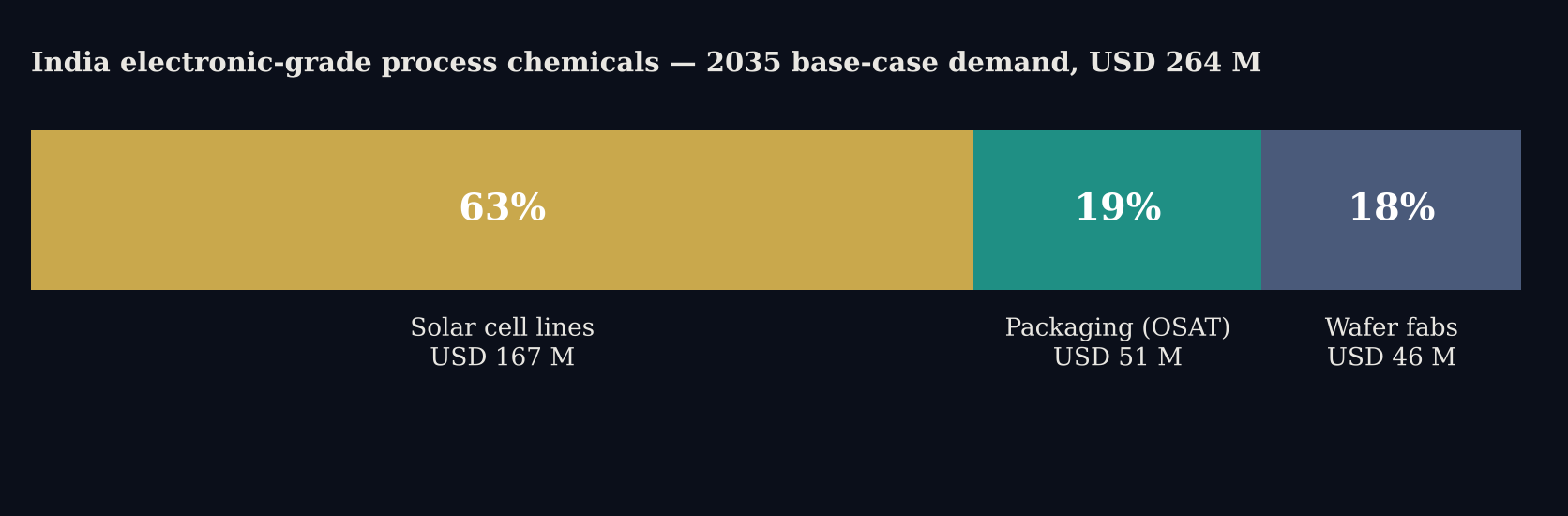
Wafer fabs will buy fewer than one dollar in five of India’s electronic-grade process chemicals in 2035. Solar cell lines buy 63%, packaging plants 19%. The binding constraint is customer qualification, not plant capital — so the first owned line in the semiconductor corridor is likelier to ship into a solar or packaging plant than into Dholera.
An MoU Is Not a Line
We moved Critical Minerals two points on a twelve-month MoU for a plant whose first phase is due in April 2029, which has not disclosed whether it has any support under the magnet scheme. By our own September rule — inputs are not output — that is generous. MoUs are cheap, and a score that rewards signatures will drift upward without a tonne being made.
We keep the +2 on probation. If Nexon shows no land allotment, site work or scheme award by April 2027, the points are returned and the correction is logged.
What Actually Moved in October
The October Changelog
Atlas /research · Signals /signals · Dependencies /dependencies · Corridors /corridors · Shape /shape
Four Published This Month
- India’s Electronic-Grade Chemicals and Process Materials, 2026-2035 - a smaller, later, solar-led market: USD 86 M (2026) to USD 264 M (2035); import dependence 57% today. 55 pp · ₹10,000 / ₹15,000.
- India Electronic Warfare Market 2026-2035 - a ₹3,200 cr FY24 baseline; a 9.5-year procurement cycle; GaN MMICs over 75% imported; a ₹45,500 cr RF prize. 98 pp · ₹6,999 / ₹11,999.
- India’s Private Strategic Weapons Industrial Base - private firms make 24% of defence production; seekers 85-90% imported; zero private test ranges. 78 pp · ₹6,999 / ₹11,999.
- Governing Logistics Under Systemic Disruption - guest paper by B. Rama Rao and K. V. Ramakrishna; the S³-LOGIC framework for freight-corridor governance. 53 pp · free.
October’s Chokepoints, Numbered
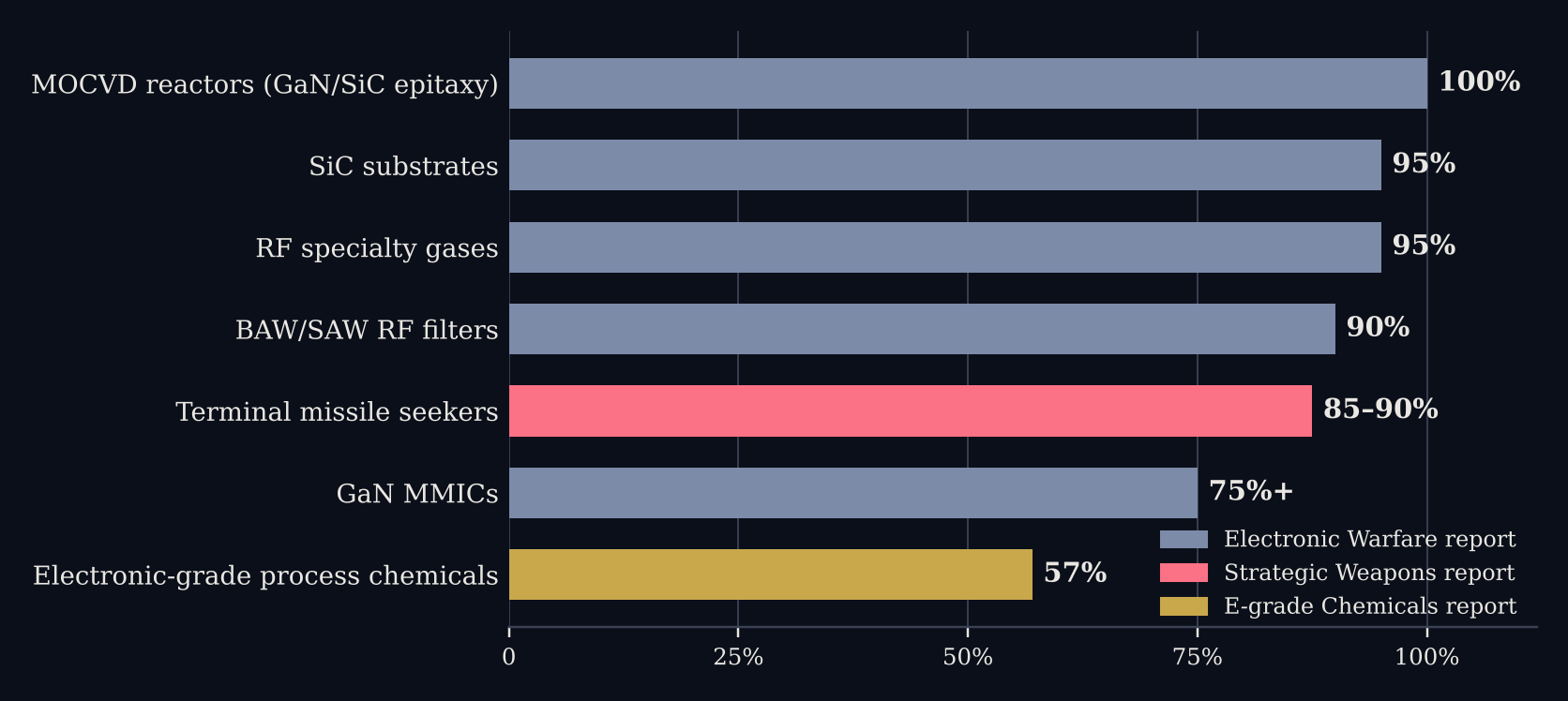
The radar, the jammer and the missile are assembled in India; the wafer they are built on, the reactor that grows it and the seeker that guides it are not. The only layer below 60% is the one where a contract — Tanfac’s solar-grade HF — already exists. Contracts move import shares; announcements do not.
The Twelfth Corridor’s Rail Spine Moves to Alignment
In September we filed NICDC procurement 187 — a consultant brief for the Perspective Plan of a Dankuni-Surat Industrial Corridor (DSIC) — as the first documentary sign of a twelfth national industrial corridor. October added two pieces. The Railway Board is examining the alignment of the proposed 2,052-km Dankuni-Surat dedicated freight corridor and consulting stakeholders; and our corridor tracker logs NICDC in early talks with West Bengal on a proposed Durgapur node, not yet approved.
The pattern is the one that built the Delhi-Mumbai Industrial Corridor: the freight line first, the industrial corridor laid on its spine. The tell is unchanged: whether DPIIT names DSIC in the official NICDP list. Status: strengthening — still a signal, not a fact. SOURCE · NICDC tenders (procurement 187) · Business Today (15 Oct 2026) · Techadyant corridor tracker
Three Ways This Plays Out — Unchanged
One or two corridors convert capability into owned output by 2035, but India stays import-dependent elsewhere. One month of named projects does not move the odds; a first shipment would.
The opened ranges, the magnet line and the fab’s order book compound into a genuine chokepoint owned in at least one corridor.
MoUs and indices become the deliverable; signatures multiply while orders keep flowing to imports.
The Watchlist — Dated Tests
Every date below is a promise someone made in public. Sanket will grade each one when it falls due.
The question we hear most: you move corridor scores on MoUs, tenders and contracts. Why should anyone trust a monthly number built on announcements?
Because the alternative — waiting for output — would leave the Board blank for years and tell you nothing about direction. A corridor moves only when a named project appears at a layer the framework scores, and the move is logged with its source. A score earned on a promise can be lost on a missed milestone, and we will say so in print — this month’s critical-minerals +2 is explicitly on probation. Send yours via Shape for next month’s Mailbag.
Citable, Every Number
The Board is an analyst-set reading on the Dependency Capture Framework™ (0-100 = value captured, not hosted); the Sanket Index is the rounded mean of the five corridors (41+40+39+33+25 = 35.6 → 36), persisted in board-history.json. Moves made on pre-production projects are held on probation.
- Revised SOP opening MoD ranges and labs to industry - Ministry of Defence (Oct 2026); Techadyant Signals S-147.
- INS Samarthak: commissioned 16 Oct at Karwar; L&T Shipyard; ~75% indigenous equipment - Indian Navy; NewKerala / IANS (16 Oct 2026).
- ₹4,106 cr contracts: GSAT-7C ₹2,563 cr (NSIL), Varunastra ~₹1,543 cr (BDL) - Ministry of Defence; Business Standard (15 Oct 2026).
- Nexon Geochem ₹1,250 cr, 600 tpa NdFeB, Phase 1 by April 2029 - APEDB MoU; Autocar Professional (14 Oct 2026).
- Recycling scheme ₹1,500 cr; 58 companies eligible - Mines Ministry; Construction World (14 Oct 2026).
- Tata Dholera: six customers, three binding offtakes - Digitimes (12 Oct 2026).
- C-DAC RFE for up to 10,000 AI compute units - C-DAC; MediaNama (13 Oct 2026).
- Electronic-grade chemicals, electronic warfare and strategic weapons figures - Techadyant Labs reports (Oct 2026).
- Dankuni-Surat DFC, 2,052 km, alignment under examination - Business Today (15 Oct 2026).
No sponsored coverage; no positions in what we analyse. Corrections to labs.techadyant.com/corrections.
Get Sanket first
Monthly strategic intelligence on India’s industrial systems — independent and infrequent.