
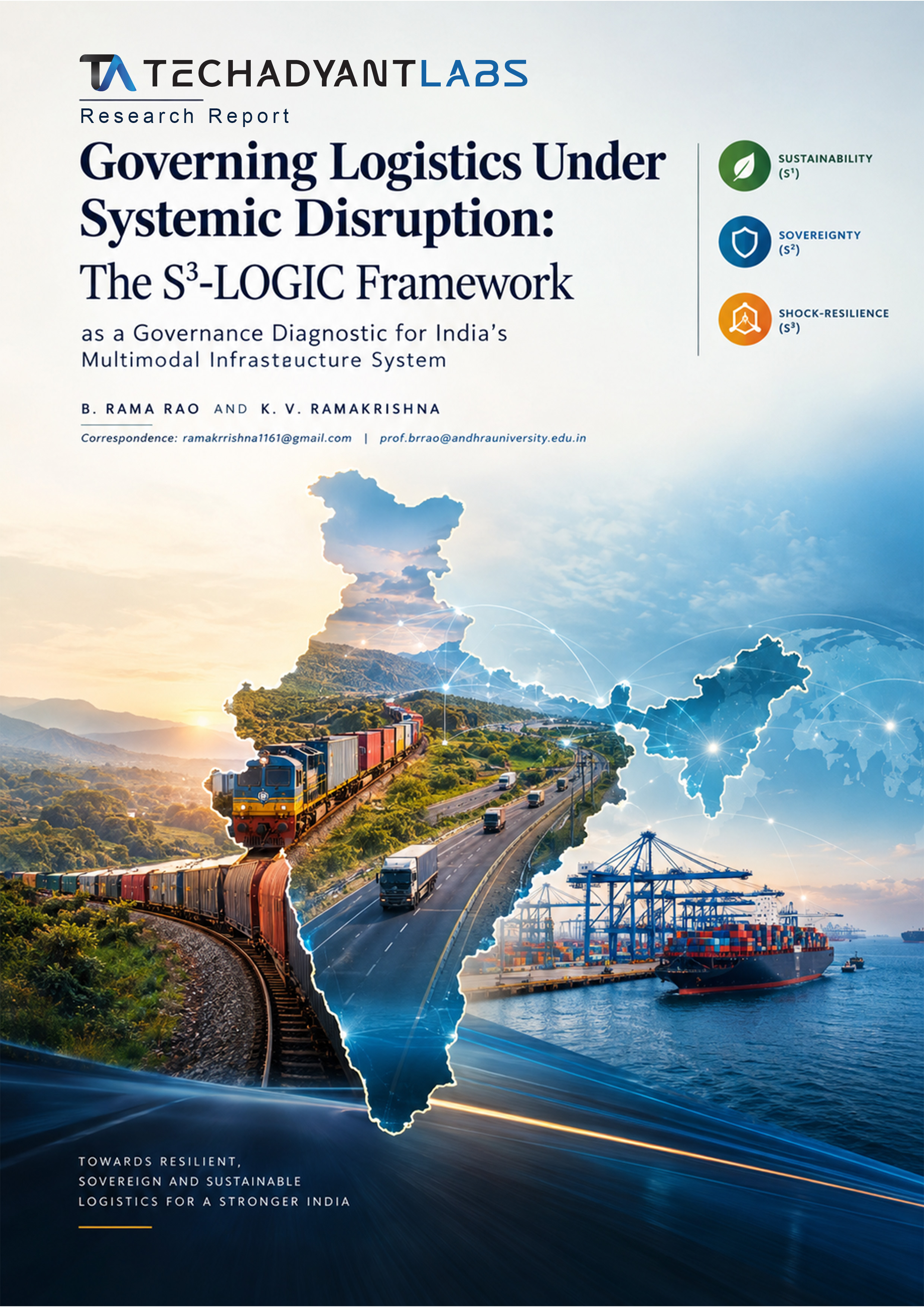
The Thesis
India is building freight infrastructure faster than it is building the governance architecture to protect it. This author-led research paper introduces the S³-LOGIC diagnostic — a framework that scores logistics governance across three non-substitutable pillars: Sustainability, Sovereignty and Shock-Resilience. Applied to three strategically distinct Indian freight corridors, it returns the same verdict for all three: Fragile. Operational performance indicators are improving while the institutional foundations that sustain them — ecological viability, digital sovereignty and adaptive resilience under disruption — remain structurally underdeveloped.
The central claim is that this is not a technical or commercial problem but a governance-architecture problem — and one that conventional performance metrics (cost, speed, modal share, LPI rank) are structurally unable to see. The paper makes the gap measurable, locates it corridor by corridor, and derives seven evidence-based governance prescriptions. It is published by Techadyant Labs as a guest research paper; its methodology, scores and conclusions are those of the named authors, B. Rama Rao and K. V. Ramakrishna.
The S³-LOGIC Framework
S³-LOGIC conceptualises logistics governance as three institutional conditions that must function simultaneously. The framework's defining assumption is non-substitutability: a deficit in one pillar cannot be offset by strength in another, because each represents a distinct institutional capability required to keep a multimodal system governable under stress.
S¹ — Sustainability
The degree to which governance operates within ecological constraints and addresses rebound risk — modal-efficiency trajectory, environmental-load monitoring, and whether demand-moderation instruments exist so efficiency gains are not eroded by demand-induced rebound.
S² — Sovereignty
The degree to which national institutions retain governance agency over logistics data, routing and MSME inclusion — DPDP Act compliance, ULIP governance provisions, data-stewardship rules, platform accountability and sovereign control over strategic freight information. This is the weakest pillar across every corridor studied.
S³ — Shock-Resilience
The degree to which corridors maintain institutional continuity under disruption without governance regression — documented rerouting protocols, inter-ministerial crisis authority, and the sensing / seizing / reconfiguring capacity to recover. Read against the 2024–2025 Red Sea maritime security crisis, which exposed how recurrent geopolitical shocks amplify governance vulnerabilities.
Governance maturity is assigned on a non-compensatory, minimum-condition rule — the weakest pillar defines the composite band — across five bands: Resilient (4.2–5.0), Consolidating (3.4–4.1), Transitional (2.6–3.3), Fragile (1.6–2.5) and Critical (1.0–1.5). The diagnostic is applied through Structured Qualitative Comparative Analysis (SQCA) of documentary evidence, validated by an expert panel (n = 19).
Key Findings
All three corridors are Fragile
The Western and Eastern Dedicated Freight Corridors and the Coastal Maritime Corridor all land in the Fragile band (composite 2.10–2.30), despite differing sustainability scores.
S³-LOGIC master diagnostic (Table 5)Sovereignty is the binding constraint
Sovereignty (S²) is the weakest dimension everywhere (1.6–1.8): digitalisation via ULIP is advancing faster than the institutions to govern logistics-data stewardship, platform accountability and sovereign control of freight information.
Corridor assessments; DPIIT 2024Investment is outrunning governance
Infrastructure capital is advancing ahead of the architecture needed to protect its outputs under disruption, sustain institutional control over digital operations, and prevent ecological rebound.
Cross-corridor patternWeaker governance → higher vulnerability
Lower governance maturity consistently tracks higher operational vulnerability (an inverse association), measured across transit variability, recovery duration and modal-fallback intensity.
Directional vulnerability associationStrong sustainability doesn't rescue the score
The WDFC records the best sustainability performance (S¹ = 3.2) yet stays Fragile — weak sovereignty and resilience are binding under the minimum-condition rule, not averaged away.
Non-compensatory scoring logicA data-sovereignty gap the DPDP Act doesn't close
The Digital Personal Data Protection Act, 2023 sets a personal-data baseline, but operational logistics-data governance, platform control and algorithmic sovereignty remain institutionally unresolved.
Governance-gap analysisThe Corridor Scores
The diagnostic's core output is a pillar-by-pillar score for each corridor on a 1–5 scale. The chart makes the pattern visible: sustainability (S¹) sits just above the Fragile ceiling, while sovereignty (S²) and shock-resilience (S³) sit well below it in every corridor — so the composite band, set by the weakest pillar, is Fragile throughout.
Master governance diagnostic
| Corridor | S¹ | S² | S³ | Composite | Band | Vulnerability* |
|---|---|---|---|---|---|---|
| Western DFC (industrial / manufacturing) | 3.2 | 1.8 | 1.9 | 2.30 | Fragile | 3.80 |
| Eastern DFC (agricultural / bulk) | 3.1 | 1.7 | 1.8 | 2.20 | Fragile | 4.03 |
| Coastal Maritime (export / coastal) | 3.0 | 1.6 | 1.7 | 2.10 | Fragile | 4.30 |
*Composite vulnerability is the average of transit variability, recovery duration and modal-fallback intensity (1–5). Governance and vulnerability move inversely — weaker governance, higher vulnerability. Source: authors (2026).
India in Context
The paper situates India's logistics governance against China and the European Union. India has closed much of the headline cost gap, but structural and governance indicators — rail and coastal modal share, LPI rank, and the absence of a dedicated freight crisis-coordination authority — show where the institutional architecture lags.
| Indicator (2023) | India | China | EU benchmark |
|---|---|---|---|
| Logistics cost as % of GDP | ~8–9% | ~14–15% | ~8–10% |
| Rail freight modal share | ~27% | ~47% | Germany ~28%; EU avg ~18% |
| Coastal / waterway freight share | <10% | — | — |
| World Bank LPI rank | 38th / 139 | 19th / 139 | Netherlands 1st; Germany 3rd |
| Dedicated freight crisis authority | None (statutory) | Present | National frameworks operational |
Source: compiled by the authors from NCAER (2024), World Bank LPI (2023) and cited material.
The Reform Agenda
Seven prioritised governance prescriptions follow directly from the diagnosed gaps — weighted toward sovereignty (S²), the binding constraint.
- G1 · S²National Logistics Data Sovereignty Act — a sector-specific framework (complementing the DPDP Act) for routing, pricing and cargo data currently ceded to platform operators by institutional default.
- G2 · S²MSME-accessible APIs on ULIP — mandated interoperable access to publicly funded logistics infrastructure, ending the structural exclusion of MSME operators from formal digital networks.
- G3 · S³National Freight Corridor Resilience Authority (NFCRA) — a statutory inter-ministerial crisis-coordination mandate for disruption governance.
- G4 · S¹/S³Coastal Freight Governance Programme — integrated with Sagarmala and Maritime India Vision 2030 to unlock the lowest-cost, lowest-carbon mode that remains institutionally suppressed.
- G5 · S¹Freight Demand Moderation Instrument — amendments to the National Logistics Policy 2022 so efficiency gains are not lost to demand-induced rebound.
- G6 · S²Annual logistics platform governance audits — assessing market concentration, data-governance compliance and MSME digital participation.
- G7 · S²/S³Port data-sovereignty clauses — operational logistics-data governance written into coastal-terminal concession agreements.
Frequently Asked Questions
What is the S³-LOGIC framework?
How do India's freight corridors score?
Why is sovereignty the weakest pillar?
What does the paper recommend?
Who wrote this report and is it free?
Methodology & Sources
The framework is applied through Structured Qualitative Comparative Analysis (SQCA) of documentary evidence across three corridor archetypes, with scores validated by an expert panel (n = 19). Governance bands are assigned on a non-compensatory minimum-condition rule; vulnerability is benchmarked against the World Bank LPI timeliness indicator and documented disruption episodes, including the 2024–2025 Red Sea crisis and COVID-19 road-fallback evidence. The analysis is qualitative and diagnostic: scores reflect structured expert judgement against documentary proxies, not a quantitative weighting model — a boundary the authors state explicitly.
Primary material cited by the authors includes NITI Aayog, DPIIT, the Ministry of Railways, the Ministry of Ports, Shipping and Waterways, NCAER, the World Bank Logistics Performance Index, and OECD sources, alongside the governance-theory literature (DiMaggio & Powell, North, Teece, Boin, Floridi and others).
Read the Full Paper
The full 53-page paper develops the theoretical foundations, the full variable operationalisation and band-classification criteria, the three corridor case studies in depth, the discussion and theoretical-contribution matrix, limitations and boundary conditions, and the complete bibliography supplied by the authors.
Free Research Paper — 53 pages
The complete author-led paper, including the S³-LOGIC matrices, the master governance diagnostic, the seven-point reform programme and the full reference list. Delivered as a PDF.
Read the free paperPublished by Techadyant Labs as a guest research paper. Methodology, findings and conclusions remain those of the named authors, B. Rama Rao and K. V. Ramakrishna.