
Pricing the Gap
Three service roadmaps, one composite index, 312 import surfaces - August was the month India put a number on what it does not make. July priced the opportunity; August priced the gap. The question now is whether the numbers build anything.
The issue at a glance
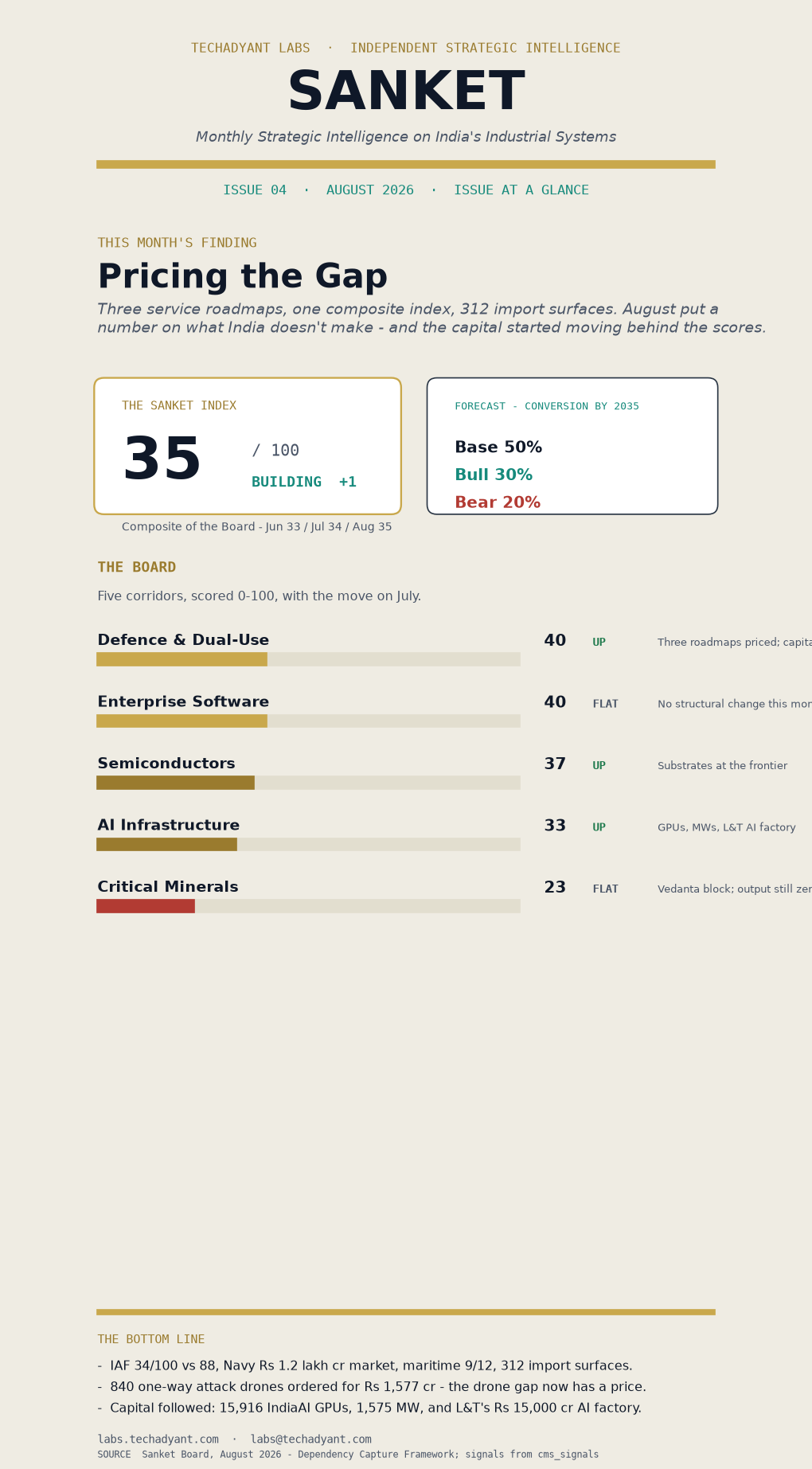
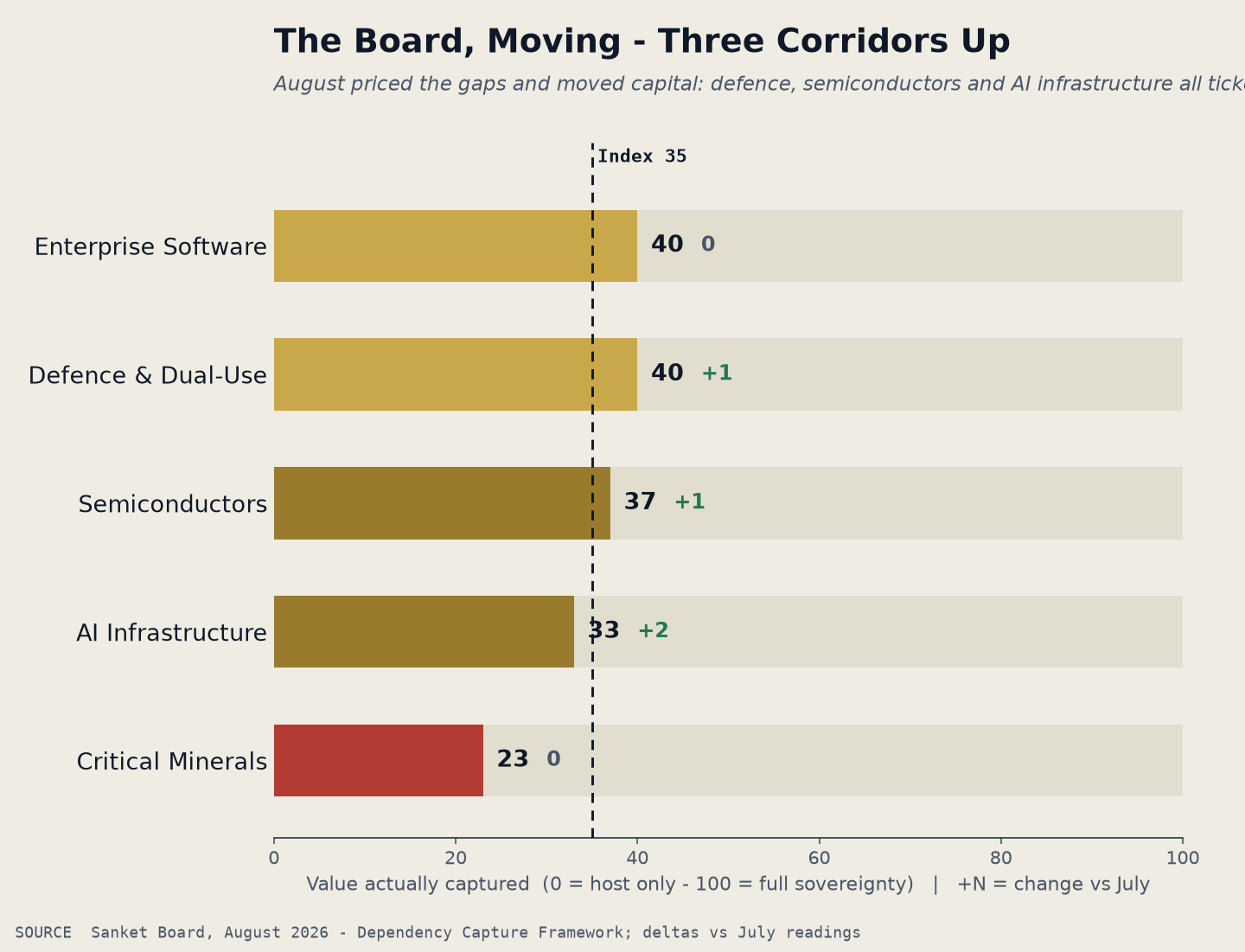
Five Corridors, Now Moving
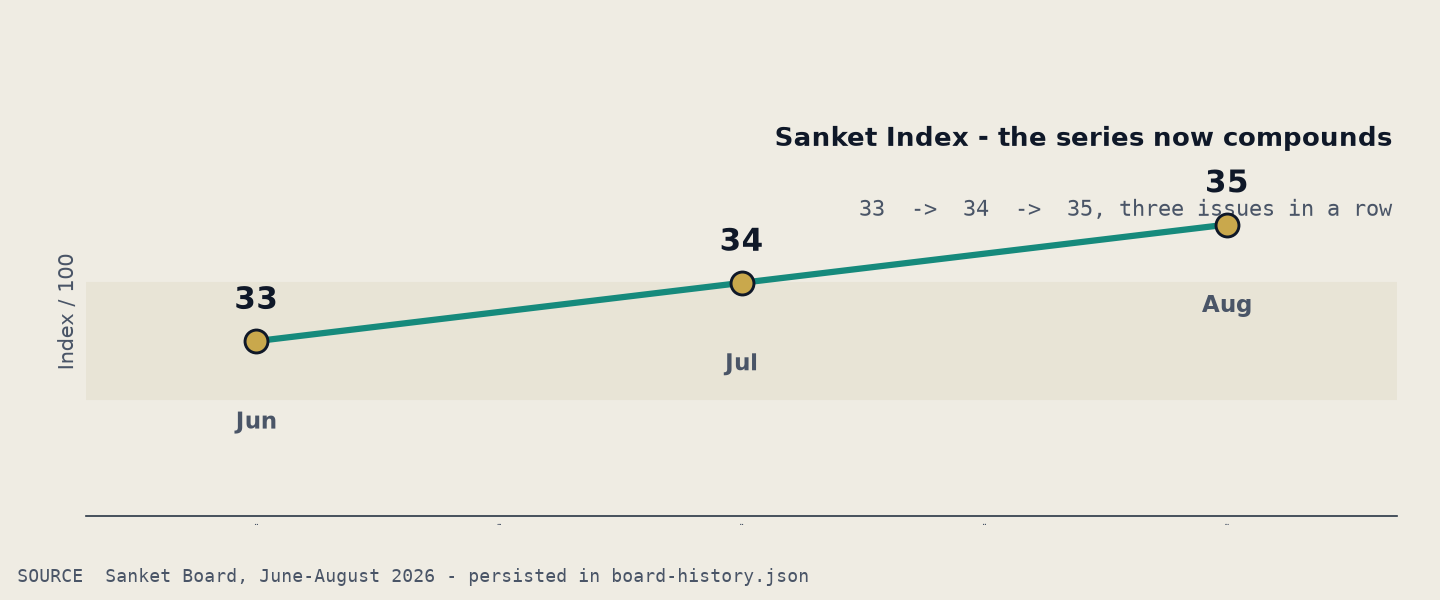
India’s industrial sovereignty, read corridor by corridor on the Dependency Capture FrameworkT - how much of the value India captures, not how much it hosts. Every reading carries its move on July, and the series is persisted in board-history.json so the trend compounds rather than resets.
- August priced the gap: IAF 34/100 vs USAF 88, a Navy ~₹1.2 lakh crore subsystem market, maritime readiness 9/12, and 312 import surfaces scored.
- The month’s biggest order - 840 one-way attack drones for ₹1,577 crore (Tata 64%, Nibe 36%) - puts a price on the drone gap.
- Capital moved behind the scores: L&T’s ₹15,000 crore AI-factory order, 15,916 IndiaAI GPUs, 1,575 MW of data-centre capacity, BEL’s ₹600 crore Chitrakoot unit.
- Every score points the same way: the gap is upstream - subsystems, silicon, cells, substrates - not platforms.
- Measurement is now real. Output is not yet. Watch the first line that runs, not the index.
Pricing the Gap
June named the problem - India assembles, but the value lives upstream. July priced the opportunity: ~₹1.5 lakh crore of it, mostly in the layers India imports. August answers the next question, and it is the most uncomfortable one yet: precisely how much does India not make? Three service roadmaps, one composite index and 312 import surfaces later, the gap is no longer a claim. It is a number.
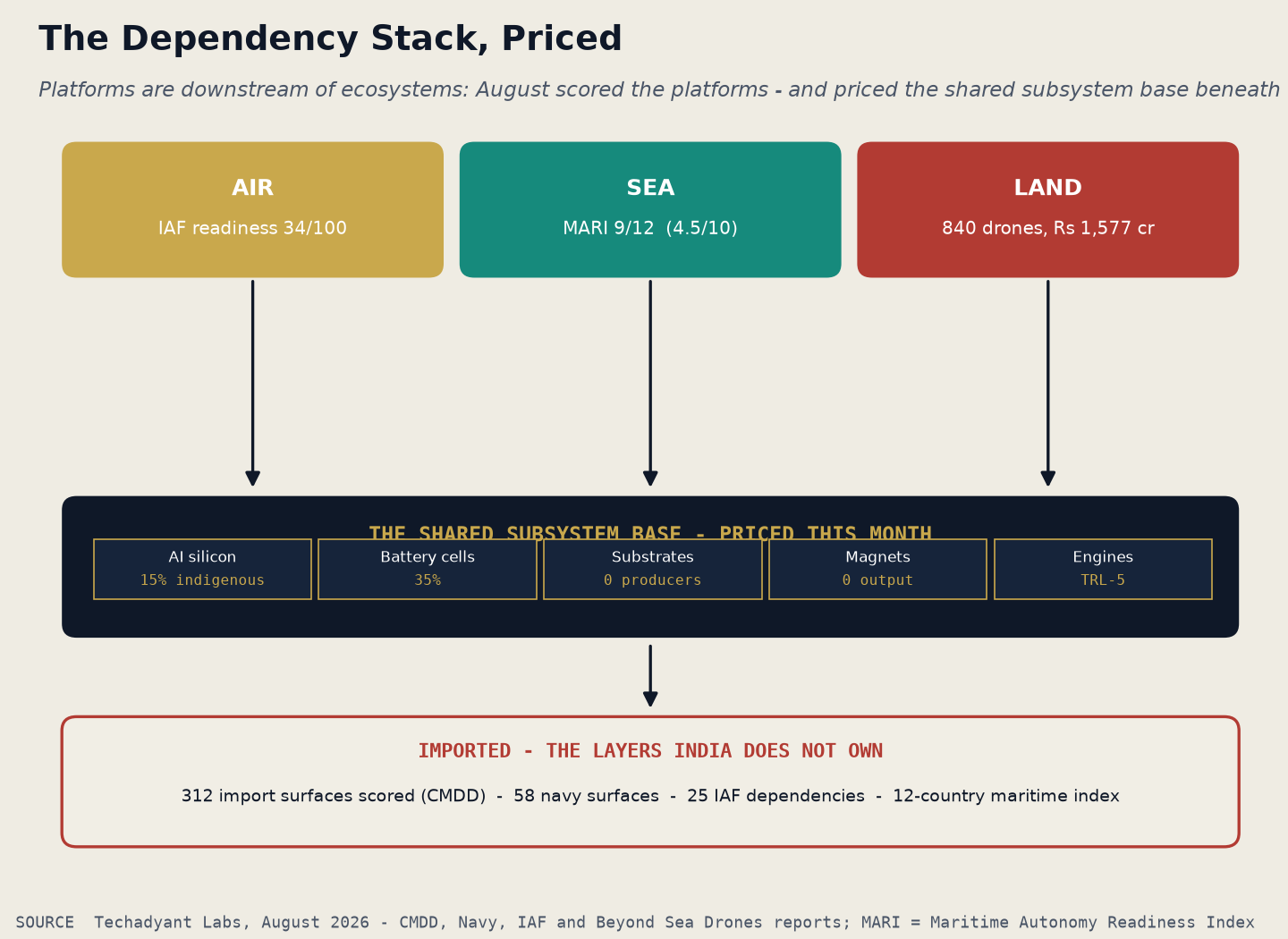
Start with the services, because that is where August is loudest. The IAF roadmap scores India’s autonomous air power at 34/100 against the USAF’s 88. The Navy’s transformation report sizes a ~₹1.2 lakh crore cumulative subsystem market to 2035 and ranks 58 surfaces - with AI silicon at roughly 15% indigenous and battery cells at 35%. The Maritime Autonomy Readiness Index places India 9th of 12 at 4.5/10. Three services, three scored gaps, one shared finding: the platform is not the problem; the subsystem base beneath it is.
The month’s orders agree. The Army’s 840 one-way attack drones for ₹1,577 crore - Tata Advanced Systems and Nibe - price the drone dependency at roughly ₹1.9 crore per platform, most of it in subsystems still imported. BEL’s ₹600 crore Chitrakoot unit, L&T Semiconductor’s OSAT shift home, UP’s ₹45,000 crore of chip-and-electronics commitments, L&T’s ₹15,000 crore AI-factory order and 15,916 new IndiaAI GPUs: the capital is arriving at the layers the scores flagged.
This is the measured dependency - India moving from slogans to indices, from "make in India" to "score what we do not make". The index is a necessary instrument of policy, and it is now in place. The risk is that it becomes an end in itself. Pricing the gap is not closing it. The decade’s question has changed shape: not where the gap is, but whether the numbers build anything.
India 34, USAF 88
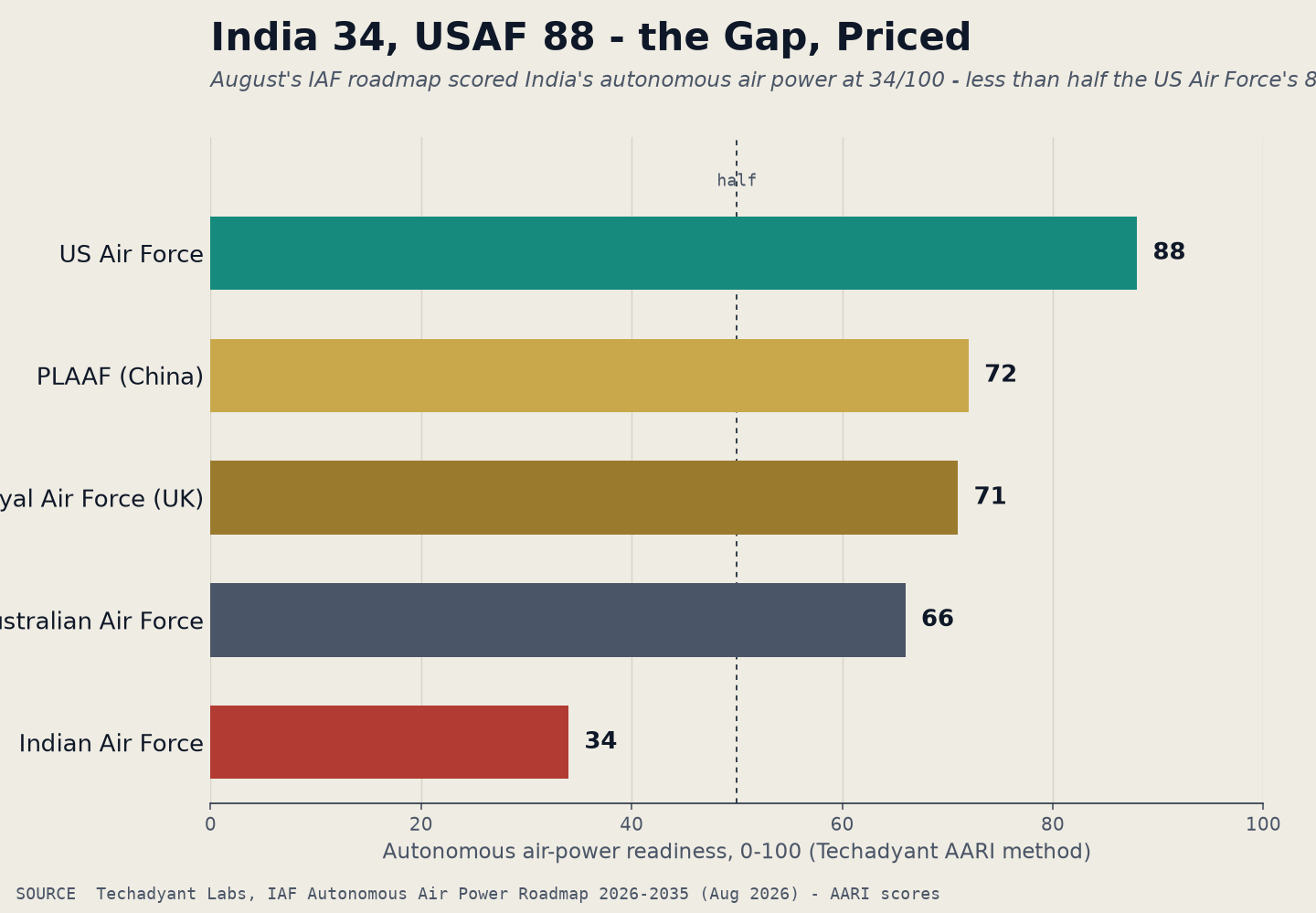
India published its own number this month - 34/100 against the USAF’s 88 - and ran the same exercise for sea and land. Nobody scored India’s dependencies for us; we scored them ourselves, and the score is the starting point for the build.
What Actually Moved in August
The month’s hard moves - capital, policy and capacity - tagged by corridor and sourced.
The August Changelog
The intelligence platform compounds, and this is where subscribers see it. Every item below shipped in August - verified against the deployment log - with what it does for you and where to use it.
Atlas → labs.techadyant.com/research · Dependencies → /dependencies · Corridors → /corridors · Shape → /shape
The Army Puts a Price on the Drone Gap: ₹1,577 Crore for 840 One-Way Attack Drones
The Ministry of Defence signed two contracts worth ₹1,577 crore with Tata Advanced Systems and Nibe on 14 August for 840 loitering munitions that strike beyond 100 km in jammed and spoofed environments - delivery within 12 months under the Buy (Indian) IDDM fast-track. It is the first large order of its kind, and it is this month’s thesis in a number: roughly ₹1.9 crore per platform, most of it in subsystems - motors, controllers, seekers, cells - that India is only beginning to make.
The tell to watch: how much of the ₹1,577 crore lands with Indian subsystem makers - and whether the follow-on orders the Army has signalled (tens of thousands of UAS over five years) price the industrial base, not just the platform.
The empanelled national compute pool reaches 34,333 (target 100,000 by end-2026) and a ~1.1 EFLOPS HPC system is ordered at the NIC data centre, Delhi - sovereign compute, priced and ordered, not just promised.
Intel and 3DGS’s US$3.3bn Odisha plant will build glass-core substrates - pre-commercial worldwide - at a layer where India has zero producers and three firms hold ~70%. India enters as host, not yet owner.
A 152-hectare G4-stage block in Andhra Pradesh (BSE filing, 13 Aug) - manganese for ferro- and silico-manganese alloys. A supply-side step while processing output stays at zero.
We assess that August moved India’s industrial debate from claims to measurements: three services, one composite index and 312 import surfaces now carry numbers, and the month’s capital - the ₹1,577 crore drone order, the ₹15,000 crore AI factory, the OSAT shift, 15,916 GPUs - is landing at the layers the scores flagged. That alignment between measurement and capital is the month’s real signal.
Principal risk: the indices become the deliverable. Scores are instruments of policy, not outcomes; import surfaces shrink only when lines run. Confidence is capped by India’s record of converting scores into output - and by the certification, power and component-capital bottlenecks the reports themselves document.
The Dependency Stack, Priced
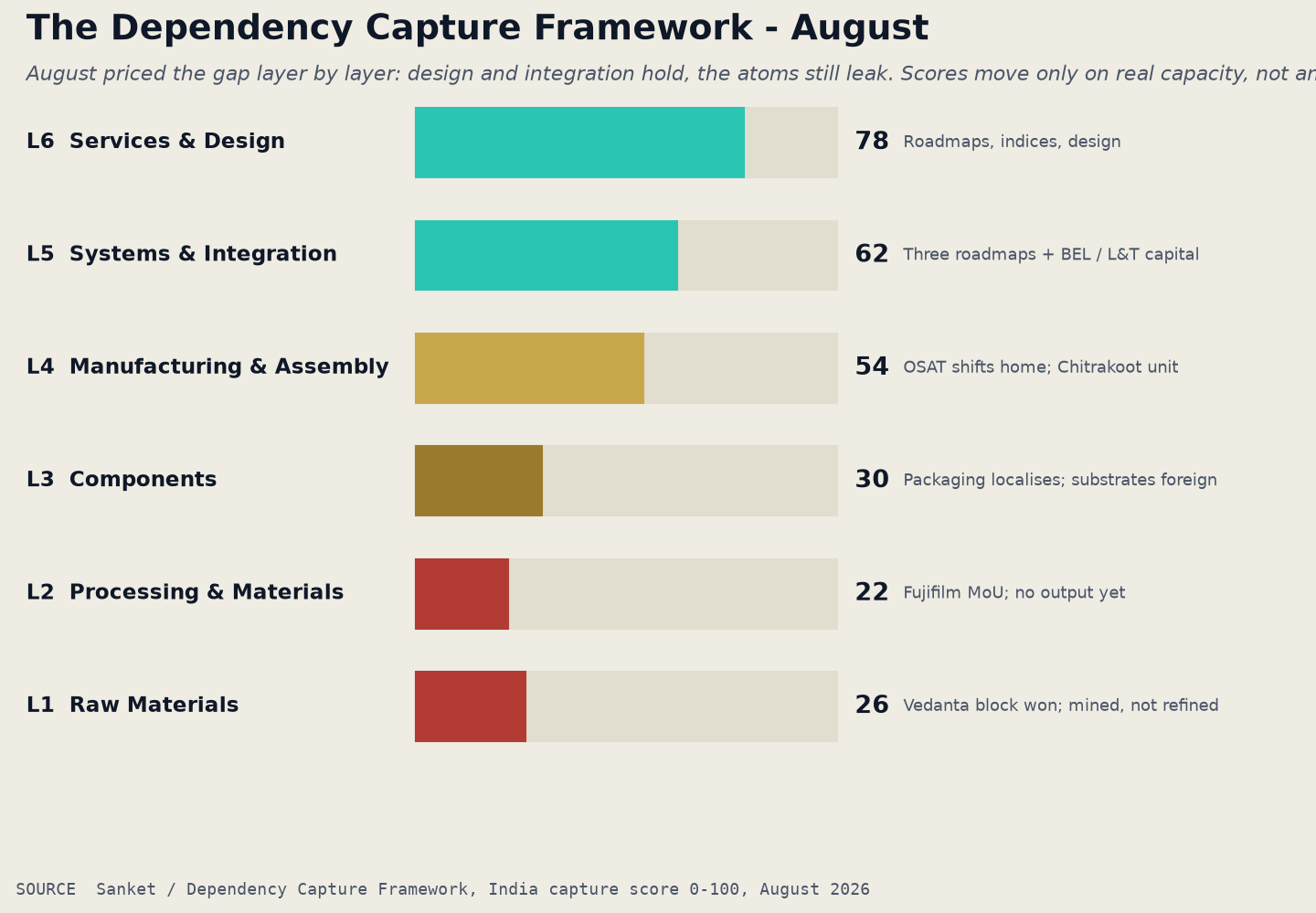
The Dependency Capture FrameworkT
"The month put a number on what India doesn’t make. Now the numbers have to build something."
Eight Reports, One Lens
August’s research, each in a line and a number - the measurement behind this month’s thesis.
- India’s Critical Manufacturing Dependencies - the CMDI, first edition: 312 import surfaces · 12 sectors.
- The Indian Navy’s Autonomous Maritime Transformation 2026–2035 - platforms are downstream of ecosystems: ~₹1.2 lakh cr · 58 surfaces.
- IAF Autonomous Air Power Roadmap 2026–2035 - 34/100 vs USAF 88, 25 dependencies scored.
- Beyond Sea Drones: India’s Autonomous Maritime Systems Ecosystem - 9/12 on the Maritime Autonomy Readiness Index; ₹35,000 cr base case by 2035.
- Beyond Solar Panels - capability inverts value up the stack: ~172 GW of ALMM-listed module capacity on an imported upstream base.
- The Hydrogen Mirage or Machine? - policy around the molecule, not the machine: ~3 GW operational electrolyser capacity.
- Q-Day India - post-quantum-cryptography readiness and migration; free, 152 pages.
- Kalpasar Economic Impact Assessment - the bay project on the superseded design: ~₹1,33,246 cr capex, tidal dropped for a ~2,470 MW solar-wind hybrid.
Indices Are Not Output
Consensus will read the month as momentum: three roadmaps, a ₹1.2 lakh crore market, 312 surfaces scored. We would be careful. India has never lacked analysis; it has lacked output - and an index is the most comfortable deliverable a dependency programme can produce, because it costs nothing to publish and changes nothing by itself.
The scores are necessary. They are not the win. The win is the first line that runs: the first sintered-magnet batch, the first substrate die, the first factory floor that turns a scored import surface into a made one. Cheer the measurement. Stay sceptical until the number shrinks.
Three Ways This Plays Out
India converts two or three of August’s scored gaps into real capacity - OSAT and packaging, the AI-factory build-out, an OWA subsystem line - but stays import-dependent in silicon, cells and magnets. The index moves in single digits.
Measurement converts into chokepoint ownership in at least one corridor - advanced packaging or rare-earth processing - and the Navy’s ₹1.2 lakh crore subsystem market starts to be captured domestically.
The indices become the deliverable; orders keep flowing to imports; another decade of scored-but-uncaptured dependencies - the gap priced, never closed.
On the Radar, Not Yet on the Board
- Semicon 2.0 pillar two: whether machines, materials, chemicals and gases is notified with real allocations and eligibility - a demand signal or a line in a release.
- The 100,000-GPU target: whether the IndiaAI pool closes 2026 at 100,000 empanelled GPUs - and where the power comes from.
- First output, not first order: the first sintered magnet, the first substrate die, the first OSAT line - the import surfaces that actually shrink.
- AI-factory power: whether the transmission build-out keeps pace with 1,575 MW of data-centre capacity and the L&T Chennai campus.
- The subsystem bill on 840 drones: how much of the ₹1,577 crore stays in India - the ledger for the follow-on order.
Own the layer, not the floor space. The full August catalogue:
- Browse all reports
- Forthcoming: India’s Edge AI Economy and India’s AI Power Infrastructure Gap - due this month.
- Then: The Cooling Economy of India · The Sensor Economy of India (Sep) · Industrial Logistics (Oct) · Water Behind India’s Semiconductor Ambitions · Industrial Machine Vision (Nov) · Semiconductor Supply-Chain Missing Links (Dec).
- Commission bespoke research or a DPR · labs.techadyant.com/services
Citable, Every Number
Every load-bearing figure in this issue traces to a source. The Board is an analyst-set reading on the Dependency Capture FrameworkT (0–100 = value captured, not hosted); the Sanket Index is the rounded mean of the five corridors. Signals are scored 0–100 on Strategic Impact 40 / India Relevance 30 / Time Horizon 15 / Confidence 15 where the engine score exists; August signals are presented by corridor and date because the engine’s score layer was unreachable this cycle.
Each corridor is scored 0–100 for how much of the value India captures - not hosts - on the six-layer Dependency Capture FrameworkT, judged monthly against capital, policy, capacity and import data. The Sanket Index is the rounded mean of the five corridor readings; movements require real events, and the series is persisted in board-history.json.
Independence: no sponsored coverage; no positions in what we analyse. Corrections at labs.techadyant.com/corrections.
Every report adds evidence. Every signal updates the record. Every Atlas page expands India’s Industrial Knowledge Graph.
Get Sanket first
Monthly strategic intelligence on India’s industrial systems — independent and infrequent.