
Kalpasar Economic Impact Assessment
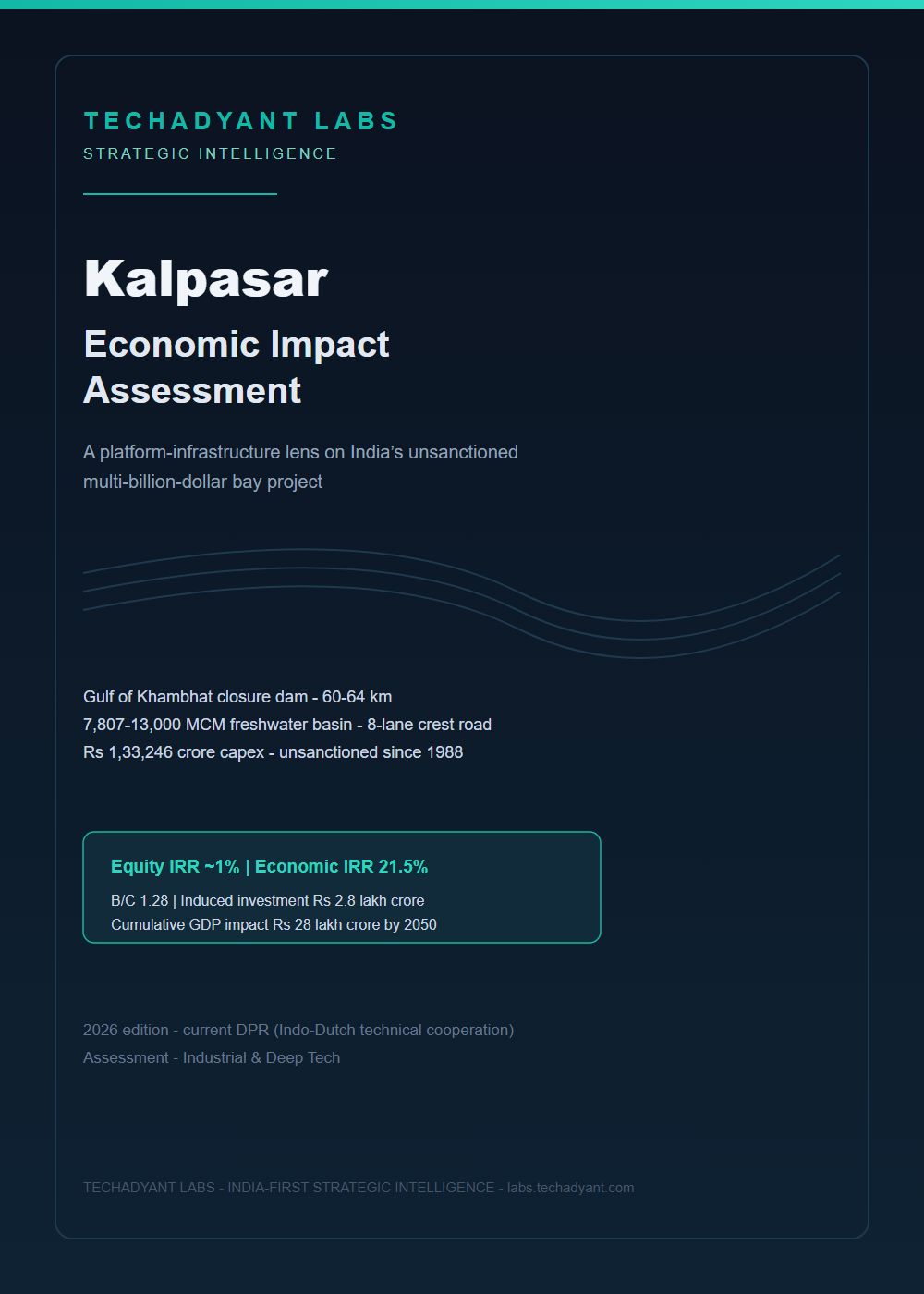
A 60-64 km closure dam across the Gulf of Khambhat to impound 7,800 MCM of freshwater a year - 40 years studied, never sanctioned. ₹1,33,246 crore of capex, an equity IRR of ~1% and an economic IRR of 21.5%. The platform thesis versus the environmental objection.
The Thesis
Kalpasar is not a project to be evaluated on its standalone financial IRR - which is now ~1% on equity. It is a platform investment whose value lies in the industrial, agricultural and urban ecosystems it enables: 7,800 MCM/yr of freshwater, a 240 → 60 km road corridor, and ₹2.8 lakh crore of induced industrial investment. The economic case is robust (21.5% IRR, B/C 1.28); the direct financial case is not. The honest conclusion: this is a project that only sovereign leadership can deliver, and only if the environmental objections - tidal-flat loss, fisheries, sediment, salinity - are genuinely resolved. Techadyant Labs assesses the probability of financial close by 2030 at approximately 50%.
Key Numbers
Key Findings
A platform, not a project
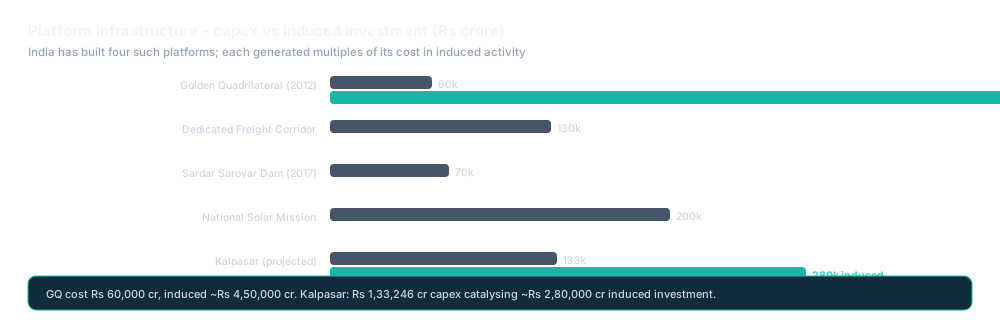
Kalpasar is best evaluated on induced impact, not direct return. The Golden Quadrilateral cost ₹60,000 cr and generated ~₹4,50,000 cr of induced investment; Kalpasar’s ₹1,33,246 cr capex is projected to catalyse ₹2,80,000 cr. No single revenue stream covers the cost; the aggregate benefit-cost ratio does.
[Ch 1 - Verified]The freshwater dividend is the engine
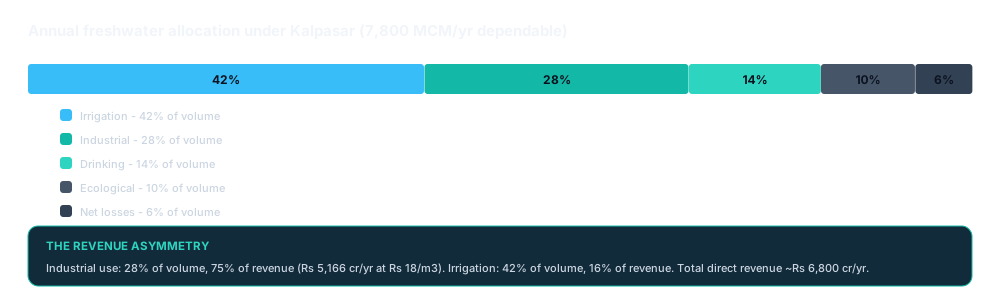
At 7,800 MCM/yr dependable yield, Kalpasar more than doubles Gujarat’s usable freshwater. Industrial offtake (2,870 MCM/yr at ₹18/m³) generates ₹5,166 cr/yr and is the binding enabler of ₹2.8 lakh cr of induced industrial investment. Every cubic metre enables ~₹65 of industrial GVA.
[Ch 3 - Verified]The road is the most under-appreciated component
The 8-lane crest corridor cuts the South Gujarat↔Saurashtra distance from ~240 km to ~60 km, integrates Saurashtra into the Dedicated Freight Corridor network, and generates ~₹4,000 cr/yr of logistics savings at steady state, structured as a toll concession with 11-13% expected IRR.
[Exec Summary / Ch 2 - Verified]Tidal retirement gutted the direct-revenue case
The 2026 DPR retired the earlier 5,880 MW tidal concept: the ₹9,075 cr/yr tidal PPA line is gone, replaced by a ~2,470 MW captive solar+wind hybrid with only a ~₹280 cr/yr merchant tail. Energy is now a cost-offset for pumping, not a revenue stream — the main reason the financial case weakened.
[Ch 2 - Verified]The environmental objections are real, not manageable
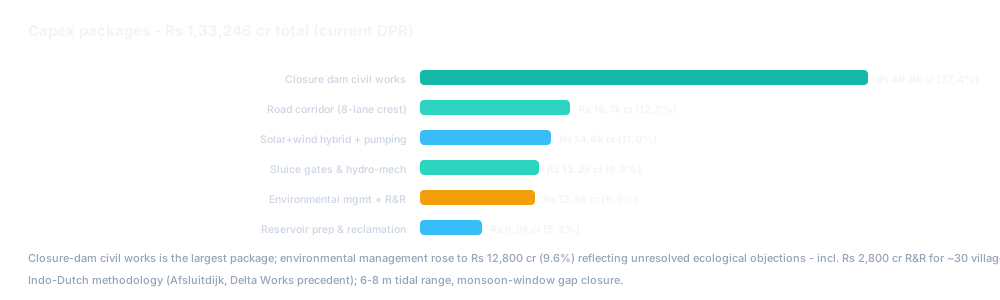
Tidal-flat loss, fisheries impact, sediment dynamics and salinity transition are unresolved ecological objections — 40 years of study without sanction is the evidence. The mitigation programme (₹12,800 cr capital + ₹240 cr/yr) is necessary but not sufficient; sediment management (TRL 6) and salinity transition (TRL 5) need targeted R&D.
[Ch 2 / Ch 11 - Verified]Only sovereign leadership can deliver it
A capital stack of 65% sovereign/state equity and grants, 30% multilateral concessional debt, 5% bond/InvIT achieves 7.8% WACC — but sovereign grants, not equity alone, are required to bridge the gap between economic and financial returns. Private capital should enter via offtake, operations and adjacent development, not construction risk.
[Ch 7 - Verified]The Framework
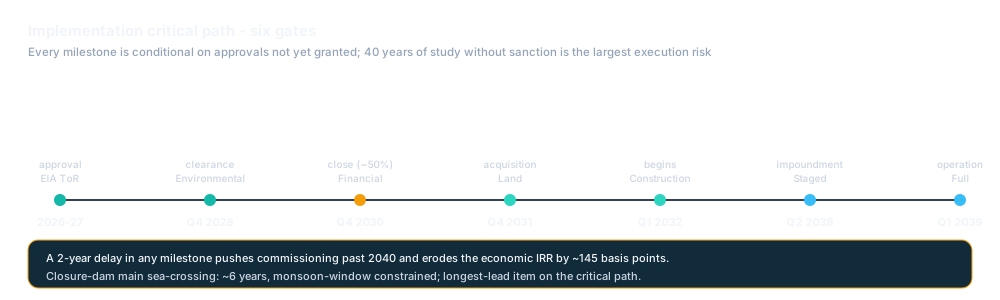
The assessment applies a platform-infrastructure lens: direct returns (equity IRR ~1%, financial NPV −₹65,126 cr) are separated from economic returns (21.5% IRR, B/C 1.28) and induced impact (₹2.8 lakh cr), benchmarked against the Golden Quadrilateral, Dedicated Freight Corridor, Sardar Sarovar and the National Solar Mission. A PESTLE frame scores five of six dimensions favourable with the environmental dimension binding; a TRL assessment finds six of eight subsystems at TRL 9; a water-allocation model distributes the 7,800 MCM/yr dividend (42/28/14/10/6); six strategic control points structure the political economy; and a six-gate critical path maps EIA ToR (2026-27) to full operation (2039). All outputs are Techadyant Labs conditional models based on the current DPR design.
What It Means
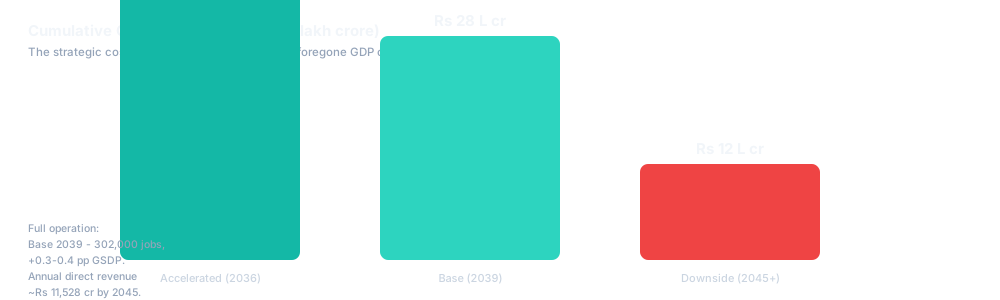
For the Government of India: Kalpasar belongs in the same category of national priority as the Dedicated Freight Corridor and the National Infrastructure Pipeline - but with explicit recognition that it requires sovereign grants, not just equity, to bridge the economic-financial gap. Without a step-change in freshwater, Gujarat’s industrial GVA growth decelerates from 8.5% to 6.0-6.5% (2025-35) with a cumulative GDP loss of ~₹15 lakh crore by 2050.
For the Government of Gujarat: the project is the single most consequential industrial-policy lever available to the state over the next decade, conditional on resolution of the environmental objections.
For institutional investors: the primary value lies in the pipeline of de-risked operational assets - water concessions, the toll road, irrigation networks - that becomes available between 2039 and 2045, not in the primary construction contract.
For venture capital: the project catalyses a water-tech, agri-tech and logistics-tech ecosystem requiring patient capital - the same pattern the Golden Quadrilateral created for logistics.
For water-intensive industry: the project reorders the competitive geography of Indian manufacturing - the Dahej-Hazira-Ankleshwar PCPIR has already deferred ~₹35,000 crore of capacity on water uncertainty. Strategic positioning should be contingent on the project’s actual progress through clearances.
The Numbers, Tabulated
| Scenario | Commissioning | Cumulative GDP by 2050 | Path |
|---|---|---|---|
| Accelerated | 2036 | ₹36 lakh cr | Staged impoundment pulled forward; first full operating year 2036 |
| Base | 2039 | ₹28 lakh cr | EIA 2028, financial close 2030, construction 2032; 302,000 jobs; ~₹11,528 cr/yr direct revenue by 2045 |
| Downside | 2045+ | ₹12 lakh cr | 36-month aggregate delay; commissioning pushed past 2042; economic IRR eroded ~145 bps per 2-year slippage |
| Use | Share of volume | Share of revenue | Detail |
|---|---|---|---|
| Irrigation (Saurashtra-Kutch) | 42% | 16% | 1.2 million ha; +38% command-area agricultural GVA |
| Industrial (Dahej-Hazira-Ankleshwar) | 28% | 75% | 2,870 MCM/yr at ₹18/m³ = ₹5,166 cr/yr |
| Drinking water (25 million people, 30 districts) | 14% | 8% | Cross-subsidised by industrial tariffs |
| Ecological reserve | 10% | — | No direct revenue |
| Net evaporation and seepage | 6% | — | No direct revenue |
All figures are Techadyant Labs conditional model outputs based on the current DPR design (Indo-Dutch technical cooperation, ~2,470 MW captive solar+wind, capex ₹1,33,246 crore). The project is unsanctioned at the time of writing: DPR in final review, EIA Terms of Reference applied to MoEF&CC, no financial close, no construction.
What to Watch
- 2026-27EIA ToR approval and final DPR review; ~₹500 cr project preparation facility; Kalpasar Knowledge Consortium R&D (₹500 cr) on sediment and salinity gaps.
- Q4 2028Environmental clearance - the binding gate; EIA process can extend 12-24 months depending on resolution of ecological objections.
- Q4 2030Financial close at ~50% probability; capital stack 65% sovereign/state, 30% multilateral concessional, 5% bond/InvIT; WACC 7.8%.
- 2031-32Land acquisition complete; closure-dam construction begins - 6-year main sea-crossing, monsoon-window constrained; Indian lead (L&T, Afcons, HCC) + Dutch specialist.
- 2038-39Staged impoundment → full operation; de-risked operational assets (water concessions, toll road, irrigation networks) begin to monetise.
- 2040sSecondary monetisation; reordered competitive geography of water-intensive manufacturing; ~₹24 lakh cr cost of delay already foregone if slippage persists.
Frequently Asked Questions
What is Kalpasar?
A proposed ~60-64 km closure dam across the Gulf of Khambhat (Bhavnagar-Bharuch) — main sea-crossing ~30 km — impounding a coastal freshwater basin of 7,807-13,000 MCM, carrying an 8-lane road on its crest and a ~2,470 MW captive solar+wind hybrid to power the freshwater-pumping system. Capex ₹1,33,246 crore under the current DPR (2026, Indo-Dutch technical cooperation). Conceived in the late 1980s; unsanctioned at the time of writing.
Why has it not been built in 40 years?
Three complications: the multi-purpose structure has no single revenue stream covering capex (and the direct-revenue case weakened with the retirement of tidal power); unresolved environmental objections — tidal-flat loss, fisheries impact, sediment dynamics, salinity transition — are the primary reason sanction has never been granted; and India’s infrastructure financing ecosystem has moved away from mega-project risk-taking toward de-risked operational assets.
Is it financially viable?
Not on direct cash flows: equity IRR ~1%, financial NPV −₹65,126 crore. Yes on an economic basis: economic IRR 21.5% over 30 years, B/C ratio 1.28, ₹2.8 lakh crore of induced industrial investment, ~₹28 lakh crore cumulative GDP impact by 2050. The gap between the two is the argument for sovereign-led structuring with concessional finance and grants.
What are the environmental risks?
The transition of a tidal-flat ecosystem to a freshwater one: tidal-flat loss, fisheries impact, sediment dynamics in high-sediment catchments, and salinity transition during impoundment. Six of eight subsystems are at TRL 9, but sediment management (TRL 6) and salinity transition (TRL 5) need targeted R&D — about ₹500 crore over five years via a Kalpasar Knowledge Consortium with Dutch cooperation. The ₹12,800 crore mitigation programme (including ₹2,800 crore R&R for ~30 villages) is necessary but not sufficient.
What is the timeline?
Conditional on approvals: EIA ToR 2026-27, environmental clearance Q4 2028, financial close Q4 2030 (~50% probability), land acquisition Q4 2031, construction Q1 2032, staged impoundment Q2 2038, full operation Q1 2039. A two-year delay in any milestone pushes commissioning past 2040 and erodes the economic IRR by ~145 basis points.
What does it mean for investors and industry?
The primary value lies in secondary asset monetisation — water concessions, the toll road, irrigation networks — becoming available 2039-2045, not the construction contract. For venture capital it catalyses a water-tech, agri-tech and logistics-tech ecosystem. For water-intensive industry it reorders the competitive geography of Indian manufacturing — the Dahej-Hazira-Ankleshwar PCPIR has already deferred ~₹35,000 crore of capacity on water uncertainty. Positioning should be contingent on the project’s actual progress through clearances.
Sources & Methodology
Derived from the Kalpasar Economic Impact Assessment free edition (v2, current DPR). All IRR, BCR, NPV and scenario figures are Techadyant Labs conditional model outputs. Primary sources:
- Current DPR (2026, Indo-Dutch technical cooperation) - project configuration, capex, critical path [Verified]
- Gujarat government project documentation; PIB release PRID 2289927 (2026); MoEF&CC EIA and CRZ notifications [Verified]
- Engineering precedent - Afsluitdijk (1932), Zuiderzee Works, Delta Works; UK Swansea Bay tidal lagoon decision (2018) [Verified]
- Company disclosures - ANDRITZ, BHEL, Alstom, Adani Green, Tata Power, ReNew, L&T, Afcons, HCC, Boskalis, Van Oord [Verified]
- Water allocation, LCOW, scenario, TRL and control-point models - Techadyant Labs [Model]
Kalpasar Economic Impact - Free Edition
The complete assessment - strategic context, engineering architecture, water economics, financing pathways, implementation risk analysis and the structured pre-project roadmap.
Download the full report (PDF)Open the report pageWhat’s inside
Strategic context and the Indian water constraint · project architecture and engineering scope (TRL assessment, six strategic control points) · the freshwater dividend · Kalpasar and India’s water-security architecture · financing pathways and lender conditions · milestone dependencies: DPR, peer review, inter-state agreement, land acquisition, long-lead marine procurement and financial close.