
The Indian Navy’s Autonomous Maritime Transformation, 2026–2035
Platforms are downstream of ecosystems. The ~₹1.2 lakh crore autonomous maritime market beneath USVs, UUVs, XLUUVs and naval UAVs — and the three substrate constraints that set its pace.

The Thesis
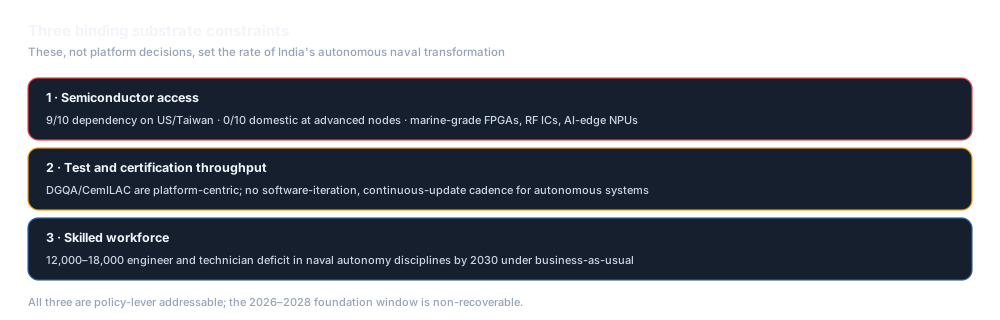
The Indian Navy’s autonomous transformation is technically feasible, industrially achievable and strategically necessary — but its pace is set by the industrial substrate, not by platform decisions. Three constraints bind: semiconductor access (9/10 dependency), test-and-certification throughput, and a 12,000–18,000-engineer workforce deficit by 2030. Address them and the Navy fields 80+ USVs, 25+ UUVs and 180+ naval UAVs by 2035 under the recommended ‘Autonomous Power’ scenario, with industry capturing ~₹1.2 lakh crore cumulatively. Address them late, and the default — ‘Indigenous but Inefficient’ at 35% probability — consolidates.
Key Numbers
Key Findings
Platforms are downstream of ecosystems
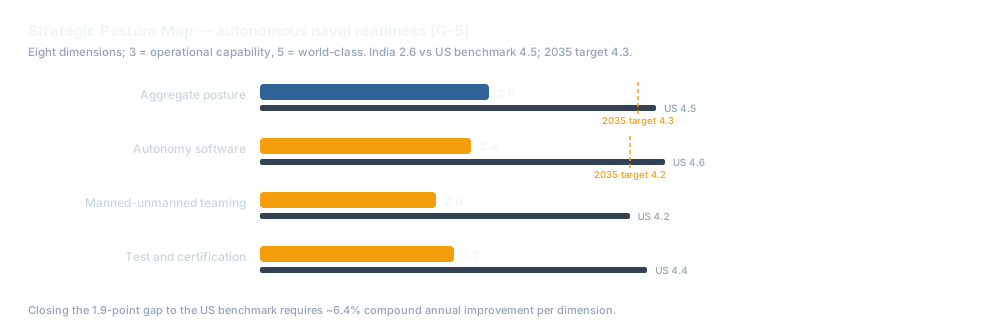
India scores 3.8 in platform design and 4.0 in marine engineering - but 2.4 in autonomy software, 2.0 in manned-unmanned teaming and 2.2 in test and certification. More USVs, UUVs and XLUUVs without proportionate substrate investment yield diminishing returns.
[Posture Map - Ch 1]The semiconductor wall
India’s dependency on US/Taiwan for marine-grade FPGAs, RF integrated circuits and AI-edge NPUs is 9/10, with 0/10 domestic capability at advanced nodes. The SCL 28nm fab is existential; the C-DAC NPU programme must triple in budget.
[Dependency Matrix - Ch 10]A ₹1.2 lakh crore market, anchored
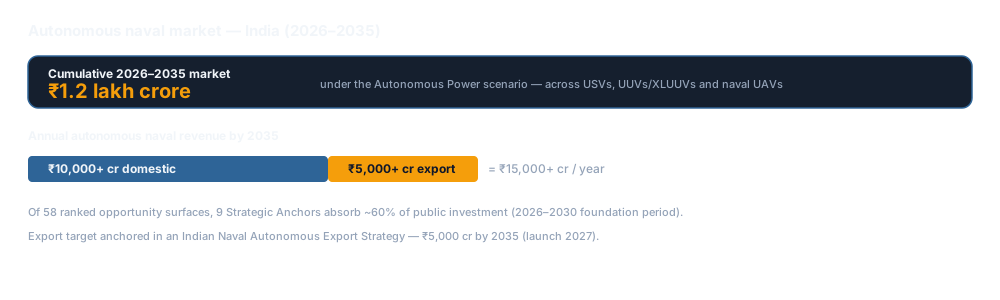
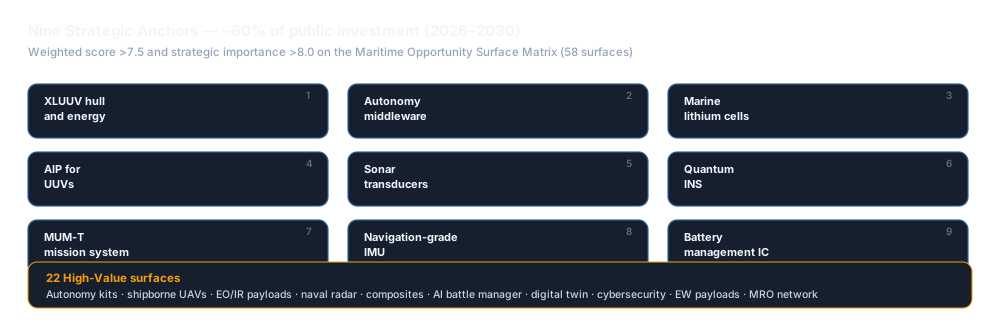
Cumulative 2026-2035 market of ~₹1.2 lakh crore; ₹15,000+ crore annual revenue by 2035, of which ₹5,000+ crore is export. Nine Strategic Anchors - XLUUV hull and energy, autonomy middleware, marine lithium cells, AIP, sonar transducers, quantum INS, MUM-T mission system, navigation-grade IMU, battery management IC - absorb ~60% of public investment.
[Ch 11 / Ch 12]MUM-T is the leverage
Without manned-unmanned teaming, India will have platforms without force multiplication. MUM-T scores 2.0 vs the US benchmark of 4.2. The report recommends a MUM-T Mission System programme office by 2027, with sovereign IP non-negotiable.
[Ch 6 / Ch 1]The default is not Autonomous Power
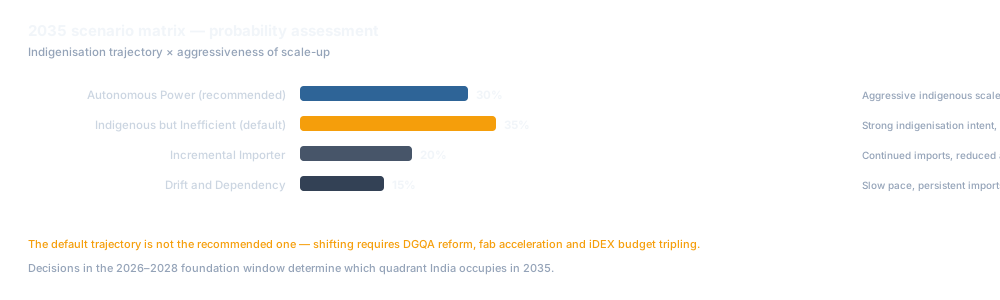
Four 2035 scenarios: Autonomous Power 30% (recommended), Indigenous but Inefficient 35% (default), Incremental Importer 20%, Drift and Dependency 15%. Shifting trajectory requires DGQA reform, fab acceleration and iDEX budget tripling.
[Ch 12]2026-2028 is non-recoverable
The foundation window: Autonomous Warfare Inspectorate (2026), MUM-T doctrine (2026), DRDO middleware consortium with sovereign IP (2026-27), ₹2,000 cr Quantum INS at RRI/IISc (2026-27). Substrate build-out takes 5-7 years; delay past 2028 forecloses the recommended trajectory.
[Ch 1 / Ch 12]The Framework
Six proprietary frameworks structure the assessment: the Naval Autonomy Readiness Framework (0–5 across eight dimensions), the Autonomous Maritime Stack (seven-layer reference architecture with TRL assessment), the Naval Industrial Readiness Index (comparator benchmarking), the Maritime Opportunity Surface Matrix (58 ranked surfaces across five scoring dimensions), the Naval Technology Dependency Matrix (supplier countries with severity scores), and the Industrial Multiplier Framework. Analysis is separated into three epistemic categories: established fact, analytical inference, and speculative assessment (future states, signalled with probability language). No claim of access to classified material; all analysis is open-source.
What It Means
For policymakers: reallocate programme budgets from platform acquisition to substrate investment. DGQA fast-track certification, SCL 28nm fab acceleration and a tripled iDEX budget shifted from breadth to depth are the highest-leverage interventions in the 2026-2028 window.
For industry: the 58-surface matrix names the products and the anchors; nine Strategic Anchors receive ~60% of public investment and demand sovereign IP. Export orientation must precede scale — the Israeli startup-led model, benchmarked against MAFAT, is more relevant than the US programme-led model.
For investors: a cumulative ~₹1.2 lakh crore market with ₹15,000+ crore annual revenue and ₹5,000+ crore export by 2035 under the recommended scenario. Anchor investment with sovereign-backed patient capital and export credit lines; the Industrial Multiplier Framework estimates downstream ecosystem value of each anchor programme.
The Numbers, Tabulated
| Scenario | Probability | Description |
|---|---|---|
| Autonomous Power (recommended) | 30% | Aggressive indigenous scale-up: 80+ USVs, 25+ UUVs incl. XLUUVs, 180+ naval UAVs; ₹15,000+ cr annual revenue by 2035 |
| Indigenous but Inefficient (default) | 35% | Strong indigenisation intent, slow scale-up, cost overruns, limited export traction |
| Incremental Importer | 20% | Continued imports, reduced autonomy ambition |
| Drift and Dependency | 15% | Slow pace, persistent imports, lost regional edge |
| Dependency | Severity | Supplier concentration | Note |
|---|---|---|---|
| Semiconductors | 8-10 | US / Taiwan | Marine-grade FPGAs, RF ICs, AI-edge NPUs; 9/10 dependency, 0/10 domestic at advanced nodes |
| AI compute | 8-10 | US | Training and edge inference capacity for fleet AI |
| Marine sensors | 8-10 | France / Israel | Sonar transducers (France); sensors, EW and autonomy IP (Israel) |
| Rare-earth magnets (NdFeB) | Material | China | Marine propulsion and sonar transducers |
| Scandium (advanced alloys) | Material | China | Lightweight alloys for hull and structures |
Dependency severity on the Naval Technology Dependency Matrix: 8-10 critical. Mitigation pathways exist for each but require 7-10 year horizon investment.
What to Watch
- 2026Foundation decisions due - Autonomous Warfare Inspectorate, unclassified MUM-T doctrine, DGQA fast-track certification path for autonomous systems.
- 2026-27SCL 28nm fab construction launch; DRDO autonomy middleware consortium with sovereign IP clause; ₹2,000 cr Quantum INS anchored at RRI/IISc; five Centres of Excellence (IITB, IITM, IISc, IITD, INSE); iDEX budget tripled.
- 2027-28L&T / Cochin Shipyard XLUUV hull programme fast-track; DRDO NMRL AIP fuel cell scale-up to 200 kW; Indian Naval Autonomous Export Strategy (₹5,000 cr target by 2035).
- 2028End of the foundation window - beyond this, the Autonomous Power trajectory consolidates out of reach and the default scenario firms up.
- 2035Autonomous Power outcome: 80+ USVs, 25+ UUVs, 180+ naval UAVs; ₹15,000+ cr annual revenue, ₹5,000+ cr export; or the 35%-probability Indigenous but Inefficient default.
Frequently Asked Questions
How ready is the Indian Navy for autonomous operations?
India scores 2.6/5 on the Techadyant Strategic Posture Map - a 'developing' posture - against a US Navy benchmark of 4.5 and an Indian 2035 target of 4.3. The gap is ~1.9 points, requiring ~6.4% compound annual improvement per dimension across eight dimensions. The weakest dimensions are autonomy software (2.4), MUM-T (2.0) and test and certification (2.2).
What are the three binding constraints?
Semiconductor access (9/10 dependency on US/Taiwan, 0/10 domestic at advanced nodes - marine-grade FPGAs, RF ICs, AI-edge NPUs); test-and-certification throughput (DGQA/CemILAC are platform-centric and lack the software-iteration cadence autonomous systems need); and skilled workforce (a 12,000-18,000 engineer and technician deficit by 2030 under business-as-usual).
What is the market opportunity?
A cumulative ~₹1.2 lakh crore autonomous maritime market over 2026-2035 under the Autonomous Power scenario - 80+ USVs, 25+ UUVs including XLUUVs, and 180+ naval UAVs by 2035 - with ₹15,000+ crore in annual revenue by 2035, of which ₹5,000+ crore is export. The Maritime Opportunity Surface Matrix ranks 58 industrial opportunity surfaces.
What are the nine Strategic Anchors?
XLUUV hull and energy, autonomy middleware, marine lithium cells, AIP for UUVs, sonar transducers, quantum INS, MUM-T mission system, navigation-grade IMU, and battery management IC. Each has a weighted score above 7.5 and strategic importance above 8.0; the nine should collectively absorb approximately 60% of public investment in the sector over 2026-2030.
Why is 2026-2028 the critical window?
The industrial substrate takes 5-7 years to build, and the foundation period is non-recoverable. Key decisions in the window: stand up an Autonomous Warfare Inspectorate, publish a MUM-T doctrine, anchor a DRDO-led autonomy middleware consortium with sovereign IP, triple the iDEX budget, launch SCL 28nm fab construction, create a DGQA fast-track certification path, establish five Centres of Excellence, and anchor a ₹2,000 cr Quantum INS programme at RRI/IISc.
What happens without intervention?
The default trajectory is 'Indigenous but Inefficient' (35% probability): strong indigenisation intent but slow scale-up, cost overruns and limited export traction, leaving India dependent on imports for its most advanced autonomous systems through 2035 - while the PLAN's USV/UUV capability gap (2-3 points in 2026) continues to widen.
Sources & Methodology
Derived from The Indian Navy’s Autonomous Maritime Transformation 2026–2035 Edition 1 (2026). Epistemic categories: established fact / analytical inference / speculative assessment. Primary sources:
- MoD Annual Reports; DRDO Annual Reports; Parliament Standing Committee on Defence; DDP disclosures; Indian Maritime Doctrine and MCPP [Verified]
- Positive Indigenisation Lists 1.0-4.0; Defence Acquisition Council approvals; Integrated HQ (Navy) statements [Verified]
- Industrial disclosures - BEL, MDL, CSL, L&T, TASL, Adani Defence & Aerospace [Verified]
- Comparator navies: US Navy (LUSV, MUSV, Orca XLUUV, MQ-25 Stingray), Royal Navy NavyX/RNUAS; IISS Military Balance; US DoD China Military Power Report [Verified]
- Anonymised industry interviews, Q4 2025-Q2 2026; Techadyant proprietary frameworks [Estimate]
Get the Full Report
153-page PDF · 12 chapters · 6 proprietary frameworks · 58-surface opportunity matrix and full appendices (Report + Data pack).
Buy Report - ₹5,900Report + Data pack - ₹10,900Free Condensed Edition
15 pages - the thesis, the frameworks and the headline findings, with figures.
15-page condensed edition (PDF). Free to read here; subscribe with an email to download the PDF. We'll also tell you when this assessment changes.
Free · no spam · unsubscribe anytime · privacy policy