
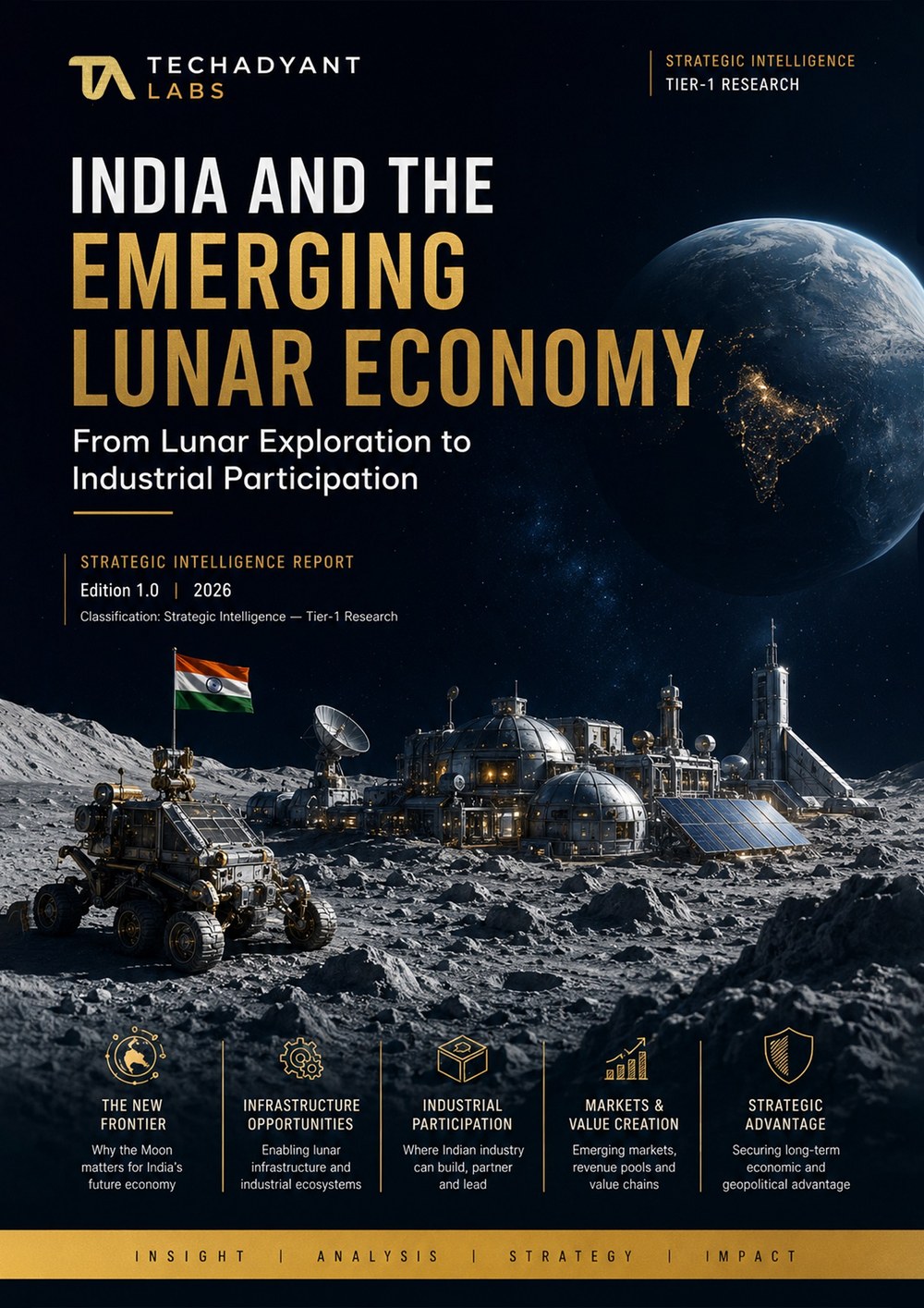
A narrow, decisive window
The lunar economy is emerging — but India is structurally under-positioned. India accounts for roughly 3.3% of cumulative announced lunar-programme investment (about USD 6 billion of an indicative global USD 181 billion through 2024–2035), a budget roughly one-ninth the size of NASA's and one-sixth that of China's. Yet its strategic position is more robust than its budget suggests. The report's central finding is that India has a narrow, decisive window — 2026 to 2032 — to convert demonstrated precision-landing capability and its post-2023 policy reforms into a strategically significant position in selected lunar value-chain segments. Miss the window and India is relegated to spectator status for the subsequent industrial phase; act within it and even a modest global scenario yields substantial Indian value.
India's distinctive capability
Chandrayaan-3 demonstrated autonomous precision landing at the lunar south pole at a programme cost of approximately USD 75 million — roughly one-twentieth of equivalent NASA programmes. This is India's most defensible capability, and the anchor around which adjacent contributions can be organised. Decomposed into thirteen layers, the lunar value chain shows India with Tier-1 potential in five — launch, landing, communications ground segment, science instruments and commercial services — and Tier-2 or Tier-3 standing in the deeper layers of surface power, resource extraction, manufacturing and habitation.
The industrial-base gap
The binding constraint is industrial, not scientific. India's supply-chain dependency audit identifies an estimated 90–95% import dependence in radiation-tolerant processors, space-grade multi-junction solar cells and travelling-wave tube amplifiers. Without closing the radiation-tolerant-electronics gap, India cannot supply Tier-1 components into the Artemis supply chain, regardless of how much mission investment is committed. Closing it requires a multi-track strategy — FDI-enabled partnerships, targeted indigenous build-out and bilateral technology access under iCET — sequenced alongside India's broader Semiconductor Mission.
Where India can capture value
India can realistically capture value in eight opportunity surfaces spanning three tiers — five Tier-1 (near-term, capability-aligned: instruments, ground segment, lunar analytics, lander avionics and launch services), three Tier-2 (build-required: propulsion components, thermal-protection materials, navigation algorithms) and long-horizon Tier-3 surfaces. The direct addressable market is meaningful but not transformative — on the order of USD 250–450 million a year by 2030–2032, scaling toward USD 400–800 million by 2035. Tier-1 opportunities are bankable today on validated government-science demand; Tier-2 and Tier-3 depend on speculative commercial demand and should be sequenced, not front-loaded.
The bigger prize is terrestrial
The larger prize is not lunar commerce but the terrestrial industrial capability the programme forces into being. India's projected direct lunar return to 2040 is on the order of USD 4–28 billion across scenarios; the indirect terrestrial spillover — radiation-hardened electronics, precision manufacturing, autonomous robotics, advanced materials and energy storage feeding defence, manufacturing and electronics — is on the order of USD 18–95 billion, roughly three-to-five times larger. The report recommends framing lunar investment explicitly as “terrestrial industrial capability uplift via a lunar programme” — a framing that broadens political support, attracts patient capital and justifies the public quantum even where lunar commercial returns stay speculative.
Six strategic moves
The strategy is a coherent, sequenced system of six moves: M1 Artemis Anchor (position India as a Tier-2 contributor into the Artemis supply chain), M2 National Lunar Programme (a dedicated programme office with budgetary authority), M3 Lunar Technology Mission (co-funded capability build-out), M4 post-LUPEX ISRU Pilot (an oxygen-extraction demonstration, sequenced after Chandrayaan-4 sample return), M5 Industrial Anchor-Supplier (NSIL anchor-tenant demand), and M6 Spillover Industrial Clusters (defence, manufacturing and electronics clusters that monetise the terrestrial spillover). M1 and M2 must be activated in 2026–2028 — that window is the binding constraint on India's 2040 trajectory.
What the full report adds
The full ~127-page edition carries all fourteen chapters — the emergence test, the global infrastructure race, the thirteen-layer value chain, India's current position, the technology and supply-chain gaps, the opportunity surfaces, the India–US strategic position, geopolitical competition, industrial spillovers, investment implications, policy strategy, the 2030/2040 scenarios and the strategic conclusion — with 37 figures and eleven appendices (company, startup, policy and funding databases; the technology glossary; a standards reference; a nation comparison; supplier, investment and regulatory directories; and a strategic reading list). The companion thirteen-sheet Lunar Economy Intelligence Workbook is available with the data tier.
Unlock the complete report
You’re reading the free preview. The full analysis continues with six more sections and the downloadable PDF edition.
- 🔒04 · Water, power & land
- 🔒05 · The packaging layer
- 🔒06 · Who captures the value
- 🔒07 · The talent constraint
- 🔒08 · Second-order effects
- 🔒09 · What to watch · references
You’ll be asked to sign in, then complete a one-time secure purchase.