
The Thesis
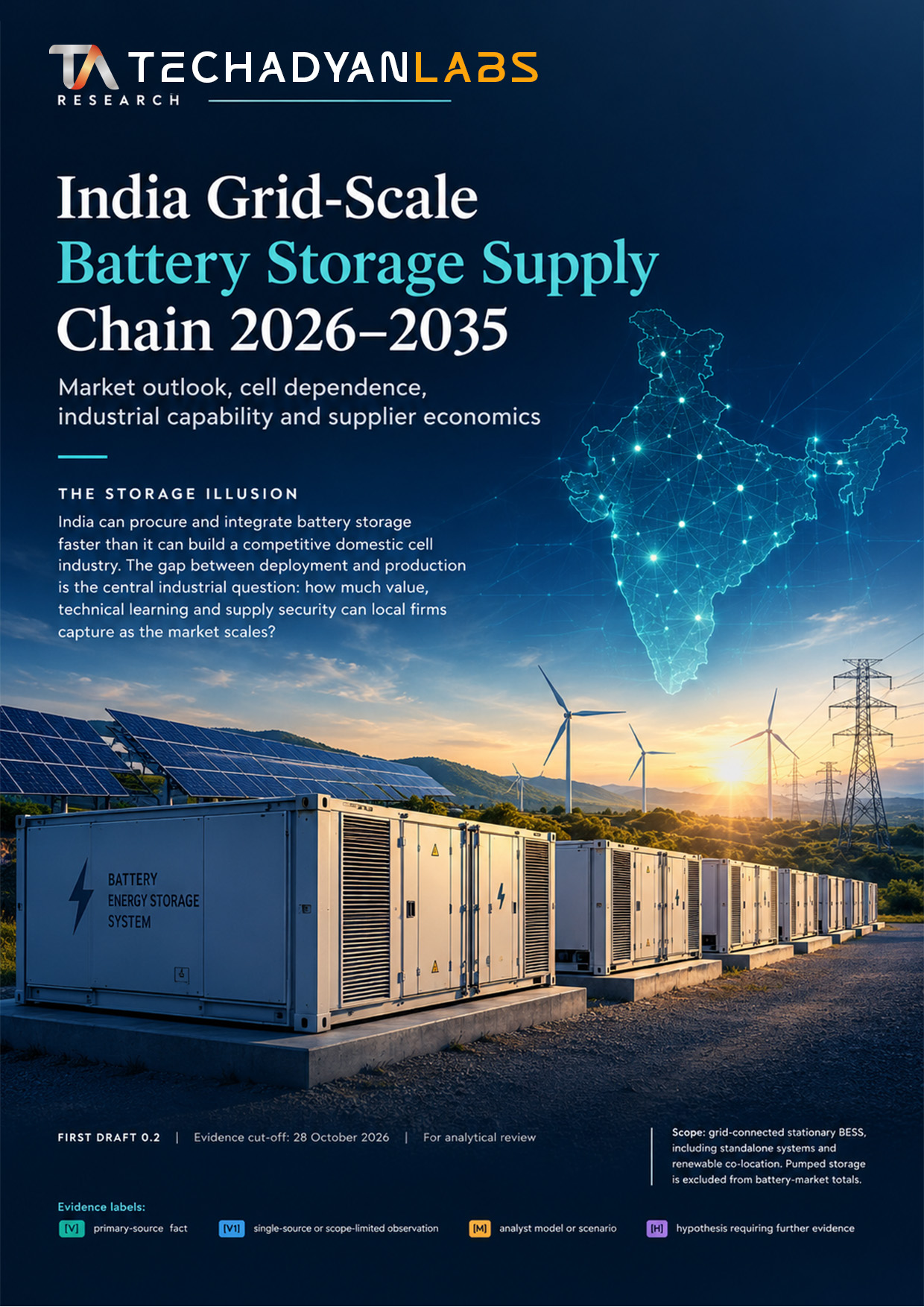
India can procure and integrate grid-scale battery storage faster than it can build a competitive domestic cell industry. The central industrial question is how much value, technical learning, and supply security local firms can capture in integration, power electronics, and lifecycle services while domestic electrochemical production scales. Deployment is scaling, but execution and domestic cell manufacturing remain separate bottlenecks.
As of 30 June 2026, the Ministry of Power reported an aggregate national pipeline of 46.69 GW / 148.53 GWh across tendering, awarded, and under-construction stages. Against this, the Central Electricity Authority (CEA) establishes a structural 2031–32 planning requirement of 47.24 GW / 236.22 GWh for BESS. Under the ₹18,100 crore ACC PLI programme, 40 GWh has been awarded, but reported installed nameplate plant capacity stood at 1.4 GWh in July 2026. This report maps the supply chain, evaluates domestic value capture, and presents a sequenced decision agenda for 2026–2035.
Key Numbers
Key Findings
Planning signal is concrete
CEA links storage to a system plan specifying 47.24 GW and 236.22 GWh for 2031–32.
CEA NEP [V]Procurement outpaces commissioning
15.75 GW is under construction and 11.75 GW awarded, but these are distinct stage buckets, not operating stock.
MoP Jun 2026 [V]Cell localization is a production question
MHI reports 40 GWh awarded under ACC PLI but only 1.4 GWh installed plant capacity as of July 2026.
MHI [V]Value capture can rise before cell self-sufficiency
Integration, PCS, controls, and fire systems create local value even with imported cells. Measure each layer.
Techadyant Model [M]Execution determines the realized market
Payment security, grid connection, and degradation guarantees govern pipeline conversion from tender to COD.
Techadyant Analysis [M]Upstream materials remain a chokepoint
Global refining concentration for key energy minerals rose to 86% in 2024, impacting LFP supply chains.
IEA [V]Tariffs are products of contract design
A SECI award of ₹10.835 lakh per MW per month for 500 MW/1,000 MWh is a capacity charge, not a universal LCOS.
MoP [V]The Framework
Techadyant Labs utilizes the Storage Sovereignty Index (SSI) and Storage Value Capture Ratio (SVCR) to measure domestic value added retained across ten supply-chain layers, net of imported intermediates. The Pack-to-Cell Gap Ratio (PCGR) tracks domestic operational pack nameplate against operational cell nameplate to quantify electrochemical dependence without conflating announcements with qualified output.
What It Means
For Policymakers
Publish consistent tender and commissioning data; tie PLI and VGF support to auditable factory milestones, eligible output, and value addition while preserving technology flexibility.
For Industry
Prioritize yield, qualification, and serviceability. Separate nameplate capacity from commercial output and target near-term opportunities in BMS, thermal management, and testing.
For Investors
Use milestone-weighted pipelines and downside cash flows. Treat uncontracted merchant revenues and announced GWh as risk until plant-level qualification is verified.
Analytical Figures
The Ministry of Power's June 2026 snapshot reveals a substantial pipeline, but stage discipline is required to avoid double-counting. The following visualization separates the reported status buckets to clarify the actual execution horizon.
Value capture in the Indian BESS market is not limited to cell manufacturing. The Storage Sovereignty Index maps domestic value addition across ten distinct layers, revealing where local firms can compete today despite imported cells.
Deployment trajectories through 2035 depend on execution bottlenecks and manufacturing ramp-up. The following scenarios illustrate how grid readiness, financing, and domestic cell qualification dictate the realized market size.
The Numbers, Tabulated
ACC PLI Beneficiaries: Awarded vs. Installed
| Beneficiary Firm | Awarded Capacity | Installed (Mar 2026) | Evidence Boundary |
|---|---|---|---|
| ACC Energy Storage Pvt. Ltd. | 5 GWh | 0 GWh | Site progress requires refreshed evidence. |
| Ola Cell Technologies Pvt. Ltd. | 20 GWh | 1 GWh | Pilot production reported; stable output not stated. |
| Reliance New Energy Battery Storage Ltd. | 5 GWh | 0 GWh | Award and land status reported; output not established. |
| Reliance New Energy Battery Ltd. | 10 GWh | 0 GWh | Awarded in 2025; commissioning milestones to verify. |
| Total | 40 GWh | 1 GWh | Jul 2026 MHI reply later reports 1.4 GWh at scheme level. |
Scenario Outputs at 2035
| Scenario | Annual Additions [M] | Domestic Value Capture [M] | Illustrative System Value [M] |
|---|---|---|---|
| Constrained | 39 GWh | 20.3% | ₹124,800 crore |
| Base | 60 GWh | 35.0% | ₹192,000 crore |
| Accelerated | 90 GWh | 49.8% | ₹288,000 crore |
What to Watch
- 2026–27 Final award and programme agreement for the 10 GWh stationary ACC PLI round.
- 2028 Review of ESO compliance and VGF delivery against actual project commissioning.
- 2029–30 Energy Storage Obligation reaches 4% of electricity consumption.
- 2031–32 CEA target of 47.24 GW / 236.22 GWh BESS requirement.
Frequently Asked Questions
How much battery storage does India need by 2031–32?
What is the ACC PLI scheme outlay and target?
How much BESS capacity is under construction?
Is battery storage mandatory for all renewable projects from July 2027?
What is the illustrative turnkey system cost used in the model?
Sources & Methodology
This independent market-structure analysis covers grid-connected stationary batteries in India. Evidence cut-off is 28 October 2026. Primary sources include:
- CEA, National Electricity Plan 2022–32, Volume I: Generation (notified May 2023).
- Ministry of Power, National Framework for Promoting Energy Storage Systems (Aug 2023).
- Ministry of Heavy Industries, ACC PLI scheme progress replies (Mar & Jul 2026).
- Ministry of Power, Rajya Sabha replies on BESS pipeline & safety regulations (Jul & Aug 2026).
- International Energy Agency, Global Critical Minerals Outlook 2025.
Get the Full Report
The full 68-page report runs the complete market analysis, pipeline conversion model, domestic cell gap audit, tariff comparability benchmarks, 2026–2035 scenarios, and the complete stakeholder decision agenda.
Full Report — Digital Edition
The complete strategic-intelligence report — pipeline analysis, Storage Sovereignty Index, ACC PLI progress, project economics, and three 2035 scenarios. Instant, secure PDF delivery after purchase.
Purchase Full ReportReport + Data edition (₹11,999) adds the full Excel workbook — demand model, BOM cost model, Opportunity Registry, and scenario models, all live. Institutional licensing: [email protected]. GST applicable.
Free Condensed Edition
Read the thesis, the headline numbers, the key findings, and the executive summary before you buy. Forward-looking figures are disclosed as conditional Techadyant modelled cases.
Read the free teaserDelivered as a 16-page preview PDF from the Techadyant Labs library.
Unlock the complete report
You’re reading the free preview. The full analysis continues with six more sections and the downloadable PDF edition.
- 🔒04 · Water, power & land
- 🔒05 · The packaging layer
- 🔒06 · Who captures the value
- 🔒07 · The talent constraint
- 🔒08 · Second-order effects
- 🔒09 · What to watch · references
You’ll be asked to sign in, then complete a one-time secure purchase.