
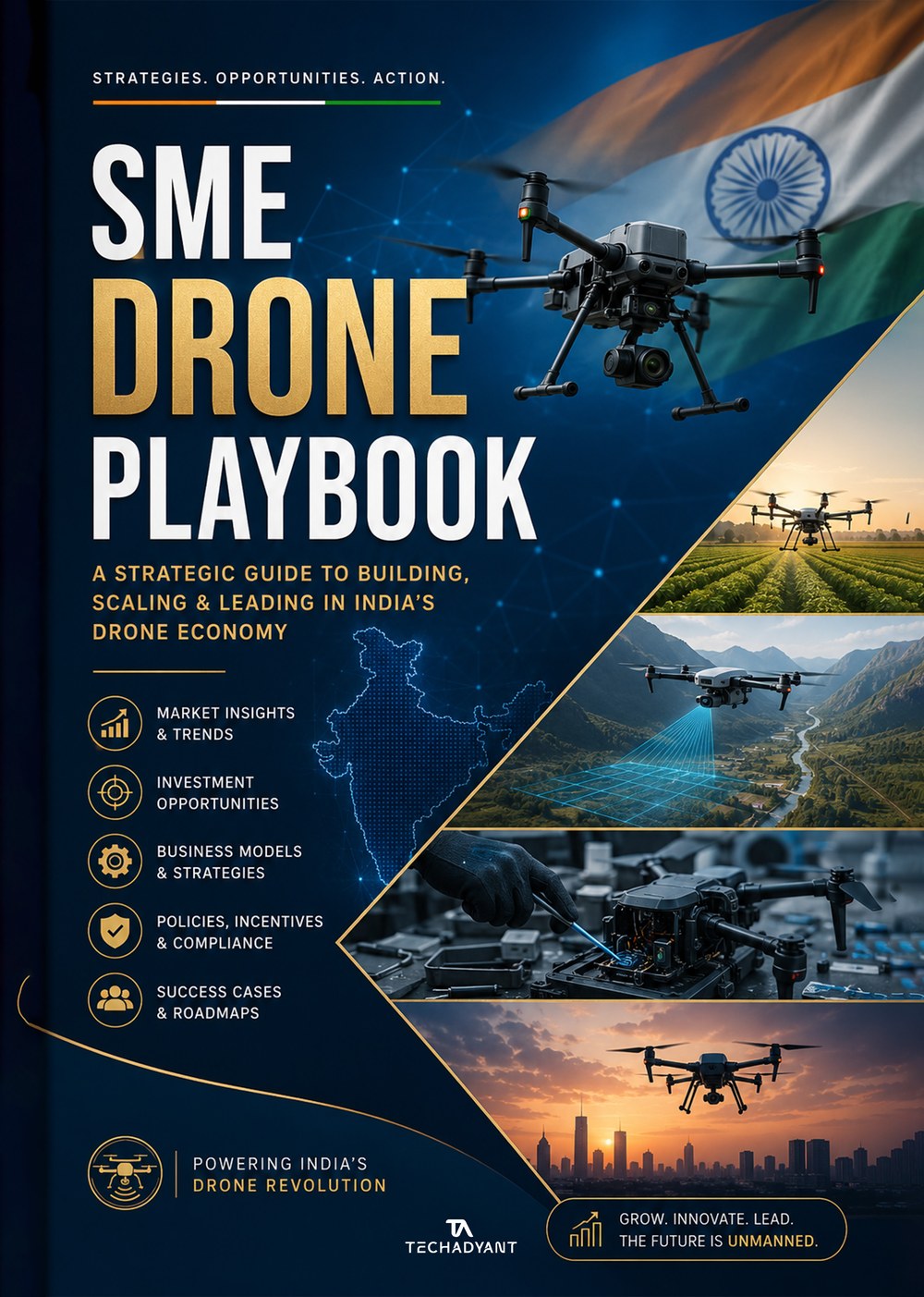
A structured industry, and a window
India's drone economy has crossed the line from experiment to industry. What was a niche, pilot-programme sector is now regulated, structured and commercially viable, with more than 38,500 registered drones, 39,890 DGCA-certified pilots and 244 approved Remote Pilot Training Organisations (RPTOs) as of February 2026. This report is written for a specific reader: the investor or operator with ₹50 lakh to ₹5 crore to deploy, who wants to know not that the sector is growing but which business inside it to build, at what margin, over what payback, and with what risk. The answer is uneven across segments — and, as with every Techadyant opportunity report, the unevenness is where the opportunity lives.
The market in numbers
India's drones market was valued at roughly USD 798 million in 2025 and, at a compound growth rate near 17.3%, is projected to reach about USD 3.93 billion by 2035 (Expert Market Research). Estimates vary by scope — across Research and Markets, IMARC, TechSci and others the 2030–2035 projection spans USD 1.39 billion to USD 3.93 billion, at CAGRs from 8.45% to 24.4% — but every credible source agrees on the direction and the steepness. Commercial drones alone were valued near USD 879 million in 2025. The market is modest today and steep tomorrow; the slope of the curve, not its 2026 level, is what a builder should position against.
The ₹50 lakh–₹5 crore sweet spot
This capital band is neither too small to be irrelevant nor too large to require institutional backing. It is the SME sweet spot — enough to build a credible operation in MRO, training, inspection, fleet operations or software, without the balance sheet a capital-intensive OEM demands. Three forces converge to make the timing unusually favourable: policy tailwinds (the PLI scheme, and an expected ~₹10,000 crore Drone Shakti incentive in Budget 2026), regulatory maturity (simplified type certification, the DigitalSky single-window platform, expanded permissions), and market pull (from Operation Sindoor's defence-procurement urgency to Namo Drone Didi's 1,094 drones deployed with women's self-help groups). Demand is broad-based and accelerating at the same moment entry barriers are falling.
Eight segments, scored
The report scores eight business segments on four dimensions that actually decide an SME's fate: capital required, gross-margin ceiling, payback period, and SME suitability. Software leads on margin (60–85%) but is a technology-first game; among physical businesses, MRO, training and inspection services stand out — each rated ‘Very High’ on SME suitability, each enterable from ₹50 lakh–₹3 crore, each paying back inside 12–24 months. Manufacturing and payload systems offer strategic depth but demand more capital (₹2–5 crore) and patience (24–48 month paybacks). The matrix below ranks the segments by margin ceiling and carries the capital, payback and suitability read-out alongside.
Where the value actually accrues
The report's organising insight is that value in India's drone economy does not sit in airframe assembly. Assembly is crowded, capital-heavy and thin-margin — the layer where India already competes hardest and captures least. Value concentrates instead at the two ends of the chain: upstream, in components, where import dependence and therefore substitution opportunity are highest; and downstream, in the aftermarket and services layer — MRO, training, inspection, fleet operations and software — that rides on top of every airframe sold. For an SME, the services layer is the defensible position: it needs less capital, pays back faster, and does not put a first-time operator head-to-head with a well-funded OEM.
The policy tailwinds
The existing Production-Linked Incentive scheme (2021–2024) carried a ₹120 crore outlay and up to 20% of value addition, with MSME-friendly eligibility thresholds (₹2 crore turnover for drones, ₹50 lakh for components) covering airframe, propulsion, batteries, flight control, communication systems, cameras, sensors and spraying systems. Budget 2026 is expected to raise the ambition sharply: a two-tier Drone Shakti / PLI 2.0 of roughly ₹10,000 crore over five years (10–15% capex subsidy plus 10–15% output-linked), with a 50–60% domestic-content requirement and a 40% critical-component localisation target by FY 2027–28. Layered on the New Drone Rules 2021, the Drone Airspace Map and the DigitalSky platform, the policy stack materially de-risks a well-timed entry — which is why the 2026–2028 window matters.
Entry points by investor profile
The report maps recommended entry points to investor profiles rather than prescribing one path. A defence-aligned SME is pointed at component manufacturing, where Operation Sindoor's urgency and the localisation mandate converge. An agri-tech entrepreneur is pointed at agri-spraying fleet operations, riding the Namo Drone Didi demand base. A technology-first founder is pointed at software and payload systems — the lowest capital intensity and the highest margins. A services-led operatoris pointed at inspection services and MRO for their low entry barriers and quick payback. And a diversifying component manufacturer is pointed at a manufacturing-plus-MRO combination that leverages existing capability. Each of these has a step-by-step entry roadmap in the full report.
What the full report adds
The full ~172-page edition carries all thirteen chapters: the macro picture and the investment-decision framework (Chapters 1–3), then a dedicated deep dive for each of the eight segments (Chapters 4–11) — manufacturing, MRO, fleet operations, training, payload systems, software, infrastructure and inspection services — each with market sizing, competitive landscape, unit economics and a detailed Actionable Entry Roadmap. It closes with the full Investment Decision Matrix and risk-mitigation strategies (Chapter 12) and strategic recommendations for ecosystem development (Chapter 13), plus appendices covering the regulatory reference, the government-scheme catalogue, a directory of selected DGCA-approved RPTOs, a glossary and full sources. Twenty-six figures throughout, and an eight-segment scorecard designed to be used, not just read.
Unlock the complete report
You’re reading the free preview. The full analysis continues with six more sections and the downloadable PDF edition.
- 🔒04 · Water, power & land
- 🔒05 · The packaging layer
- 🔒06 · Who captures the value
- 🔒07 · The talent constraint
- 🔒08 · Second-order effects
- 🔒09 · What to watch · references
You’ll be asked to sign in, then complete a one-time secure purchase.