
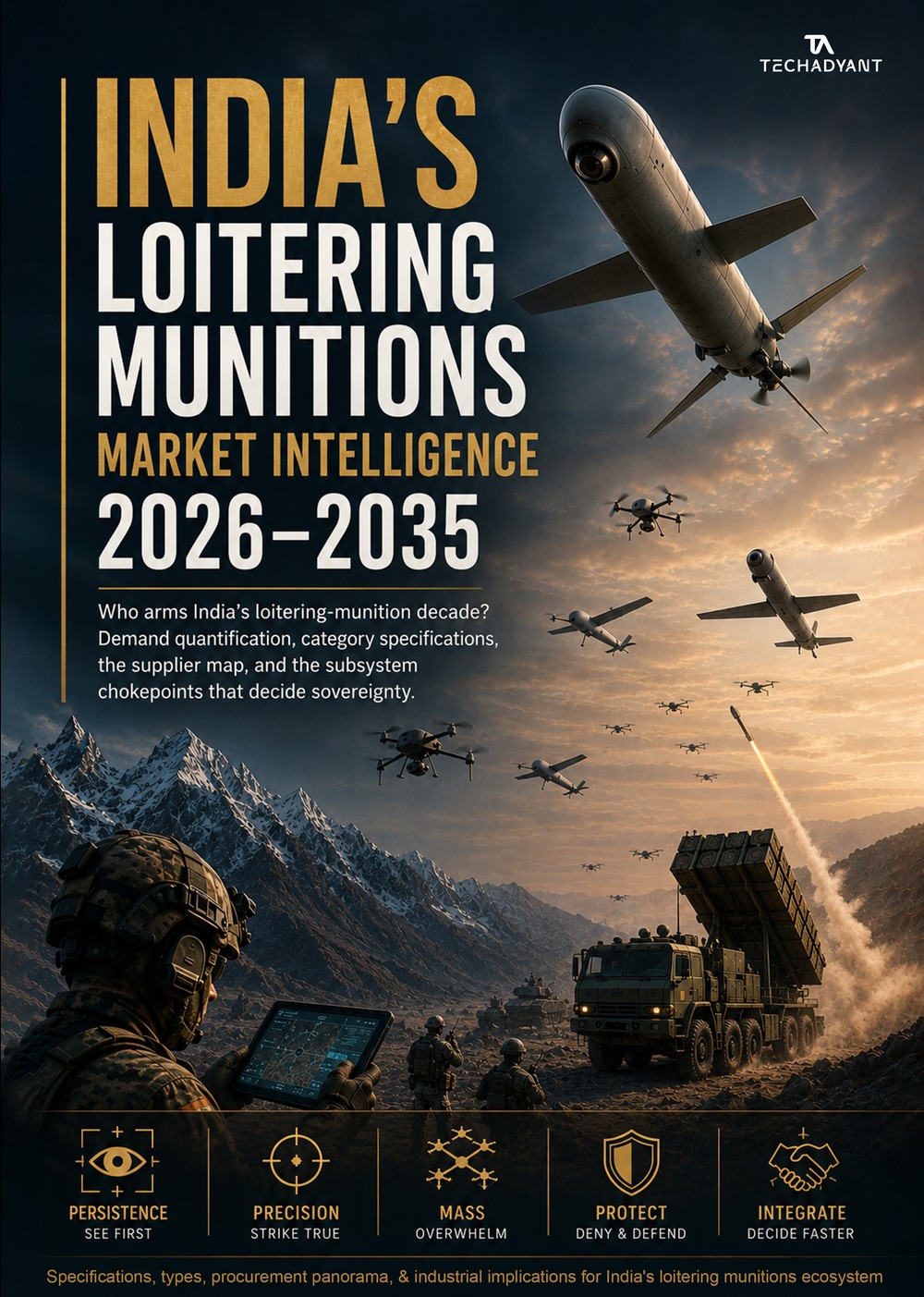
A sovereignty problem, not a capability one
India has entered a ten-year window in which loitering munitions move from the margins of its arsenal to the centre of its land-warfare doctrine. It can already build world-class systems — the Nagastra family, the Tata ALS-50, the DRDO ULPGM-V3, the licence-built SkyStriker. The harder question is not whether India can field the weapon, but whether it can sustain it: when the country buys hundreds of thousands of attritable precision munitions over the decade, how much of that value, and how much of the security that is meant to come with it, is actually captured at home? Read against India's own supply chain, the answer is uncomfortable. India can integrate and assemble loitering munitions superbly; the layers that decide whether it could rebuild the fleet under stress remain foreign. That gap — not the next prototype — is the strategic task of the decade.
The procurement signal is now on the record
Operation Sindoor in 2025 converted a doctrinal debate into a procurement fact. Within months the Ministry of Defence had exhausted a ₹9,100 crore emergency-powers ceiling and directed roughly four-fifths of the field-formation tranche to loitering and kamikaze systems. In December 2025 the Defence Acquisition Council cleared a package worth about ₹79,000 crore that, for the first time, named a “Loiter Munition System for Artillery Regiments.” The Union Budget for 2026-27 then raised the defence allocation to ₹7.85 lakh crore, carved out ₹1.85 lakh crore for capital acquisition, and earmarked 75% of that — ₹1.39 lakh crore — for domestic procurement, explicitly citing the post-Sindoor purchases. The demand is proven and primary-sourced; what is unresolved is who captures it.
Why the weapon changes the arithmetic
Every argument for loitering munitions reduces, in the end, to arithmetic. A first-person-view drone costing a few lakh rupees, or a loitering munition costing a few crore, can destroy armour, artillery, radars and air-defence launchers worth tens to hundreds of crore. The exchange runs in the attacker's favour by orders of magnitude, and it runs against the defender in reverse: intercepting a cheap munition with an expensive missile is a losing trade, which is why saturation works. The report formalises this as the Cost-Exchange Efficiency Curve, and draws the conclusion that governs the rest: the correct objective is not per-unit capability but cost-per-effect and replenishment rate — and replenishment is exactly what a foreign-dependent supply chain cannot guarantee.
Where India is exposed
Value and vulnerability both sit below the airframe. India is genuinely sovereign at the top of the stack — in warheads and explosives, in airframe design and integration, and, uniquely, in NavIC satellite navigation, which gives it an anti-jam advantage few competitors hold. It is dependent at the bottom, where the weapon is actually decided. Close to 90% of India's small-drone flight controllers are imported from China; roughly 84% of its lithium-ion cells; and the deepest dependency of all is the sintered neodymium-iron-boron magnet, with its dysprosium and terbium, which sits under every electric motor in the fleet and which China placed under export licensing in April 2025. India's buffer against a supply shock is measured in weeks; its remedies — the ₹7,280 crore magnet scheme and the ₹34,300 crore critical-mineral mission — do not reach scale before roughly 2028.
The eight frameworks
The report scores India's position on eight reproducible instruments. The LM-Sovereignty Indexgrades roughly forty subsystems on India's capability against the global leader. The SHAKTIBAAN Demand Model derives the ten-year requirement from force structure rather than assertion. The Attritable-Precision Value Stack shows where the money and the vulnerability sit in one munition. The Category-Attractiveness Matrix ranks the six loitering-munition categories on market attractiveness against Indian readiness. The Cost-Exchange Efficiency Curve formalises the procurement economics; the Indigenisation Readiness Ladder grades each subsystem from import to sovereign export; the Investment Priority Matrix scores the opportunity surfaces for capital; and the Procurement Sovereignty Clock sets out, as a datable sequence, what must be true by when for India's fleet to be genuinely its own by 2035.
Where to build now
For builders and investors the clearest conclusion is that the airframe is the crowded trade and the subsystem is the open one. The most defensible, least-contested positions sit in magnets, seekers, trusted flight controllers and anti-jam datalinks — the layers every prime needs and none owns. The highest-strategic-value layers score “Build-now” not because they are easy but because the demand is guaranteed and the substitution prize is largest.
| # | Opportunity surface | Why it is open | Tier |
|---|---|---|---|
| 1 | Sintered NdFeB magnets (Dy/Tb) | Deepest chokepoint; guaranteed offtake | Build-now |
| 2 | EO/IR seekers & detector integration | Contested frontier; import-substitution | Build-now |
| 3 | Trusted flight controllers | ~90% imported today | Build-now |
| 4 | Secure anti-jam datalinks | EW battlefield survival layer | Build-now |
| 5 | Drone-grade BLDC motors & ESCs | Scales with fleet; magnet-linked | Position-early |
| 6 | Edge-AI compute / trusted silicon | Autonomy & swarm premium | Position-early |
| 7 | FPV & short-range strike at scale | Highest-volume category | Position-early |
| 8 | Test, certification & sustainment | Throughput bottleneck; recurring | Position-early |
What Israel, Turkey and China teach
The countries that lead this field lead it because they own the upstream. Israel holds the seekers and the electronic-warfare depth — and routes almost all of the foreign technology transfer into India, through Elbit, IAI and now UVision. Turkey built export-grade capability from a standing start with a lever India lacks: a state expectation of 75%-plus domestic content that deliberately constructs a component base, of which Baykar's roughly 93% localisation is the proof. China controls an estimated four-fifths of the world's drone-component supply chain through the Shenzhen cluster. None of them leads by assembling well. India, which assembles well, must decide whether it wants to lead or merely to field.
A path to 2035
The realistic doctrine is selective sovereignty, not autarky. Build now what is ready — the high-volume categories, autonomy software, counter-UAS, certification capacity — and seed the hard layers in parallel; close the magnet, seeker and compute gaps as the critical-mineral and magnet schemes mature toward the end of the decade; and treat sovereignty as a schedule rather than a slogan. Whether India's fleet is genuinely its own by 2035 depends less on technology than on whether the industrial policy of 2025-2028 is executed.
What the full report adds
This online edition gives you the thesis, the procurement signal, the cost-exchange economics and the sovereignty map. The complete edition adds the full LM-Sovereignty Index across every subsystem, the transparent SHAKTIBAAN Demand Model and its three 2035 scenarios, the six-category specification matrix and Category-Attractiveness Matrix, the domestic and foreign supplier atlas with company profiles, the Investment Priority Matrix, the force-structure and operating concepts, and the procurement, budget and subsystem evidence base in full — six parts, seventeen chapters, 25 figures and the appendices.
Unlock the complete report
You’re reading the free preview. The full analysis continues with six more sections and the downloadable PDF edition.
- 🔒04 · Water, power & land
- 🔒05 · The packaging layer
- 🔒06 · Who captures the value
- 🔒07 · The talent constraint
- 🔒08 · Second-order effects
- 🔒09 · What to watch · references
You’ll be asked to sign in, then complete a one-time secure purchase.