
Q-Day India
India has roughly four years before exogenous deadlines - CNSA 2.0 (2030-2033), SWIFT’s migration programme, Quad interoperability - force a national post-quantum migration. A country that cannot guarantee the confidentiality of its own strategic communications has ceded a core function of statehood.

The Thesis
India is a cryptographic superpower on borrowed infrastructure. Aadhaar authenticates 1.4 billion residents, UPI processed 134 billion transactions in 2025, and GSTN, RTGS, the e-Rupee and defence C2 networks all rest on RSA and elliptic-curve cryptography that a sufficiently large quantum computer breaks. Beneath them, the trust infrastructure itself is imported: 92% of HSMs, the crypto libraries, the entropy sources. The migration to post-quantum cryptography is therefore not an IT project - it is a sovereignty event, and India is the only Quad member without a published national roadmap for it.
Key Numbers
Key Findings
The harvest is already happening
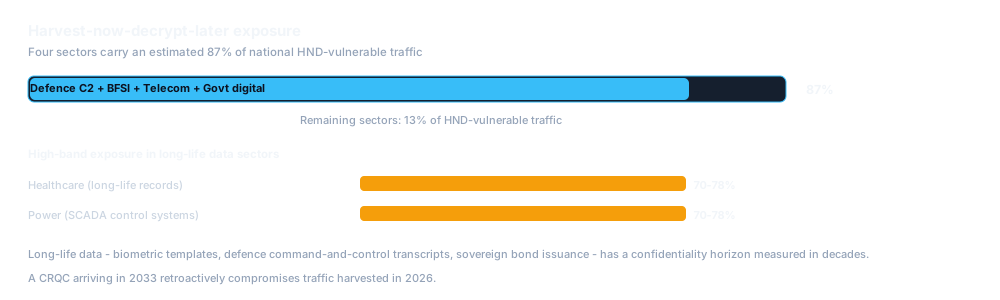
Harvest-now-decrypt-later is present tense, not a future risk: adversaries are capturing encrypted Indian government, defence and banking traffic today. A CRQC arriving in 2033 retroactively compromises data harvested in 2026. Biometric templates, defence C2 transcripts and sovereign records carry decade-scale confidentiality horizons.
[Ch 1 / Ch 3 - Verified]The trust infrastructure is 92% imported
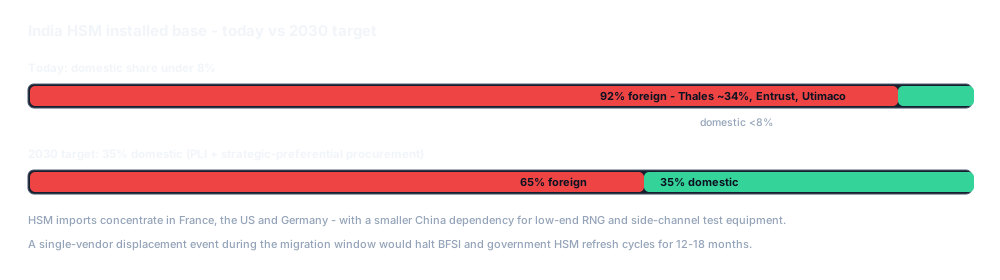
India’s HSM installed base is 92% foreign-sourced - Thales ~34%, Entrust and Utimaco the rest. Crypto libraries and entropy sources are imported too. A single-vendor displacement event during the migration window would halt BFSI and government HSM refresh for 12-18 months.
[Ch 3 / Ch 10 - Verified]Four sectors carry 87% of the exposure
Defence C2 networks, banking and capital markets, the telecom backbone and government digital infrastructure account for an estimated 87% of national HND-vulnerable traffic. Healthcare and power face high-band exposure (70-78%) through long-life records and SCADA systems.
[Exposure model - Ch 1]No mandate, no roadmap, no industry
As of January 2026 India is the only Quad member without a published national PQC roadmap. Domestic industry employs under 1,500 crypto engineers; startups hold under ₹150 crore of cumulative funding; the IT Act, DPDP Act, CERT-In directions and RBI guidelines nowhere reference PQC.
[Ch 3 / Ch 8 / Ch 9 - Verified]Defence interop is a 2030 binding requirement
CNSA 2.0 interoperability with US INDOPACOM systems is a 2030 binding requirement for joint-operational infrastructure. The Tactical Communication System, Air Defence Grid and Naval ACOTS networks carry multi-decade-confidentiality traffic and must adopt PQC-agile architectures by 2028.
[Ch 4 - Verified]The base case is Drift - until policy fires
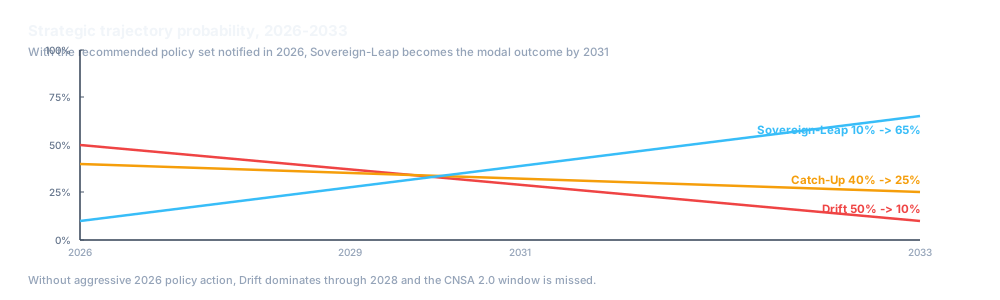
Without aggressive 2026 policy action, the Drift pathway dominates through 2028: compliance without sovereignty, foreign-controlled stack, HND exposure through the 2030s. With the recommended mandate set, Sovereign-Leap rises from 10% to 65% probability and becomes modal by 2031.
[Scenario model - Ch 14]The Framework
The report’s analytical core is a layered national cryptographic stack map - applications, protocols, libraries, HSMs and entropy sources - scored for HND exposure and sovereignty. A sectoral exposure model quantifies vulnerable traffic (87% in four sectors); a market-sizing cascade (TAM → SAM → SOM) sizes the domestic opportunity; a scenario model projects Sovereign-Leap, Catch-Up and Drift probabilities to 2033; and a five-pillar implementation roadmap sequences the 2026-2033 migration against CNSA 2.0, SWIFT and Quad deadlines. Every claim carries a confidence rating and every model a documented assumption set in the methodology section.
What It Means
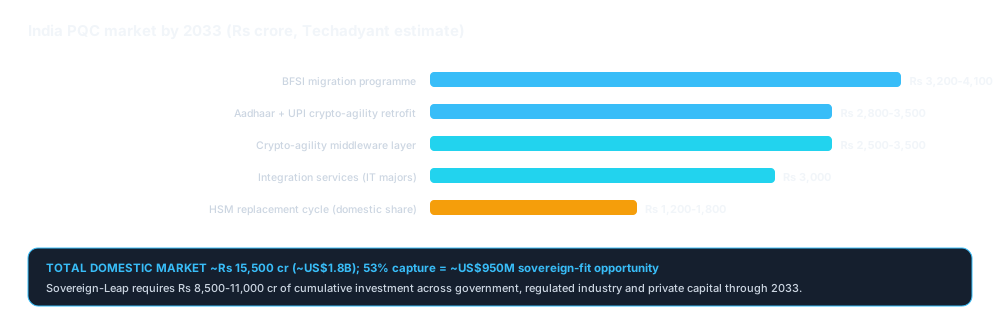
For the Government of India: the absence of a national PQC mandate is the single largest strategic gap in the country’s cybersecurity posture. A mandate notified in 2026 unlocks an estimated ₹8,500-11,000 crore of compliance-driven private-sector investment through 2033.
For the Reserve Bank of India: BFSI faces the highest absolute migration cost (₹3,200-4,100 crore over 2027-2033) but has the clearest regulatory template. The CBDC track is the leapfrog: a PQC-native e-Rupee by 2028 makes India the first major economy with a quantum-safe sovereign digital currency.
For the Ministry of Defence: CNSA 2.0 interoperability with US, UK, Australian and Japanese systems is a 2030 binding requirement. TCS, the Air Defence Grid and Naval ACOTS networks must adopt PQC-agile architectures by 2028, with sovereign-preferential procurement for crypto hardware.
For boards and CISOs: PQC migration is a capital-expenditure programme with a hard external deadline, not an R&D line item. Treat 2030 as the operational compliance year and 2033 as absolute; the cost-of-delay premium is an estimated ₹3,500-4,000 crore for the BFSI sector alone.
For investors: the Indian PQC market sits at the inflection point Indian cybersecurity occupied in 2015. Capital deployed in 2026-2028 - in HSMs, crypto-agility middleware and integration services - compounds at venture-grade returns through 2033.
The Numbers, Tabulated
| Scenario | 2026 probability | 2033 (with policy) | Outcome |
|---|---|---|---|
| Sovereign-Leap | 10% | 65% | Domestic PQC stack, 35% domestic HSM, third pole of global capability by 2033 |
| Catch-Up | 40% | 25% | PQC adopted broadly, but on foreign technology - compliance without sovereignty |
| Drift | 50% | 10% | CNSA 2.0 window missed; HND exposure through the 2030s; forced migration crisis mid-decade |
| Pillar | Action | Deadline |
|---|---|---|
| National PQC Mandate | MeitY notification with RBI, MoD, TRAI and MoP directions | 2026; phased 2027 / 2030 / 2033 |
| Sovereign PQC Stack | CDAC + DRDO with startups and IT incumbents - production KEM, signature, HSM, key orchestration | Production by 2028 |
| Domestic HSM build-out | PLI + strategic-preferential procurement; domestic share 8% to 35% | By 2030 |
| Crypto-agility retrofit | Aadhaar, UPI, CBDC, GSTN, defence C2, telecom backbone, SCADA | 2027-2031 |
| Talent and standards | Double PQC-trained crypto engineers every two years (15,000 by 2033); NIST, IETF, ISO JTC1 SC27, TSDSI representation | Continuous to 2033 |
Migration cost centres: BFSI ₹3,200-4,100 cr; Aadhaar + UPI retrofit ₹2,800-3,500 cr; crypto-agility middleware ₹2,500-3,500 cr cumulative; integration services ~₹3,000 cr by 2033. Domestic PQC industry employs fewer than 1,500 crypto engineers today; Sovereign-Leap needs ~7,500 by 2030 and 15,000 by 2033.
What to Watch
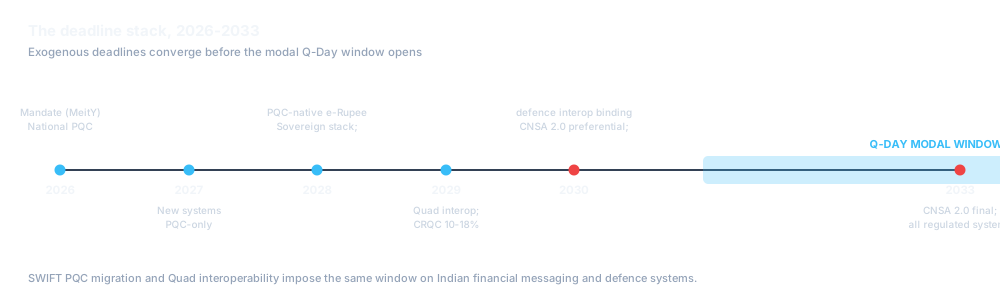
- 2026National PQC Mandate expected - unlocks an estimated ₹8,500-11,000 cr of compliance-driven private-sector investment through 2033.
- 2027New systems PQC-only; BFSI HSM replacement cycle begins (₹3,200-4,100 cr through 2033); Aadhaar and UPI crypto-agility retrofit funded (₹2,800-3,500 cr).
- 2028Sovereign stack production (CDAC/DRDO); a PQC-native e-Rupee makes India the first major economy with a quantum-safe sovereign digital currency; defence systems PQC-agile.
- 2029Quad PQC interoperability formalises into a treaty-grade arrangement with India as designated third pole; CRQC by this year is 10-18% probable.
- 2030CNSA 2.0 preferential deadline; defence interop binding; domestic HSM share at the 35% target.
- 2033The verdict: Sovereign-Leap (₹15,500 cr market, 15,000 engineers, third pole) or Drift (foreign-controlled stack, secrets in foreign HSMs).
Frequently Asked Questions
What is Q-Day and when is it?
Q-Day is the date a cryptographically relevant quantum computer becomes operational - one large enough to run Shor’s algorithm and break RSA-2048 and ECC-P256 in operationally relevant time. The modal expert estimate is 2031-2035, squarely inside the CNSA 2.0 compliance window; a CRQC by 2029 is non-trivially probable (10-18%).
What is harvest-now-decrypt-later?
An adversary intercepts and stores encrypted traffic today, then decrypts it once a CRQC becomes available. Because long-life data - biometric templates, defence command-and-control transcripts, sovereign bond documentation - has a confidentiality horizon measured in decades, HND makes PQC migration urgent before Q-Day, not after it. A CRQC in 2033 retroactively compromises traffic harvested in 2026.
What does India actually need to migrate?
Everything on RSA, ECDSA and ECDH: Aadhaar (1.4 billion identities), UPI (134 billion transactions in 2025), GSTN, RTGS, the e-Rupee CBDC, defence C2 networks and the telecom backbone. Beneath the applications, the trust infrastructure itself - HSMs (92% foreign), crypto libraries and entropy sources - is imported and must be replaced with PQC-capable, preferably sovereign, components.
What are the hard deadlines?
CNSA 2.0: 2025 software/firmware signing, 2030 preferential, 2033 final. SWIFT has run a PQC migration programme since 2024. Quad interoperability makes 2033 a de facto deadline for any Indian defence, intelligence or financial-messaging system touching US, UK, Australian or Japanese infrastructure. The report recommends Indian phases aligned to these: 2027 new systems, 2030 critical infrastructure, 2033 all regulated systems.
What would Sovereign-Leap cost and return?
Roughly ₹8,500-11,000 crore of cumulative investment through 2033 across government, regulated industry and private capital - against a domestic PQC market estimated at ₹15,500 crore by 2033 (about US$1.8B, with a 53% sovereign-fit capture yielding a ~US$950 million domestic opportunity). The strategic return is measured in sovereignty, not P&L: ownership of the cryptographic stack that protects Indian defence, financial and identity infrastructure through the post-quantum century.
What should an organisation do now?
Four actions in 2026: build a cryptographic inventory (algorithms, keys, HSMs, vendors); classify long-life data by confidentiality horizon; mandate crypto-agility for all new systems so primitives can be swapped without re-architecting; and plan HSM refresh with PQC-capable paths. Boards should treat 2030 as the operational compliance year and 2033 as absolute.
Sources & Methodology
Derived from the Q-Day India free edition, Strategic Risk 2026. Forward claims carry confidence ratings; model assumptions are documented in the Methodology section. Primary sources:
- NIST FIPS 203 (Kyber), 204 (Dilithium), 205 (SPHINCS+) - August 2024 [Verified]
- NSA CNSA 2.0 deadlines (2025 / 2030 / 2033); NCSC, ASD and NISC parallel roadmaps [Verified]
- SWIFT PQC migration programme (since 2024); RBI cyber-security framework; CERT-In directions (April 2022); DPDP Act 2023; MeitY NQM documents [Verified]
- Expert consensus surveys - ETSI, Global Risk Institute, NIST PQC forum; peer-reviewed quantum-roadmap literature 2024-2025 [Estimate]
- Industry disclosures - Thales, Entrust, Utimaco, PQShield, ISARA, Crypto4A; QNu Labs, BosonQ Psi, DataGrid; TCS, Infosys, Wipro, HCL [Verified]
- Techadyant Labs exposure, market-sizing, scenario and roadmap models [Model]
Q-Day India - Free Edition
The complete strategic-risk report - 17 chapters, 40 figures, sector deep-dives on defence, BFSI, telecom and government, plus the startup, policy, funding and supplier directories.
Download the full report (PDF)Open the report pageWhat’s inside
The Q-Day threat from theoretical to operational · global migration mandates and 2026-2033 deadlines · India’s cryptographic posture · four sectoral deep-dives · the PQC ecosystem · policy and regulatory framework · supply-chain vulnerabilities · the sovereign-security opportunity · the 2026-2033 implementation roadmap.