
The Hydrogen Mirage or Machine?
India committed ₹19,744 crore to the molecule. But the machine that makes it is ~60% Chinese-built and 100% dependent on imported platinum-group metals - and ten of nineteen value-chain components sit at critical risk.

The Thesis
India has built its green-hydrogen policy around the molecule - not the machine that makes it. The electrolyser is ~60% Chinese-manufactured and 100% dependent on imported platinum-group metals, and 10 of 19 value-chain components sit at High or Critical risk. The molecule can, in principle, be made without importing the machine. In current practice, it cannot. Closing this gap is the single largest determinant of whether the National Green Hydrogen Mission becomes an industrial-transformation programme or an import-substitution programme in reverse.
Key Numbers
Key Findings
The machine is Chinese
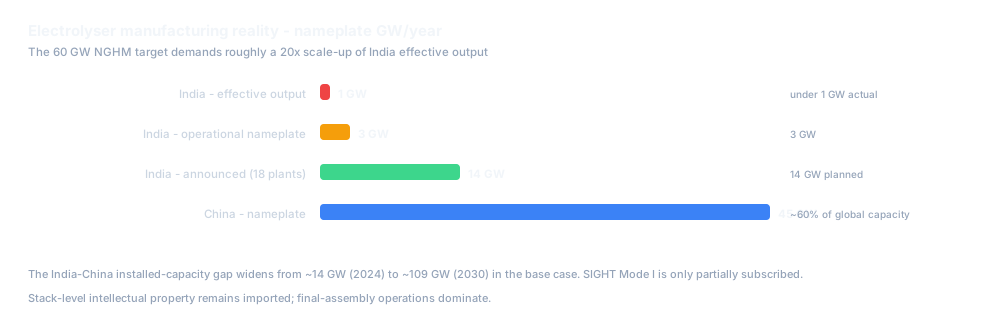
India’s electrolyser base is ~60% Chinese-manufactured. Operational nameplate is ~3 GW/yr with effective output under 1 GW against a 60 GW 2030 target - roughly a 20x scale-up. The India-China installed gap widens from ~14 GW (2024) to ~109 GW (2030) in the base case.
[Ch 5 / Ch 6 - Verified]Zero catalysts, 100% dependency
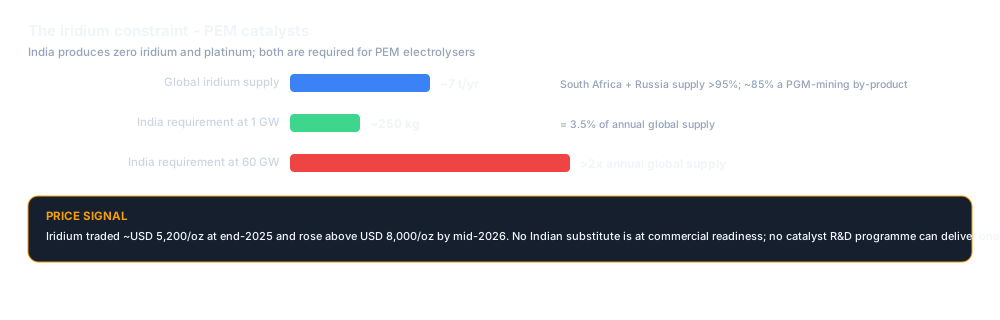
PEM electrolysers need iridium and platinum; India produces zero of either. At a 1 GW base, PEM loading implies ~250 kg of iridium - 3.5% of annual global supply; at 60 GW, the requirement exceeds annual global supply by 2x. Iridium traded above $8,000/oz by mid-2026.
[Ch 4 - Verified]Three companies own the membrane
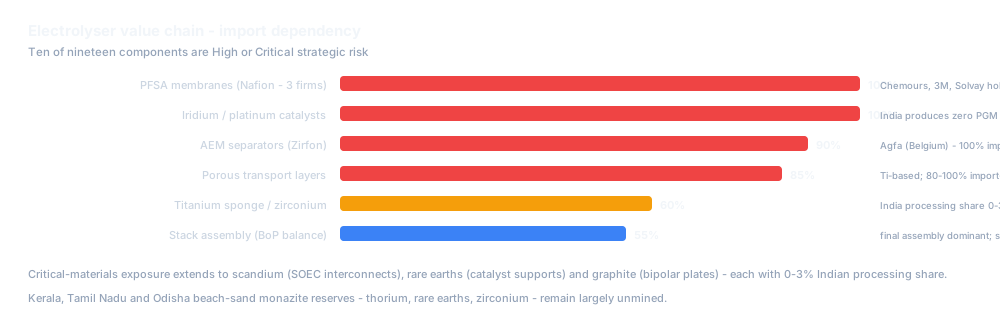
The de-facto PEM membrane (Nafion, a PFSA ionomer) has IP concentrated in three Western firms - Chemours, 3M, Solvay; the alkaline separator (Zirfon) is Agfa’s (Belgium). India imports 100% of both and has no public programme to establish domestic PFSA production.
[Ch 3 / Ch 4 - Verified]The deadlock is demand, not supply
SIGHT Mode III demand aggregation - mandatory blending in refineries and fertilizer plants - is notified in principle but not operationalised. No mandates, no bankable contracts, no FIDs, no capacity. Mandates would cut WACC from 11% to 8.5% and unlock ₹2.5 lakh crore of project finance.
[Ch 9 - Verified]LCOH is an electricity story
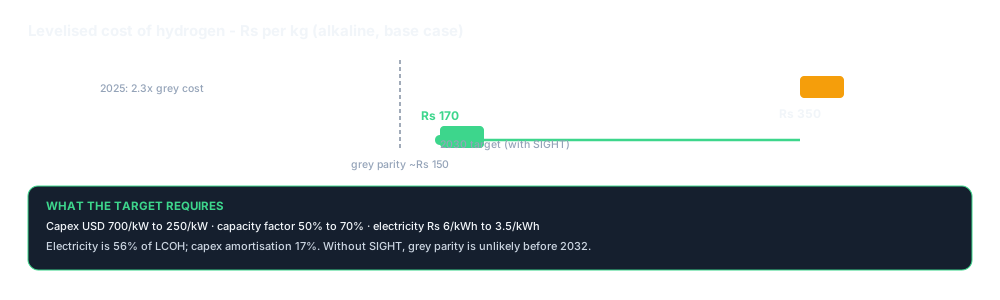
Electricity is 56% of LCOH; capex amortisation is 17%. Getting from ₹350 to ₹170/kg requires capex to fall from $700 to $250/kW, capacity factors to rise from 50% to 70%, and power to fall from ₹6 to ₹3.5/kWh - each itself a multi-billion-dollar programme.
[LCOH model - Ch 7]The base case is Muddle, not Machine
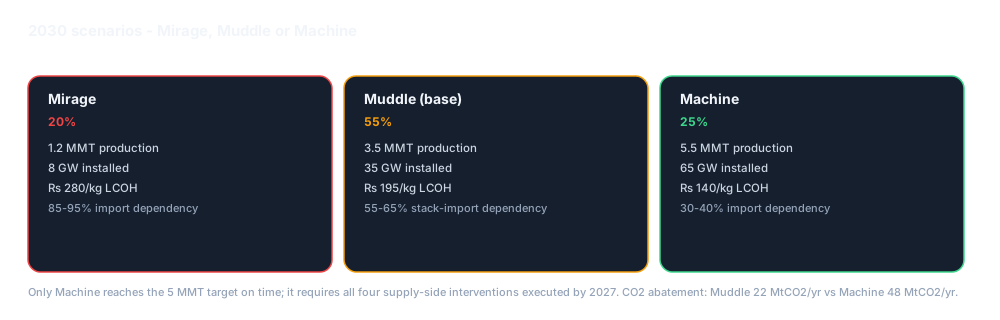
Base case (55%): 3.5 MMT by 2030 - 30% below target - 35 GW, ₹195/kg, 55-65% import dependency. Machine (25%): 5.5 MMT, ₹140/kg, net exporter. Mirage (20%): 1.2 MMT, 85-95% dependency. Only Machine reaches the 5 MMT target on time.
[Scenario model - Ch 15]The Framework
The report’s analytical core is the electrolyser value-chain dependency analysis - nineteen components scored on import dependency and strategic risk - cross-referenced with a strategic control points matrix (fourteen control points; nine sit in the “Act Now” quadrant where India’s leverage is weak and value capture is critical) and a critical-materials dependency matrix. The LCOH model decomposes cost (electricity 56%, capex amortisation 17%); the enterprise risk register scores sixteen risks on probability × impact; the scenario model projects Mirage, Muddle and Machine outcomes to 2030. Every forward claim carries a confidence rating (Appendix L) and every model a documented assumption set (Appendix M).
What It Means
For the government: another ₹10,000 crore of incentives on the existing SIGHT architecture will not close the manufacturing or catalyst gap - re-orient the existing ₹17,490 crore toward the Critical Materials Reserve, catalyst R&D and demand-side mandates.
For Indian corporates: the electrolyser stack, not the project pipeline, is the strategic battleground. Reliance, Adani and Greenko commitments are largely project-pipeline; Ohmium, L&T and Newtrace are stack-level. Pool stack R&D through a Hydrogen Industrial Alliance - or accept that ~70% of electrolyser value accrues to foreign OEMs for the next decade.
For investors: stacks commoditise by 2030; value sits in catalysts, membranes, AEM/SOEC deep-tech, midstream compression and storage, and bankable offtake. Infrastructure capital should target H2 pipeline and storage SPVs with regulated returns (IRR 11-13%); avoid pure-play stack assemblers and mobility pure-plays.
For defence planners: treat green hydrogen as a strategic fuel dependency equivalent to crude oil - iridium is South-African-and-Russian, rare earths Chinese, PFSA American-and-European. Stockpile, dual-use mobility (rail, naval), and a sovereign-manufacturing requirement for defence-critical applications.
The Numbers, Tabulated
| Scenario | Probability | 2030 production | Installed | LCOH | Import dependency |
|---|---|---|---|---|---|
| Mirage | 20% | 1.2 MMT | 8 GW | ₹280/kg | 85-95% import dependency |
| Muddle (base case) | 55% | 3.5 MMT | 35 GW | ₹195/kg | 55-65% stack-import dependency |
| Machine | 25% | 5.5 MMT | 65 GW | ₹140/kg | 30-40% import dependency |
| Vulnerability | The gap |
|---|---|
| Electrolyser manufacturing | 3 GW nameplate / <1 GW output vs 60 GW 2030 target; SIGHT Mode I partially subscribed; stack IP imported |
| Catalysts | Zero Indian PGM production; PEM needs iridium (anode) and platinum (cathode); ~7 t/yr global iridium, >95% SA + Russia |
| Membranes | PFSA (Nafion) IP in Chemours, 3M, Solvay; Zirfon separator (Agfa); 100% imported, no domestic programme |
| Critical materials | Titanium sponge, zirconium, scandium, rare earths, graphite - 0-3% Indian processing share; monazite reserves unmined |
| Capital cost | 2025 LCOH ₹350/kg (2.3x grey); target ₹170 needs capex $700→$250/kW, CF 50→70%, power ₹6→₹3.5/kWh |
| Demand aggregation | SIGHT Mode III not operationalised; no bankable contracts, no FIDs; the binding constraint on the whole programme |
Demand composition 2030: refining, ammonia and steel absorb 81% of hydrogen demand; mobility is 3%. Existing grey-hydrogen demand (6.5 MMT/yr) already exceeds the entire NGHM 2030 target.
What to Watch
- 2026Green Hydrogen Mandate expected - 30% refinery + 20% fertilizer blending, unlocking ~$8B of bankable offtake; customs duty rationalisation (~8% capex reduction).
- 2027H2-DRI steel pilot expected (1.8 MMT demand pool by 2030); refinery blending at 25%; three National Hydrogen Catalyst Centres funded; 30% DVA mandate phased in.
- 2028PGM-free AEM catalyst delivery target; carbon-intensity certification aligned at ≤1.5 kgCO2e/kgH2; SOEC commercial deployment.
- 2030The 5 MMT / 60 GW verdict - Muddle base case lands at 3.5 MMT (30% below target); only Machine reaches 5.5 MMT with 65 GW.
- 2032Grey-hydrogen parity without SIGHT; under Machine, 5-8 MMT/yr export opportunity (USD 5-8B) to Japan, South Korea and the EU materialises.
Frequently Asked Questions
Why "mirage or machine"?
India has committed ₹19,744 crore and a 5 MMT target to green hydrogen - the molecule - while the machine that makes it, the electrolyser, is approximately 60% Chinese-manufactured and 100% dependent on imported platinum-group metals. The question is whether India builds the machine or remains an importer of it.
What exactly is imported?
Electrolyser stacks (~60% Chinese), iridium and platinum catalysts (India produces zero; global iridium supply ~7 t/yr, over 95% from South Africa and Russia), PFSA membranes (IP in Chemours, 3M, Solvay), Zirfon separators (Agfa, Belgium), and titanium sponge, zirconium, scandium, rare earths and graphite (0-3% Indian processing share). Ten of nineteen value-chain components are High or Critical risk.
Can India reach 5 MMT by 2030?
Only under the Machine scenario (25% probability): 5.5 MMT, 65 GW, ₹140/kg, 30-40% import dependency - contingent on all four supply-side interventions executing by 2027. The base case (Muddle, 55%) lands at 3.5 MMT - 30% below target - with 55-65% stack-import dependency. The downside (Mirage, 20%) is 1.2 MMT and 85-95% dependency.
What would fix it?
Four supply-side interventions: a Critical Materials Reserve under ANRF (~$250M for the PGM component, 12 months of consumption); three National Hydrogen Catalyst Centres at ₹4,000 crore over five years (cutting PGM loading from 2.5 to 0.5 mg/cm² by 2030 and delivering a PGM-free AEM catalyst by 2028); a 30% domestic value-addition mandate for SIGHT Mode I; and demand-side blending mandates (25%/50% refinery, 20%/40% fertilizer), which cut WACC from 11% to 8.5%.
Where is the investment opportunity?
The global electrolyser market grows from $4.2B (2024) to ~$35B (2030), a 42% CAGR - but stacks commoditise by 2030. Value capture sits in catalysts, membranes, AEM/SOEC deep-tech, midstream compression and storage, and long-life offtake contracts. Infrastructure capital should go to H2 pipeline and storage SPVs with regulated returns (IRR 11-13%).
What should startups attack?
PGM-free catalysts, AEM membranes and ionic compressors - the lowest-competition, highest-strategic-leverage segments. Avoid pure-play AWE/PEM stack assemblers (commoditised by Chinese imports by 2027) and hydrogen mobility pure-plays (battery-electric dominates light and medium duty through 2030).
Sources & Methodology
Derived from The Hydrogen Mirage or Machine? Volume I, Q1 2026 edition. Forward claims carry confidence ratings (Appendix L); model assumptions in Appendix M. Primary sources:
- MNRE notifications - National Green Hydrogen Mission (Jan 2023); SIGHT scheme documents and Gazette of India [Verified]
- IEA, IRENA, BloombergNEF, Hydrogen Council, World Bank, ADB comparative datasets [Verified]
- Company disclosures - Reliance, Adani, Greenko, NTPC, JSW, IOCL, BPCL (~USD 46B disclosed commitments) [Verified]
- Goldman Sachs Carbonomics (2024); Morgan Stanley Global Hydrogen Outlook (2025); WEF Global Risks Report 2025 [Verified]
- Industry and policy interviews - IOCL, BPCL, Reliance, Tata Steel, JSW, L&T, Ohmium, Greenko, BHEL; MNRE, NITI Aayog, DST, BIS, PESO; IIT-M/B/K, IISc, CSIR-IICT, CSIR-CECRI, ARCI, TERI [Estimate]
- Techadyant Labs LCOH, scenario and dependency models [Model]
Get the Full Report
133-page PDF · 18 chapters · 26-sheet companion workbook · full supplier, startup, policy and funding databases (Report + Data pack).
Buy Report - ₹4,900Report + Data pack - ₹7,900Free Condensed Edition
33 pages - the thesis, the frameworks and the headline findings, with figures.
33-page condensed edition (PDF). Free to read here; subscribe with an email to download the PDF. We'll also tell you when this assessment changes.
Free · no spam · unsubscribe anytime · privacy policy