
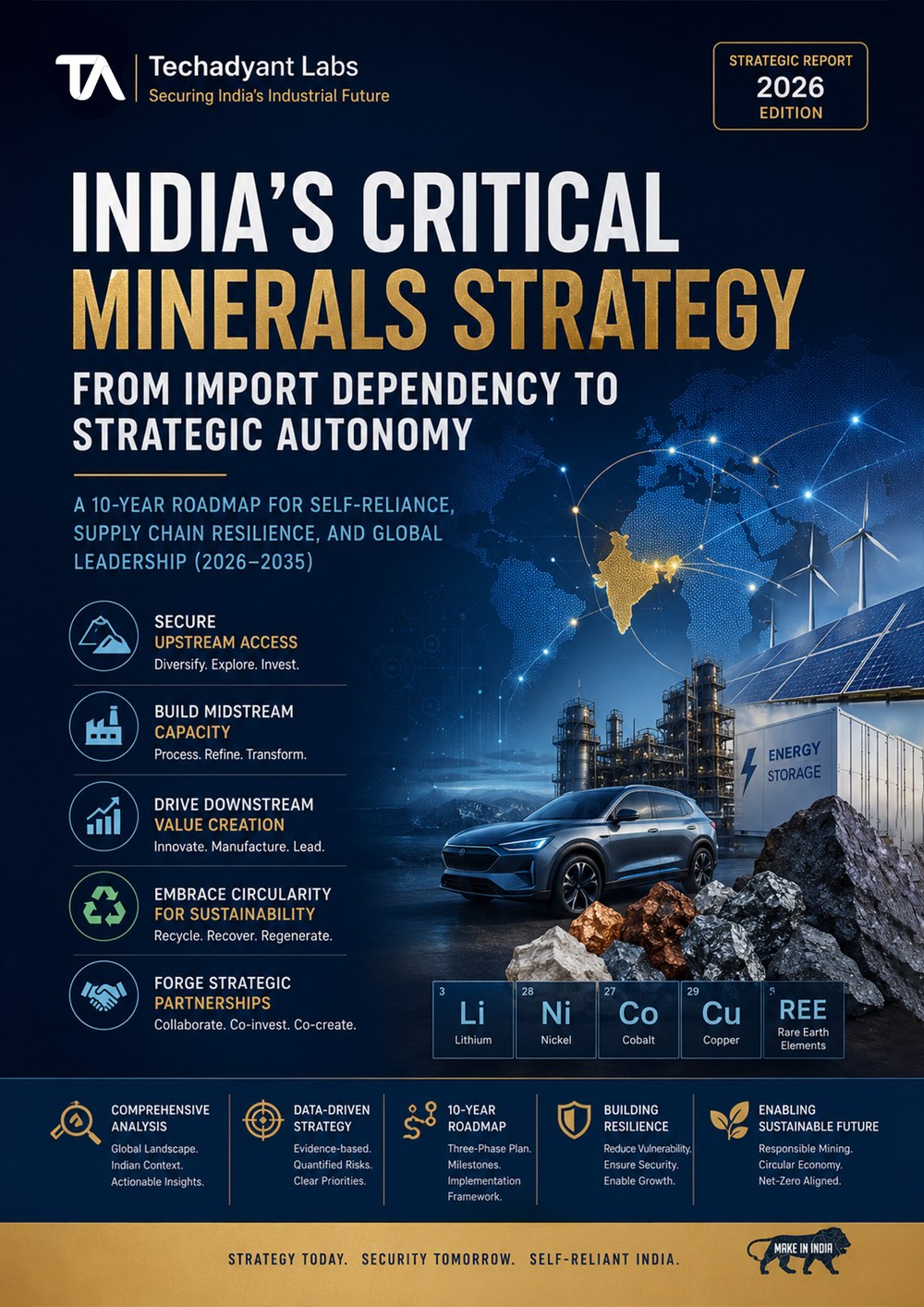
India has spent the past two years securing access to critical minerals — overseas acquisitions, exploration blocks, bilateral partnerships. It has spent far less building the capability to process them. This report separates the two, and argues that mineral security without processing capability is a strategy that stops one step short of where the value and the leverage actually sit.
Access is not capability
The headline story of India’s critical-minerals push is about reserves and supply deals. The more important story is about the middle of the value chain. A tonne of mined ore is worth a fraction of the refined metal, and a fraction again of the finished magnet or battery material. That value migrates downstream — and so does the dependency. China controls an estimated 60–90% of the world’s midstream separation, refining and magnet-making capacity. Securing a mine abroad does little for sovereignty if the material still has to travel through a single country to become usable.
The Critical Mineral Vulnerability Matrix
The report scores India’s exposure with a multi-dimensional Critical Mineral Vulnerability Matrix — combining import dependence, supplier concentration, strategic-sector demand and substitutability into a single read per mineral. The point of the matrix is prioritisation: not every mineral is equally urgent, and not every vulnerability is best solved by mining. It sorts minerals into those that need domestic processing first, those that need secure supply agreements, and those where recycling or substitution is the faster route.
The midstream bottleneck
This is the core finding. India’s weakness is not at the mine and not at the factory — it is in the middle, in separation, refining and alloy conversion. That is where China’s share is highest and India’s capability lowest, and it is precisely the layer that turns a raw mineral into something an EV, a wind turbine or a guided weapon can use.
The strategic implication follows directly: capital and policy attention should concentrate on the midstream, because that is the chokepoint that converts mineral access into industrial capability — and the layer a rival can most easily use as leverage.
Who is pulling the demand
Three sectors are driving India’s critical-minerals demand, and each is accelerating. Electric-vehicle retail penetration crossed 11% in mid-2026; renewable capacity reached roughly 150 GW of solar and 56 GW of wind; and the FY2026–27 defence budget rose to ₹7.85 lakh crore. All three pull hard on lithium, cobalt, nickel and rare earths that India largely imports — which is why the processing gap is not an abstract risk but a live constraint on the sectors India most wants to grow.
The policy architecture
India has begun to respond. The National Critical Mineral Mission, approved in January 2025, carries a ₹16,300 crore outlay plus an expected ~₹18,000 crore of PSU and other investment, spanning exploration, overseas acquisition, processing and recycling. The ₹1,500 crore Critical Mineral Recycling Incentive Scheme (September 2025) adds a secondary-supply leg, and rare-earth magnet incentives target the single most exposed material. The report reads these commitments against the scale of the gap — and is candid that the announced outlays are a start, not a solution, for a midstream that must be built almost from zero.
The circular-economy layer
Recycling is not a footnote here — it is a strategic supply source. Urban mining of e-waste and end-of-life batteries can supply refined material without the geopolitics of primary mining, and it plays to an existing Indian informal-sector strength that formalisation could scale. The report treats secondary supply as a first-class part of the roadmap, not an afterthought.
A three-phase roadmap to 2035
The report closes with a sequenced plan. The sequence is the point: processing capacity built before feedstock is secured, or downstream integration attempted before processing exists, is how mineral strategies stall.
What the full report covers
The complete 169-page edition — rendered in full below — carries the geopolitical concentration analysis, the full Critical Mineral Vulnerability Matrix scored mineral by mineral, the upstream exploration and rare-earth-corridor chapters, the midstream capex-and-returns modelling, the downstream EV / defence / net-zero demand chapters, the circular-economy build-out, the fiscal and regulatory architecture, and the three-phase strategic roadmap — 16 figures, 29 tables, a glossary and a companion data workbook. It is free to read and download.