
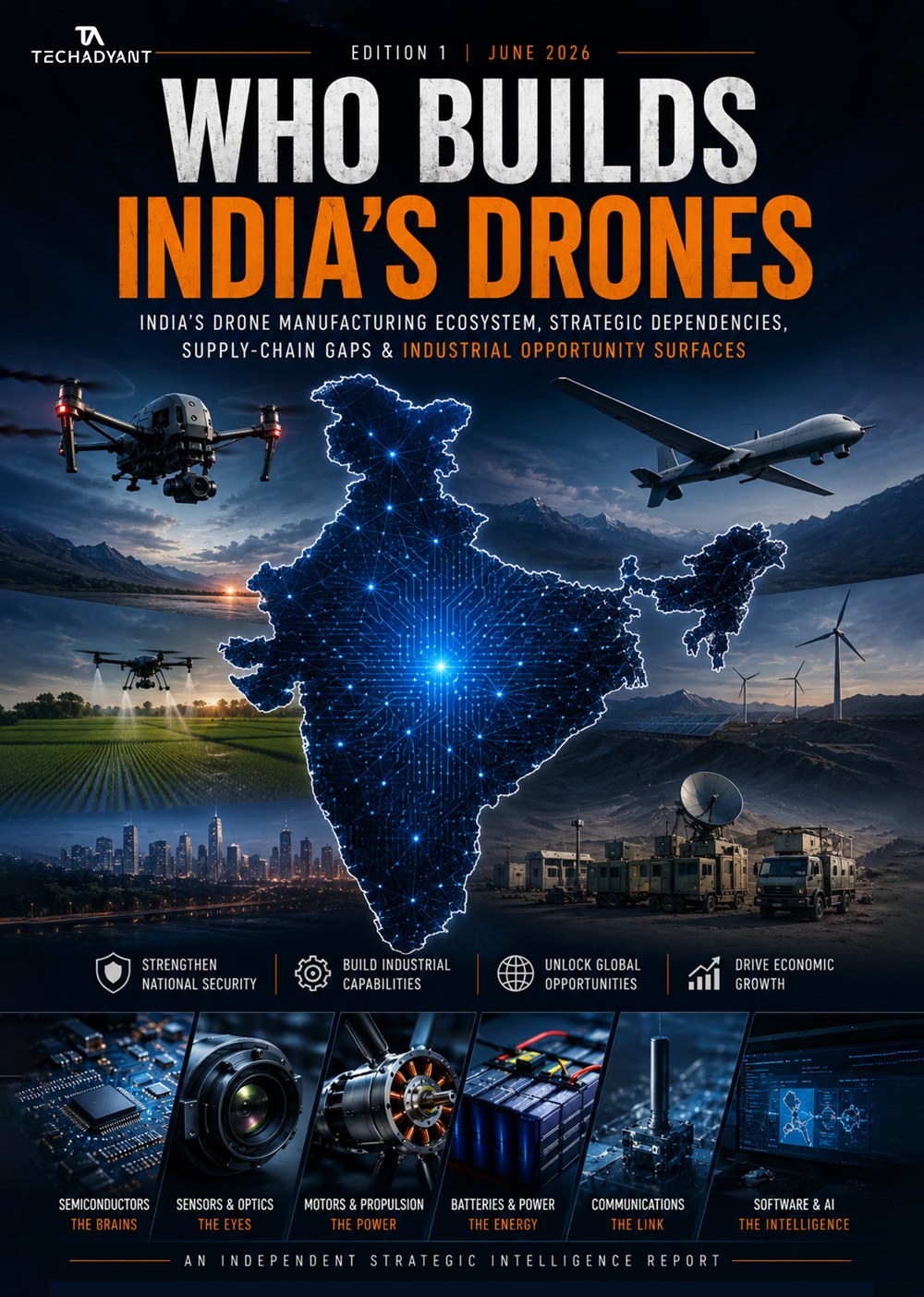
Assembles, but does not build
India now has more than 38,500 registered drones, nearly 40,000 certified pilots and a policy stack that treats drones as national infrastructure. By almost any headline measure the industry is thriving. Underneath the growth, however, sits a harder question: when India fields a drone, who actually built it? Read from India's own trade data, the answer is uncomfortable. India has built a drone assembly industry, not a drone manufacturing one — and the distinction is the whole story.
The customs proof
In FY2025-26 India imported only about US$8 million of finished drones, because the 2022 import ban works on whole units. In the same year it imported roughly US$767 million of drone and aircraft parts — about a hundred times more — alongside US$4.7 billion of lithium-ion cells. The country buys the parts, not the planes, and assembles the difference. That is not a failure of entrepreneurship; it is a feature of policy. The 2022 ban prohibited finished foreign drones while leaving components free to import, creating a protected market for assembly without building the component base beneath it — and so relocating the dependency upstream rather than removing it.
Where India is exposed
Value and vulnerability both sit upstream. The airframe — the most visible part of a drone — is the least strategically significant; capability and intellectual property concentrate at the back of the stack, in the magnets and motors, the cells, the sensors, the radio-frequency electronics and the flight-controller silicon. India is genuinely strong in software and systems integration and weak below that line. The dependency is also concentrated in one direction: China supplies roughly 78% of India's rare-earth permanent-magnet imports, about 84% of its lithium-ion cells, and the bulk of small-drone flight controllers and motors. China's 2025 rare-earth export controls showed this is not merely a commercial fact but an instrument — one India met directly during Operation Sindoor in May 2025, which triggered an emergency-procurement ceiling of ₹9,100 crore weighted heavily toward drones and counter-drone systems.
What the gap costs
Measured by value-weighting localisation across the component stack, India captures roughly 43% of its drone market's economic value today, and could capture about two-thirds if the upstream gaps were closed. At the 2030 market scale that difference is a reshoring prize of roughly US$1.1 billion a year, concentrated in exactly the four layers the data flags as critical: propulsion, sensors, electronics and power. The missing quarter of the value is the same quarter every time — which is what makes the problem tractable.
The six frameworks
The report scores India's drone industrial base on one reproducible system of six indices, each running 0–100 from published band anchors: the Drone Localization Index (how much value India captures in a component), the Drone Supply-Chain Dependency Map (its mirror — exposure if a supplier stops), the Drone Capability Stack (the picture layer by layer), the Drone Industrial Readiness Matrix (the hidden enabling industries), the Drone Corridor Readiness Index (which states can anchor manufacturing), and the headline Drone Opportunity Surface Framework, which turns all of it into a single question: of every place you could build, which is most attractive today?
Where to build now
Four opportunity surfaces clear the Build-now bar — autonomy and mission software, counter-unmanned-systems, battery packs and management systems, and test-and-certification infrastructure. The highest-strategic-value layers (motors, sensors, communications) score lower today because India's readiness in them is thin, which is precisely why they are the deliberate, longer-horizon bets.
| # | Opportunity surface | DOSF | Tier |
|---|---|---|---|
| 1 | AI / autonomy software | 76.0 | Build-now |
| 2 | Counter-UAS systems | 71.5 | Build-now |
| 3 | Battery packs & BMS | 69.0 | Build-now |
| 4 | Test & certification infrastructure | 68.5 | Build-now |
| 5 | Ground control stations | 63.0 | Position-early |
| 6 | Autonomous swarm systems | 62.0 | Position-early |
| 7 | Drone motors | 60.5 | Position-early |
| 8 | Drone sensors & optics | 58.0 | Position-early |
What Turkey and Korea teach
Turkey built export-grade drone capability from a standing start with a lever India lacks: its state procurement agency reportedly requires producers to pass 60–80% of contract value down to domestic subcontractors, deliberately constructing a component base. South Korea is the sharper near-peer — it hosts some of the world's largest battery-cell makers yet its drone-grade ecosystem is thin and China-dependent, proof that a giant adjacent industry does not automatically confer drone capability. Both point to the same instrument for India: attach domestic-value conditions to the large institutional offtake it already controls.
A path to 2035
The realistic doctrine is selective sovereignty, not autarky. Build now what is ready — autonomy software, counter-UAS, battery packs, certification capacity — and seed the hard layers in parallel; close the strategic gaps as the sintered-magnet and battery-cell schemes mature toward the end of the decade; and own the deep layers last — trusted flight-controller silicon and sensors — through partnership-led capability transfer. Success is one measurable number: value capture moving from roughly 43% toward two-thirds.
What the full report adds
This online edition gives you the thesis, the customs evidence, the value-capture finding and the Build-now map. The complete edition adds the full scoring rubrics for all six frameworks, the 100-opportunity Drone Opportunity Registry, the 50-component Drone Sovereignty Index, a supply-chain atlas and company directory of India's and China's drone industries, an investor opportunity matrix, state-by-state playbooks, supply-shock dependency scenarios with likelihoods, a bill-of-materials database by drone type, a manufacturing playbook for each venture type, and the customs, procurement and policy evidence base in full — thirteen chapters, sixteen figures and thirteen reference appendices.
Unlock the complete report
You’re reading the free preview. The full analysis continues with six more sections and the downloadable PDF edition.
- 🔒04 · Water, power & land
- 🔒05 · The packaging layer
- 🔒06 · Who captures the value
- 🔒07 · The talent constraint
- 🔒08 · Second-order effects
- 🔒09 · What to watch · references
You’ll be asked to sign in, then complete a one-time secure purchase.