
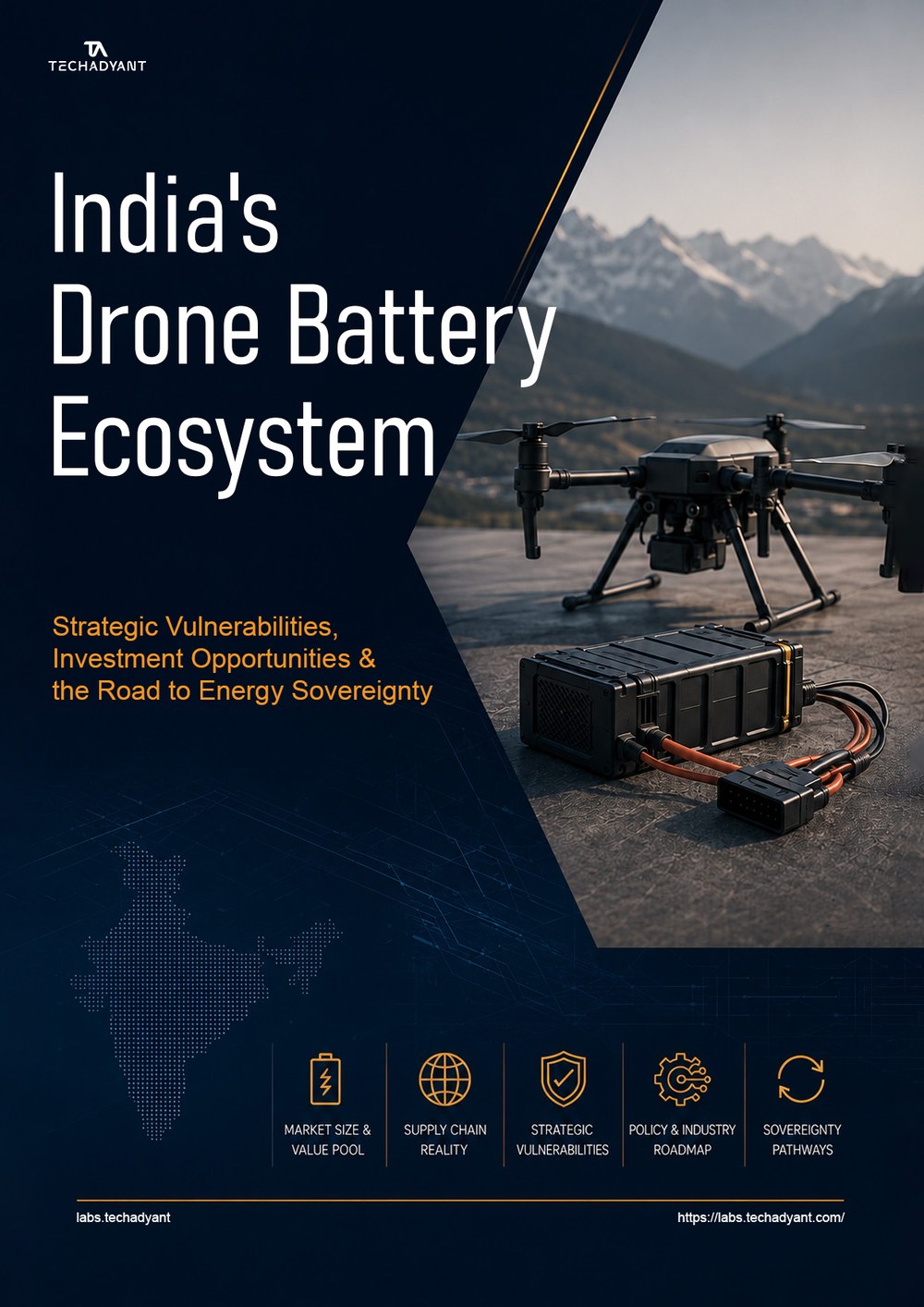
Built on imported power
India is building a world-class drone industry on an imported energy core. Of every ₹100 of value an Indian drone OEM earns, more than ₹50 leaves the country for a concentrated, overwhelmingly Chinese, battery supply chain. On the report's Drone Battery Sovereignty Index, India scores just 30 out of 100 — last among the major battery nations. Yet the path out is counter-intuitive: India does not need to win cell manufacturing first to start winning. The fastest, highest-return move is to capture the intelligent layer — battery-management systems, analytics, certification and recycling — where value capture jumps from roughly 5% to 35–40% without first solving cell independence.
Why the battery decides the race
Drones have become decisive infrastructure, and their single point of failure is energy. A drone's airframe and software can be Indian; if its battery cannot be sourced, the platform does not fly. The binding technical requirement is not energy density alone but high-rate (high-C) discharge — delivering power violently and instantly, often at 15–25C, without voltage collapse or thermal runaway. This is precisely the cell class India does not make, and the EV-focused PLI scheme — designed to reward energy density for electric scooters and grid storage — does not reward.
The China chokepoint
China controls roughly 78–84% of the lithium-ion cells and permanent magnets the Indian drone fleet depends on, by customs value. Concentration, not price, is the risk: a single administrative export halt — no formal ban required — could idle commercial and defence drone lines within weeks, because high-C cells have a brutal 100–200 cycle life and almost no domestic buffer stock exists. The opacity is itself part of the finding. Customs data can prove the dependence but not its end-use, because a drone motor and a washing-machine motor share an HS code — a traceability gap that is a national-security problem as much as an economic one.
Where the value sits
The cell is roughly 60% of a pack's cost and is essentially 100% imported. The remaining ~40% — the enclosure, thermal management, high-current connectors, BMS firmware, state-of-health analytics, integration and certification — is where India can compete today, and it is where the margins are highest. Understanding exactly where that 40% sits is the difference between assembling drones and building an industry.
The Sovereignty Index and the Readiness Model
Two original frameworks turn the argument into numbers a board can track. The Drone Battery Sovereignty Index (DBSI) scores a country 0–100 across the six value-chain layers. India's composite of 30 is built on strong packs and software — a far better starting position than 30 built on minerals alone. The Readiness Model defines five levels of value capture, from assembly to cell sovereignty: India sits between Level 1 and Level 2 today, and the near-term prize is Level 3, the intelligent energy systems provider, where capture reaches 35–40% without requiring cell independence first.
Where to build now
The India-addressable prize is about US$10.8 billion by 2030. The investable near-term pools are not the cells; they are the intelligent and service layers, defensible under Indian jurisdiction and reaching software-like margins. All figures are Techadyant Labs estimates, shown as base cases.
| Opportunity pool | Base (₹ Cr) | Margin | Horizon |
|---|---|---|---|
| Smart BMS & analytics | 3,200 | 28–35% | Now |
| Testing & certification | 1,200 | 32–38% | Now |
| Battery recycling | 2,500 | 20–26% | Now |
| Thermal & high-altitude IP | 1,500 | 22–28% | Now |
| Sodium-ion (build-ahead) | 3,000 | — | 3–5 yrs |
| High-C cell manufacturing | 18,000 | 16–20% | 5+ yrs |
Four futures to 2035
Four scenarios to 2035 turn on a single variable: whether India invests in the layers it can build — intelligence, certification, recycling — or waits to solve cells first. A continued-dependence path keeps the least value and the most imports; a Drone Battery Mission path captures the most value, the most jobs and the most strategic autonomy. The difference between the best and worst case is not the size of the market — it is how much of it India keeps, and whether its fleet can fly without a foreign veto.
What to do
Sequence capital by readiness, not by ambition. Phase 1 (0–2 years) monetises the intelligent layer India already leads — smart BMS, certification labs, certified pack integration. Phase 2 (2–5 years) builds the moat in recycling, thermal IP and a sodium-ion pilot. Phase 3 (5–10 years) earns sovereignty in materials and cells. For government, the highest-leverage move is a domestic-value pass-through condition on defence offtake, paired with capex-weighted incentives for the high-power cell the PLI scheme ignores. The economics favour starting immediately; the strategic risk favours not waiting. The window is the next twenty-four months.
What the full report adds
This online edition gives you the core finding, the dependency, the value argument and the Build-now map. The complete ~145-page edition adds nine chapters and thirteen analytical sections, the full DBSI and Readiness Model rubrics, the Moat & Margin Map, investment playbooks by capital tier, full financial models, six global case studies, a strategic risk dashboard, four quantified 2035 scenarios, thirty-plus figures, a ten-chart CXO dashboard, six appendices and a companion Excel data pack — India import data with a drone-grade flag, an interactive TAM/SAM model, a competitor battle-card database and an ED-301 certification cost estimator.
Unlock the complete report
You’re reading the free preview. The full analysis continues with six more sections and the downloadable PDF edition.
- 🔒04 · Water, power & land
- 🔒05 · The packaging layer
- 🔒06 · Who captures the value
- 🔒07 · The talent constraint
- 🔒08 · Second-order effects
- 🔒09 · What to watch · references
You’ll be asked to sign in, then complete a one-time secure purchase.