
Mapping the hidden systems shaping India’s next industrial decade.
Independent, long-form research on industrial infrastructure, semiconductors, AI infrastructure and the second-order economic effects of India’s manufacturing transition — written for people who need to understand systems, not headlines.
The current edition
Our flagship long-form analysis — the systems, dependencies and beneficiaries behind a single strategic question.
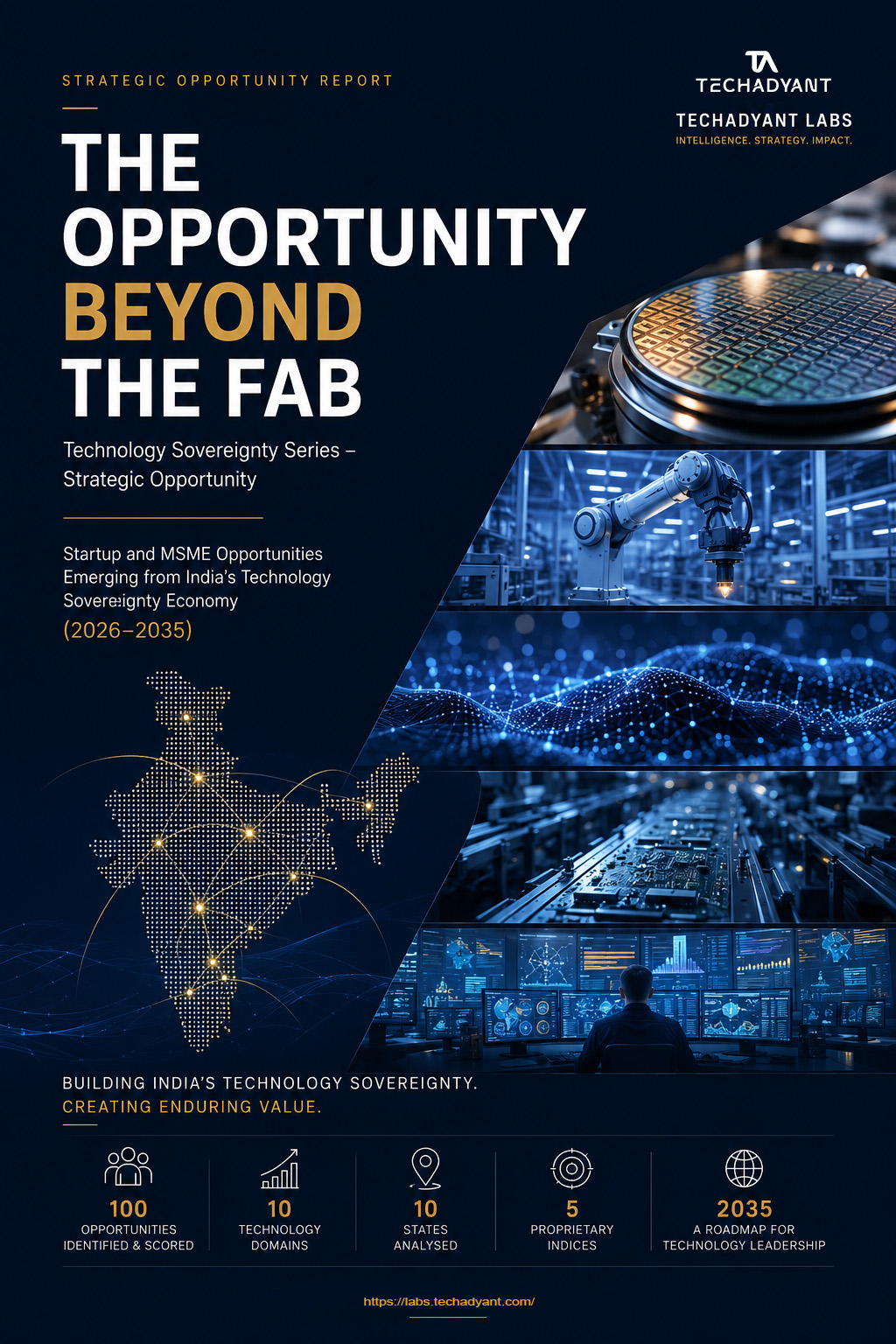
The Opportunity Beyond the Fab
Startup and MSME Opportunities Emerging from India’s Technology Sovereignty Economy (2026–2035)
India has committed roughly ₹1.6 lakh crore to semiconductor manufacturing — thirteen projects across seven states. The fab gets the headlines, but it is the visible peak of a ten-layer industrial pyramid, and the layers around it are where most of the capturable value sits and where India’s existing MSME and talent base can actually compete. This report identifies, scores and ranks 100 startup and MSME opportunities across the full technology-sovereignty stack — materials, precision components, industrial software, AI, engineering software, cybersecurity and export — using five proprietary frameworks (TOMI, TSVI, IRR, GEM, SOE). 144 pages, 43 figures, 100 one-page scorecards, 10 state dashboards, a master opportunity map. The opportunity is around the fab, not instead of it.
Intelligence dispatches
Kerala’s NetraSemi, backed by Zoho, has unveiled the A2000 — a 12nm edge-AI system-on-chip and the first Indian-designed AI chip to reach silicon. It matters less as a product than as proof of a thesis: edge AI is the one layer of the AI-hardware stack India can contest now, without a leading-edge fab.
India has built or is building twelve semiconductor projects worth ₹1.65 lakh crore. None of them produces the chips that AI accelerators are made from — because the binding constraint is not the fab, it is advanced packaging.
The 71% concentration of India’s submarine-cable capacity at Mumbai and Chennai is the single largest geographic risk to Indian AI infrastructure. Visakhapatnam is the one project that materially diversifies it.
India’s AI infrastructure cycle creates a ₹80,000–150,000 crore aggregate Indian-vendor opportunity through 2030. ₹28,000–60,000 crore of it is addressable to SMEs. Eight industrial segments capture most of it.
The unit of competition for India’s AI build-out is the corridor, not the state. Seven corridors are competing for the next decade of hyperscaler and semiconductor capital; their endowments and binding constraints differ sharply.
Front-end fabrication attracts the headlines, but the binding constraint on near-term output is back-end assembly, test and packaging capacity — and the specialised inputs it quietly depends on.
Capital and policy can be assembled quickly. The deep process-engineering and yield-management talent that makes a fab productive cannot — and that asymmetry shapes the realistic ramp curve.
Placeholder — analysis of water sourcing, allocation and resilience dependencies forming around the Dholera industrial corridor. To be published.
Capital and policy can be assembled in a board meeting. The deep process-engineering and yield-management talent that makes a fab or a hyperscale DC productive cannot. The asymmetry is what sets the realistic ramp curve.
CGWB classifies Bengaluru and Hyderabad as over-exploited, Chennai as critical. The DC pipeline is densest where the water position is most stressed. This signal names the corridor-level audits that are not yet being published.
Of a ₹91,000 crore mature-node fab, roughly two-thirds flows to ASML, AMAT, Lam, TEL and KLA. The Indian-capture economy lives in the remaining one-third — construction, gases, UPW, logistics and the durable industrial capabilities those build.
Not capital, not policy, not aggregate talent supply. The binding constraint on India’s 4.5–9 GW DC trajectory is local: transmission, water rights, fibre right-of-way and DISCOM-level interconnection-queue execution at the level of seven specific districts.
Lines of inquiry
Semiconductor Ecosystems
Fabrication, assembly and test, advanced packaging, materials and the industrial dependencies that determine who captures value as India builds chip capability.
1 report · 2 forthcoming · 2 signals →Industrial Infrastructure
Power, water, land, logistics and the physical substrate of manufacturing corridors — the systems that quietly govern whether industrial policy converts into output.
4 forthcoming · 2 signals →Strategic Technology
AI infrastructure, compute, energy systems and the dual-use frontier where technology, industrial capacity and national strategy intersect.
1 report · 2 forthcoming · 3 signals →Economic Geography
Where value concentrates and why — the spatial logic of clusters, corridors and second-order economic effects across India’s industrial map.
2 briefings · in development →Defence & Dual-Use
Autonomous systems, battlefield AI, post-quantum readiness and the industrial base that underwrites them — the dual-use frontier where civilian semiconductor and AI capability becomes strategic capacity.
2 forthcoming →Executive-ready analysis
An independent research lab
Techadyant Labs is an independent strategic intelligence platform focused on India’s industrial transformation, infrastructure systems and emerging strategic technologies.
We study industrial systems the way analysts study capital markets — as interdependent structures with hidden constraints, asymmetric beneficiaries and second-order effects. Our work begins where the press release ends.
The publication is reader-oriented and independent. We carry no sponsored coverage and take no position in the companies and projects we analyse.
- IndependentNo sponsored coverage, no undisclosed interests.
- Systems-levelWe map dependencies, not just events.
- India-firstBuilt around India’s industrial and strategic context.
- Long-formDepth over frequency; analysis over aggregation.